The Jazz.com Blog
July 09, 2008 · 3 comments
Where Copyright Goes Wrong
Jazz.com's ever-vigilant resident curmudgeon, Alan Kurtz, has a typically contrarian take on copyright laws. Corporate-driven "enhancements" to this hoary hand-me-down from English common law have, claims Kurtz, allowed bottom-line driven companies to control the rights to classic jazz recordings that they can't be bothered to actually release on CD. Meanwhile jazz standards must assume aliases to permit lyricists to collect royalties. Readers are invited to share their own intellectual property by adding comments below or emailing them to editor@jazz.com. T.G.

Copyright is out of control. If you accept the proposition that creative artists deserve to be compensated by consumers, then laws protecting such rights merit obedience. But in practice, the issue is seldom so cut and dried. Often those who created a work of art no longer own its rights. Perhaps the artist sold them to the highest bidder, bequeathed them in an act of charity or passed them on to heirs. In such an exchange, the creator is rewarded by, if nothing else, satisfied intentions. But the new owner, who may not be the slightest bit artistically inclined, now demands to be compensated for someone else's creativity. Is that fair?
Well, the reasoning goes, since the creator voluntarily relinquished interest, consumers should honor the arrangement by compensating whoever owns said rights, even if it's a person or organization far removed from the act of creation.
Yet what if those goods are willfully and indefinitely withheld from the open market? It's hard to sympathize when a humongous corporation cries foul because some pipsqueak pirate has violated a dusty copyright that said Humongous Corporation has heretofore shown no interest in exploiting. Don't custodians of artwork protected by public law have an implicit responsibility to share it with the public?
Not when it comes to classic jazz tracks, obviously. Case in point: the great 1949-52 recordings by the George Shearing Quintet. These are among the most luminously pleasurable tracks in jazz history, yet shamefully have never been suitably restored and reissued. Why not? In a word: -P-Y-R-I-G-H-T.
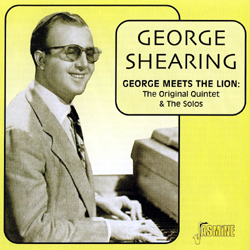
Formed in January 1949, the GSQ first recorded 8 sides for Discovery, a small indie label that, as Shearing joked in his autobiography Lullaby of Birdland, "had distribution from Hollywood & Vine to Sunset Boulevardwhich was a gross exaggeration of the distribution it really had." Subsequently reissued by Savoy, these 8 sides were an aperitif. GSQ began serving their main course when Shearing joined major label MGM, leading off with a glorious "September in the Rain." Over a 4-year span, GSQ recorded four dozen instrumental sides, mostly gems, and others backing a vocalist. In the fullness of time (as lawyers like to say), MGM's copyright passed to Verve, was next acquired by PolyGram and ultimately gobbled up by Universal Music. Along the way, haphazardly strewn reissues have come and gone with, at best, lackluster remastering.
Once the millennium turned, this neglectful situation promised to improve. As UK copyright, which unlike U.S. protection lasts a mere 50 years, began to expire on the GSQ recordings, British firms (Sir George is after all an Englishman, knighted in 2007) issued partial compilations that were, alas, royally mediocre. Proper Records came closest to a comprehensive anthology with From Battersea to Broadway (2002). Yet this 4-CD box opens 10 years before GSQ's formation, meaning the classic quintet does not appear until the 10th track of Disc 3, which is a long wait. Moreover, by adhering to the UK's 50-year copyright limit, the set terminates prematurely, excluding GSQ's signature "Lullaby of Birdland" (1952).
The label played catch-up with its cursory A Proper Introduction to George Shearing (2004), adding GSQ's 1952 sides plus some previously omitted 1951 tracks. While Proper's CDs are affordable to budget-minded collectors, this scattershot approach requires buying often superfluous and redundant packages. And once you do find an essential track, audio can be abysmal, to wit the lovely "Indian Summer," rendered virtually unlistenable by Proper's wretched reproduction.
But don't blame the Brits. Since Humongous Corporation still jealously guards their original masters, overseas producers must rely on such inferior audio sources as secondhand shellac discs that fail miserably to do justice to GSQ's shimmering soundscapes. From the U.S. consumer's point of view, copyright protection protects us from hearing this music fully restored as it so richly deserves.
The Brits are, however, indirectly to blame insofar as American copyright stems from 15th-century English common law. Yet as usual, we American Cousins have carried this Limey tradition to grotesque extremes in our quest to, as the U.S. Constitution puts it, "form a more perfect Union, establish Justice, insure domestic Tranquility, and provide for Everlasting Corporate Welfare."
And when, in the fullness of time, the Constitution no longer suffices, do not despair. We got Congress, babe. Under the Sonny Bono Copyright Term Extension Act of 1998, copyrighted works produced from 1923 onward will not enter the public domain until 2019 at the earliest. Moreover, in 2005 the New York State Court of Appeals ruled that performance copyright survives in perpetuity regardless of a recording's country of origin. Eventually federal statutes will preempt state law, but not until 2067. As an attorney for the losing side in N.Y. groused, "The ramifications are that anybody who ever did a musical piece from the time of Thomas Edison has common law rights and can come forward and sue anyone who uses their music, whether it is lost in time or not."
The Act's namesake, record producer-turned-Congressman Sonny Bono (1935-1998), would've been gratified by these developments. Perhaps his tombstone inscription ought to be re-chiseled from "The Beat Goes On" to "The Copyright Goes On"and on and on, foreverexcept that epigraphs too may enjoy copyright protection, making them eternally sacrosanct in more ways than one.
Another, even more outlandish by-product of copyright overreach involves the practice of renaming jazz standards when adding lyrics to the original tune. This wasn't always the case. In 1961, when Abbey Lincoln put words to "Blue Monk," she did not tamper with Thelonious's eponym. Likewise in 1968, when Jon Hendricks vocalized "In Walked Bud" on Monk's Underground, the song was not redesignated "Every Hip Stud Really Dug Whatshisname."
Over ensuing decades, however, the Great Blob Copyright has consumed more landscape than alien invaders in a 1950s sci-fi flick. By 1988, for her album Carmen Sings Monk, Carmen McRae presented a baker's dozen switcheroos. "In Walked Bud" became "Suddenly," "Ruby, My Dear" got simplified to "Dear Ruby," and Abbey Lincoln's "Blue Monk" was now "Monkery's the Blues." Only the venerable "'Round Midnight" escaped the indignity of identity theft.
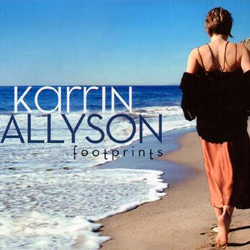
The titular gelding of jazz classics continues to this day. Karrin Allyson, for one, wielded the scalpel of name-change surgery for her 2006 CD Footprints. With six other trans- nomenclature victims, John Coltrane's "Equinox" now had "A Long Way to Go," Dizzy Gillespie's "Con Alma" was "Something Worth Waiting For" and Duke Jordan's "Jordu" turned into "Life Is a Groove." The album's chief lyricist, Chris Caswell, described this in his liner notes as "a detail that has to do with royalties."
"What's in a name?" besought Shakespeare's Juliet in 1597. "That which we call a rose by any other name would smell as sweet." Beyond her gift for stating the obvious, Juliet begged the question: What's the point of calling a rose anything else?
Admittedly, it's possible that Coltrane did not personally christen "Equinox." Jazz musicians have often recorded untitled tunes and left naming to the record company. On the other hand, maybe Coltranean exceptionally thoughtful man with a wide-ranging curiosityvery deliberately titled "Equinox." If so, then that was part of his original intent. And in any case, it's disrespectful to rename a composition that has over the past half century earned recognition from jazz fans worldwide.
Don't misunderstand. Songwriters are entitled to make a buck. But when "a detail that has to do with royalties" compels them to deface classic jazz compositions, copyright has gone woefully wrong.
I could rail on in this disputatious vein, but you'll have to excuse me now. I must return my attorney's call. She's filing for copyright registration of my latest literary endeavor, a brilliant set of lyrics added to Dave Brubeck's "Blue Rondo la Turk." I've re-titled it "Groovy Footprints Have A Long Way to Go but Are Worth Waiting For." Needless to say, it may not be performed or quoted from for the next 10,000 years without my express written permission.
This blog entry posted by Alan Kurtz.
Tags:

Although there are specific copyright laws that do exist, there are always those who choose to try to steal musical ideas from others. This is not new. However, I think it is important, now more than ever, to secure copyrights within different media, because as the technology changes, the possibility for infringement also can change. Good article.
I agree with this statement on Wikipedia.com's Copyright Term Extension page: "...a rich, continually replenished, public domain is necessary for continued artistic creation." Read more at: http://en.wikipedia.org/wiki/Sonny_Bono_Copyright_Term_Extension
I am very confused by copyright. I write lyrics and poems to standards such as All Blues, Sidewinder, Senor Blues etc... I have recorded these but have been told I need to gain permission to use them. Tracking down the owners of each title is timeconsuming and takes me away from creativity (I'm also a published novelist). What should I do? Do I need permission to record something like Senor Blues, with extra lyrics/a poem? If so, is it going to cost me a lot of money because if so, then there's no point in me recording anything. How do the legions of jazz artists manage? No one seens able to tell me.