The Jazz.com Blog
August 12, 2008 · 0 comments
Does Return to Forever Tour Signal a Return to Fusion?
Walter Kolosky is a regular contributor to jazz.com -- his interview with John McLaughlin is one of the most popular articles published on the site -- and our resident expert on jazz.rock fusion. Below he reports on the recent Return to Forever reunion tour and asks whether its success signals a resurgence of 'old school' fusion music. T.G.
I had the chance to see Return to Forever during its recent reunion tour stop in Boston. What was originally scheduled to be the groups penultimate performance on the world tour which Chick jokingly told the audience included nine hundred shows, was pushed back one because demand made the group add an extra show two nights later in New York.
The concert didnt quite bring me back to the fusion glory days of my youth. To do that completely the people seated around me would have to be about 30 years younger and busy passing me joints. Ah, memories. I certainly cant be as old as these folks. What happened to them? And wheres the weed?
The crowd-pleasing Bela Fleck and the Flecktones opened the show. The last time I heard this band they were so loud that they shook some kidney stones loose. This time out they took it a bit easier on the volume. Their signature piece Sinister Minister brought the crowd to its feet. But this was all a prelude to the main event.
During the band set-up the public address system was playing jazz-rock from back in the day. The lights lowered. An excerpt from In a Silent Way quieted the crowd. Then the band walked on stage to a tremendous ovation. Chick said a few words before the guys began. He commented that the long tour was almost over and that the band was now well-greased. The crowd greeted that statement with much applause and screaming.
The band was tight. They approached each tune with enthusiasm and purpose. Stanley Clarke stood center stage and looked back and forth between Al DiMeola and Chick as he played protagonist and mediator. Lenny White banged away behind an acrylic drum shield. One thing that was very apparent to this listener was the generosity that Chick Corea showed to Clarke and DiMeola. Corea was more than happy, without shirking his own duties, to let those two masters bask in the spotlight. The show became more and more powerful until the band reached its height on the evenings two final pieces, the acoustic Romantic Warrior and the feverish The Duel of the Jester and the Tyrant. The band proved its staying power by bringing the house down. This was one reunion show that matched the hype.
Afterwards I was lucky enough to go back stage. Chick was talking about the music and a recent show in Maryland for which Larry Coryell and Alphonse Mouzon had put together a partial-reunion of the seminal jazz-rock group Eleventh House to open for RTF. Chick was quite pleased that those guys saw fit to do that. He was also very happy with the success of the RTF tour and sees signs. We think fusion is back, he said. He mentioned he will be touring with John McLaughlin next as another sign of a possible fusion future.
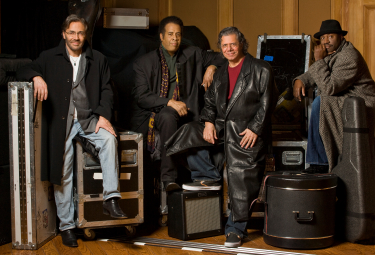
Return to Forever Reunion Tour
Is fusion really back? It depends, in my opinion, on what you mean by fusion. To me, it seems as if it never left. Its influence is in tons of pop, jazz and world music. People just dont recognize it. Surely the huge commercial appeal of straight fusion is long gone. It was done in by greedy music executives who wouldnt know their Moog from their ass. They were able to convince enough musicians that they had to smooth-out their jazz-rock rough edges to appeal better to the great masses. Those record company monkeys still stick in my craw.
To me jam bands like Dave Mathews and Blues Traveler, of course Martin, Medeski and Wood and many, many more acts of that ilk are all fusion bands to a certain degree. Even the World Music movement itself is a natural extension of the fusion principle. And we shouldnt forget that many of the jazz-rock pioneers have been playing variations of the fusion theme the last three decades.
I remember when I was young and all of these old guys like TV talk show host Merv Griffin kept talking about how the big bands were coming back. I used to hate that. The big bands were not coming back and those old squares needed to get a grip. Those days were over. But, as I have aged I realize that they only wanted to do the same thing I want to do now. And that was to simply recapture a part of their youth. There is an element of that nostalgia that surrounds the current interest in the fusion music revival. And make no mistake: there is a fusion revival in progress. (For the record I love big band music. No need to send any nasty notes.)
I would have liked to see a few more young people at the RTF show. Perhaps the ticket costs kept them away in favor of us older citizens who may have a little more dispensable income in these tough economic times. But I know that they are out there, listening to the likes of Mars Volta, Garaj Mahal, Bonobos Convergence, Hadrien Feraud, Surinder Sandhu Bela Fleck for that matter and many others. Those bands and musicians are the direct descendants of the great fusion bands like Mahavishnu, Return to Forever, Weather Report, Head Hunters, The Eleventh House etc.
Fusion will never come back in the undiluted sense in which those early bands once presented it. Music can only be new once. But the critical and financial success of Return to Forevers tour serves as both nostalgia and as an example of musical standards for young musicians to strive for and for young fans to admire. Perhaps this achievement will give impetus for other historic fusion bands to do some new recording and touring.
This blog entry posted by Walter Kolosky.
Tags:

Comments are closed.