The Jazz.com Blog
August 14, 2008 · 4 comments
Life at Gypsy Jazz Camp (Part Three)
In case you haven’t noticed, Gypsy jazz is hotter than ever, and finding fans in surprising new places. During his recent sojourn at Gypsy jazz camp, jazz.com’s Bill Barnes encountered everyone from middle-aged guys in Hawaiian shirts to the token twenty-something rocker in black leather, complete with studs and piercings. But all parties were united in their devotion to this exciting pre-WW II jazz tradition. Below is the third and final installment of his report on this communal attempt to channel the spirit of Django in 21st century New England. Click here for part one and part two in the series. Be on the lookout for Bill's interview with the great modern-day Django-inspired guitarist Adrien Moignard, which jazz.com will publish next week. T.G.
Rising early, I hit the dorm showers and stumble over to breakfast at the campus dining hall, a ten minute walk past a mist-shrouded boat pond and the Smith College botanical gardens. The communal meals are a crucial part of the camp experience; where total strangers sit down to eat at the large round tables speaking fluent guitarese, discussing modal theory and swapping Django stories or tidbits of technique garnered from the week’s jams and clinics. Even though I have arrived late in the week, I’m relieved to know that few cliques have congealed among the participants, at least at mealtime. Teachers, featured concert artists and students dine together freely, part of the egalitarian approach which has been the cornerstone of Andrew Lawrence’s vision for Django in June.
Completely jazzed about the upcoming classes, I grab my new imported Dell’Arte Pigalle model and head for the morning clinic, where I find a dozen other participants warming up on their own Selmer-style guitars. Although Gypsy jazz guitarists from Django Reinhardt to Bireli Lagrene have played archtops and other types, it was the Selmer petite bouche and grand bouche guitars embraced by Django that remain the preferred choice among players in this genre, due to their historic relevance and revered sonic properties. Half the sound is in the idiosyncratic design; the other half is in the way it is played -- largely due to the traditional Gypsy picking method known as the rest stroke.
Even the type of pick is different- instead of flimsy, three-for-a-quarter Fender Mediums, most of these players use the very expensive Wegen -- a thick, unyielding device with grooves and an indentation for the thumb, hand crafted somewhere in the Netherlands. Shortly before leaving for camp I had bitten the bullet and purchased five such plectral extravagances, to the tune of $65 plus shipping. Rumor has it that Django himself used an old piece of tortoise shell and did just fine, but there it is.
RELATED LINKS |
|
GOING GYPSY: A Guide to Resources |
|
LINGUA DJANCA: A Glossary of Gypsy Jazz |
|
REVIEWS: Django Reinhardt’s Music on Jazz.com |
|
FEATURE: Adrien Moignard |
|
THE DOZENS: Essential Stéphane Grappelli |
Although I had done extensive reading on the subject as well as listening to this distinctive sound on various recordings, I had actually never been in the physical presence of a ‘Django guitar’ until the arrival of my internet-ordered instrument a few weeks ago. Now, in the presence of all these cherished instruments, it seems I have hit the Selmer mother lode. Over the next few days, I will play a range of models from the pricier American-made Dell’Artes and several of the ubiquitous Saga Gitanes to a vintage Dimauro, a coveted Maurice DuPont model, and one of the holy grails of jazz Manouche: an authentic, full-bodied Favino. A few years ago Selmer-style petite bouche guitars were a rarity in the States, but now it seems that neither luthiers nor guitar factories can make them fast enough to keep up with the demand.
Just minutes away from the start of the clinic we sit in a semi-circle, comparing axes and diligently plucking away with our Wegens, until a young man casually attired in a running suit and sneakers enters the room and picks up a borrowed Selmer copy, prompting an awed hush among the participants. Adrien Moignard’s master class begins. Over the next hour and a half he will take us through a series of flowing horizontal arpeggios as well as some patent licks based on the changes to “Sweet Georgia Brown,” demonstrating the Gypsy technique with remarkable patience and lucidity for one so new to both teaching and the English language. This class alone was worth the trip.
The week-long seminar offers detailed instruction on all facets of jazz Manouche for all instruments crucial to the genre. Returning instructors include Michael Horowitz, who authored the definitive book on Gypsy right-hand technique, Gypsy Picking, Argentine guitar virtuoso Gonzalo Bergara, and all the aforementioned concert performers. In the limited amount of time left over the weekend, I chose to take classes with just four of the instructors, including Robin Nolan, whose focus is on building a solo around one of the Gypsy standards, and Montreal’s Denis Chang, who will be concentrating on merging the Manouche style with bebop. Each instructor offers unique knowledge and perspective, but perhaps the most profound is that of veteran clinician, Stephane Wrembel.
A native of Fontainebleau, France, where Django Reinhardt spent his last days, Stephane has earned accolades from music critics and fellow players on both sides of the Atlantic. Now living in Brooklyn, he has taken the Gypsy genre in a world beat direction with his latest CD, Terre Des Hommes. But his jazz Manouche background is evident, his playing firmly rooted in the Django tradition. Today he focuses on the importance of working with a metronome in building a solid foundation of time . . . before he ventures into a bit of philosophy. Critical of the superficial mimicry often found among students of this style, he expounds upon making the transition from “walking in the shadow of Django,” to “walking in the light of Django,” a dead give-away to his Buddhist influences. Over the remainder of the two hour session he uses the power of his considerable chops as evidence, frequently quoting passages from Django’s solos on his custom signature “Gitane.” It’s as if the master himself has just entered the room.
Tonight’s concert features Adrien Moignard’s current group, L’ensemble Zaiti, and they manage to exceed expectations while time-traveling across decades of music, from the Django classic, “Blues En Mineur “and Goodman’s “Stompin’ at the Savoy,” to the sixties pop hit "Sunny." Tenor sax man Cedric Ricard wails on “Polkadots and Moonbeams” before venturing into Coltrane territory on Charlie Parker’s “Donna Lee.” The audience is wildly enthusiastic as Adrien Moignard’s nimble fingers dance up and down the fretboard, never seeming to repeat or run out of ideas. L’ensemble Zaiti is clearly moving beyond the confines of the stereotypical Hot Club Swing quartet; although Mathieu Chatelain and bassist Jeremie Arranger still provide plenty of pump foundation, Cedric Ricard adds a mainstream element with his lusty tenor. Following a brief intermission Adrien provides a second set surprise, bringing onstage fellow clinician Gonzalo Bergara. Their good-natured six-string sparring sends the crowd over the top. After the last encore, we leave the Helen Hills Chapel thoroughly sated.
It had been raining hard throughout the evening and the cool droplets hit my face as I walk back to the Laura Scales House dormitory. In these soggy conditions, it is doubtful that any courtyard jams will be forming tonight. Heat and the long day’s activities have taken their toll. I reluctantly turn in, mindful that tomorrow morning I still have a clinic with Denis Chang, who will be covering Gypsy technique used in conjunction with bebop phrasing. In terms of chop-building, it will prove to be one of the most productive sessions of the week.
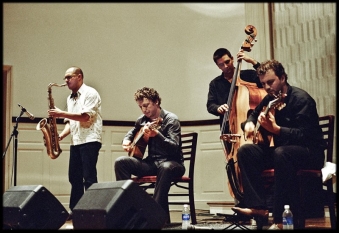
L’ensemble Zaiti (photo by Frederic Moretto)
Waking suddenly in the morning darkness, I hear the distant sounds of pump-chomp-pump, chunka-pump-chomp, and ferocious violin and guitar solos, which I had thought to be part of a dream, but is actually a full-blown jam which had materialized in the King House living room shortly after midnight. I recognize Matt Glaser and several other staff members taking a chorus or two and hope that someone is capturing this session on a decent recording device. I’m also thinking that, had I stayed up, I would have felt more comfortable joining in this time. Damn.
The final evening jam session for the 2008 Django in June had continued until the sun made its unwelcome appearance and the last bar of la pompe had been strummed. This five hour marathon accounts for the fact that the dining hall is only about a third full at breakfast. I’m having my fourth cup of coffee with several 50-something males, who have now apparently forsaken their beloved Hawaiian shirts. We are in the middle of a discussion on the state of music and the arts in America when a tiny figure carrying a tray of food takes her seat next to me. It’s Sarah, the remarkable fourteen year-old violinist. Mustering my most accusatory, fatherly tone, I ask her, “Young lady, please tell me you weren’t one of those people in King Dorm, jamming until five in the morning?” She breaks into a grin, admitting, “Yes, I’m afraid I was.” We all laugh.
The future of jazz Manouche is in good hands. I think Stéphane Grappelli and Django would be extremely proud.
This blog entry posted by Bill Barnes.
Tags:

Bill, Great review! Too bad you weren't at D-I-J Tuesday morning before Andrew had the Smith College staff turn the hot water back on! Whoops... someone forgot that us 50-something overweight guys still like HOT showers in the morning! In spite of no A/C the whole week and no hot H2O for one morning, a splendid time was had by all.
Great article. It felt like being there all over again.
Superb article. You are quite a wordsmith! Normally I get impatient reading lengthy articles, but I couldn't "put it down."
Bill, we met at Ted's lecture, but I knew we had met somewhere before. We jammed on "Secret Love" at The Press Room about 2 1/2 years ago! Wow. You are an awesome guitarist.