The Jazz.com Blog
August 19, 2008 · 0 comments
Herbie Hancock on the Beach
Bill Barnes is a regular contributor to jazz.com, and the author of our recent series on life at a Gypsy jazz camp. Here he leaves Django behind for the evening and checks out another traveling caravan: the Herbie Hancock road show. His report is below. T.G.
Flashback . . . Atlanta, Georgia, summer of 1974: Sitting in the nose-bleed cheap seats of the gigantic circular concrete abomination known as Atlanta-Fulton Stadium, I await Herbie Hancock’s set, one of the few actual jazz acts in the Atlanta Kool Jazz Festival. The evening’s roster includes Moms Mabley, The Staple Singers, Gladys Knight and the Pips, Marvin Gaye and Kool and the Gang. But only Herbie, the Crusaders and Chick Corea add jazz legitimacy to the festival’s lineup.
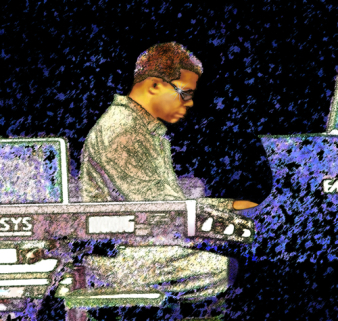
Herbie Hancock (artwork by Julie Powers)
The ineffectual sound system can’t possibly compensate for the chaotic echo chamber created by this behemoth acoustic nightmare, an unlikely venue for the complex and sometimes introspective art of jazz. But from the first Hindewhu-inspired opening notes of “Watermelon Man” Herbie has the crowd rocking. Released just two years earlier, Hancock's Headhunters had been a huge commercial success at a time when the fusion movement was collapsing under the weight of its gravitas and technical sturm und drang, an implosion similar to that which would later bring down this cold, archaic, over-sized monstrosity of a coliseum, the former home of the Braves.
Fast-forward to the summer of 2008 and the Hampton Beach Casino Ballroom, an entertainment oasis surrounded by the cultural desert of a honky-tonk beach town. Thirty-four years later I find myself once again in an unlikely setting to hear the legendary keyboard artist on the crest of yet another commercially successful release. Casino box office receipts indicate that comedy puppet-meister Jeff Dunham and KC and the Sunshine Band are completely sold out but, as of the day of the performance, advance ticket sales are only 60% for Herbie. The fact that he’s booked here at all is a minor miracle. It will take another to put butts in all these seats for tonight’s concert.
Herbie Hancock has already pulled off a major miracle- winning Album of the Year at the Grammy Awards for his latest crossover recording, River: the Joni Letters. Though he had once again broken the commercial sound barrier with Possibilities, this is the first jazz album in 43 years to win in this category. Hancock’s choice of material may be the result of survival skills honed from the hard lessons of the seventies, when jazz as a viable commercial element really began its nose-dive. Who could forget that dark summer day in ’79, when New York’s venerable jazz station WRVR suddenly switched to an all-Country & Western format?
Tonight’s performance is the 45th stop on his River of Possibilities tour. Waiting for the group to take the stage, I wonder how they will find the energy to make it through the night. Looking around at rows of empty tables, the question becomes, “should they even bother?” A gray-haired codger in a tank top sporting a lifetime collection of tattoos sits at a nearby table and I can’t help theorizing that he’s a homeless person looking for shelter, who has somehow evaded security.
Then, another miracle: about fifteen minutes before curtain time, the Casino Ballroom fills to capacity with late arrivals. My “homeless person” is joined by friends; eavesdropping, I pick up snatches of conversation in which he recounts anecdotes of nights hanging out at Birdland and listening to ‘Trane. As the musicians pick up their instruments, I am feeling rightly ashamed of myself.
The set begins with a hard-driving funk of “Actual Proof,” from his 1974 album, Thrust. Drummer Vinnie Colaiuta lays down a solid backbeat, while demonstrating remarkable independence; providing ample organized chaos in which he hears and supports all components with judicious intensity and taste. Chris Potter attacks the vamp with his wicked-deadly modal arsenal. Right out of the gate, the group’s tightness and polish from over 40 tour dates is apparent, with no loss of energy, and is rewarded with thunderous applause. I am rapidly reassessing my opinion of the Hampton Beach crowd.
The two singers are introduced and Sonya Kitchell delivers affected renditions of Joni Mitchell’s “River,” and “All I Want,” sounding a little like a cross between Joni and Ricki Lee Jones -- long on drama, a bit short on chops. But Amy Keys takes no prisoners in the blues number “When Love Comes to Town,” trading licks with Herbie’s synthesized Delta slide ‘guitar’ before spreading the love with phrasing and vocal timbre a bit reminiscent of Sarah Vaughn. Herbie manages an artful tightrope routine, balancing between his trademark reharmonization and standard blues changes. Guitarist Lionel Loueke wails convincingly, taking this crowd-pleaser home.
Loueke is a source of many surprises this evening. The West African guitarist has been playing with Herbie for several years and contributes one of the set’s more musically challenging compositions, “Seventeens,” a mind-bending exercise in (what else?) the time signature of seventeen-eight. Later on he will demonstrate his remarkable facility with stomp box effects, using a modulator on his voice to provide rich 4-part harmony on variations of a folk number in his native tongue, while looping West African rhythms beaten out on the body of his guitar. It’s amazing stuff and a tantalizing glimpse of this quirky guitarist’s promising future.
Giving the rest of the ensemble a breather, Dave Holland offers a powerful solo improvisational piece on the acoustic bass, punctuated by the boom of Hampton Beach fireworks. Upright is his forte, but throughout the concert his surprising competence on electric bass is evident, as he locks into Colaiuta’s funk with the precision of a Bootsy Collins. Amy Keys then returns with a lovingly crafted version of Leon Russell’s “A Song For You.” Her precise pitch and impressive range make this ballad one of the evening’s highlights.
The final segment of the non-stop three hour performance features Herbie on the piano with some introspective solo improvisation, eventually meandering into his now-classic “Maiden Voyage.” This is the Herbie Hancock we know and love. They wind up the evening on a satisfying, in-the-pocket “Cantaloupe Island,” elevated by Chris Potter’s stratospheric, free range tenor work. The encore number comes as no surprise -- a rousing “Chameleon,” which has the crowd practically dancing on the tables.
Herbie’s Hampton Beach concert, while amazing enough, may have actually been dumbed down a bit for the overall demographics of the tour. There was no material from the VSOP recordings, nor was the Mwandishi period specifically represented. But this tendency to patronize a theoretically unsophisticated audience may be a necessary evil: better to have a slightly diluted jazz performance than no jazz at all. Herbie will always be one of the all-time great artists. If he has to Norah Jones-ify his music to sell tickets and albums, so be it. As long as he doesn’t resort to performing with puppets or playing Country & Western, who cares?
This blog entry posted by Bill Barnes.
Tags:

0 responses so far
There are no comments yet...