The Jazz.com Blog
August 20, 2008 · 0 comments
Sardinia Presents Time in Jazz
Paris-based Thierry Qunum, a regular contributor to jazz.com, sends us this report on an unusual jazz festival in a small Sardinian village. Here Steve Coleman, Uri Caine, Don Byron and other jazz stars adapted their music to the intimate performances spaces of this small town of 3,000 inhabitants. Check back soon for part two of Qunums article. T.G.
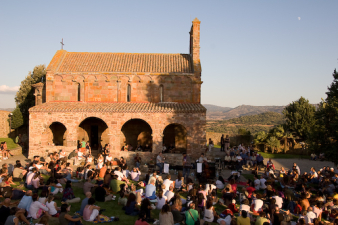
Chances are that Berchidda, a village of 3000 inhabitants, set on the slopes of Monte Limbara, a mid-sized mountain in Northern Sardinia, would be largely ignored by tourists if it werent the birthplace of a jazz celebrity. Paolo Fresu, one of his countrys foremost improvisers, started his musical career in the local banda (the traditional marching band that lots of Italian villages and towns are proud to host) in this locale, some 20 miles from Olbia, the large city on the coast with its beaches and its airport.
Fresus parents still live in Berchidda. And even if Fresus own quintet has often recorded for the Italian branch of Blue Note records, even if he once co-led a band with Enrico Rava, even if Carla Bley recently asked him to join her Lost Chords quartet, even if he recorded a duet with Uri Caine, even if he plays so often in France that he owns a flat in Paris, this trumpeter never estranged himself from his Sardinian roots. More than that, two decades ago he decided to start a festival in his birthplace, and in the course of its 21 years of existence it has become one of the major cultural events on the island, attracting musicians and jazz lovers from the whole Italian peninsula and from the rest of Europe.
Obviously, Berchiddas Time in Jazz (TIJ) festival has something unique that one is bound to love deeply or frankly dislike, and Fresu and his team are legitimately proud of TIJs idiosyncrasies and willing to carry on with most of them as the festival evolves over the years. How many such events do you know, where the first concert of the day can start at 5 AM with a cello or piano solo, played in the open air in the forest? Or where the audience has to walk on a dirt road in the pre-dawn hours, up the slopes of a hill, to listen to it? (In the case of the piano recital, of course, a bunch of roadies had carried the instrument beforehand on their shoulders to the chosen place, for a couple of hours, in the dark.) And why all these efforts? Just because its a beautiful spot where you can see the sun rise in the middle of nowhere while listening to music!
Same with the duet between two electric guitarists in a small isolated chapel on a hill, overlooking the sun-dried Sardinian countryside, a couple of years ago. Some may complain that two thirds of the audience had to listen to this concert from outside the (really very small) chapel, and that the sound of the music was regularly mixed with the ringing of bells sported by a flock of sheep grazing just a couple of yards outside the venue. But who cares? The setting was unique, inspirational, and beautiful!
Now I guess youve understood the idea: at TIJ, you can hear carefully chosen music in unique spots, while taking part in rare events, tasting delicate wines and local food, and this rare mix is what youre here for. So you dont complain if you had to wait an hour to extract your car from the queue of vehicles parked on the narrow path leading to that isolated chapel where you saw and heard a beautiful guitar duet (Norways Eivind Aarset and Frances Nguyn L, by the way) or saw nothing of it and heard only a little through the sheep bells choir. Or perhaps you were among those who had a hard time finding the chapel on the map and unfortunately arrived late.
TIJ is unique, thats a fact. Each year its program is related to a theme that allows it to include other arts and crafts -- cooking two years ago; trance last year; architecture this year. And that comes as a puzzle: what strange kind of variations are Fresu and his team going to play on their chosen theme? This year, after a lively 20th anniversary in 2007, the surprise TIJ has come up with is that this usually mainly European festival has invited a majority of American musicians, and not your average blockbusters that roam the Old Continent every summer with their super-bands and hyper-all-stars, looking for high euros either. Says Fresu about this surprising choice: Actually we didnt invite American musicians, but rather musicians from New York. The chosen theme, architecture immediately made me think of NYCs vertical structures, then of the way Uri Caines built his version of Bachs Goldberg Variations and of Steve Colemans vision of polyrhythmic architecture. Thats the type of idea we built the program on rather than thinking in terms of geographical origins. Just the same, mixing Italian and English you can make a play on words on archi [strings] and texture. Thats why we invited the Alborada String Quartet and those three cellists who played one solo each, then played together and confronted their styles. These types of very ambitious and well considered programs explain why, year after year, audiences have come to Berchidda to attend a festival that has no equivalent anywhere else, and that confirmed its uniqueness during these hot days of mid-August 2008.

Its late afternoon and the audience has gathered on the lawn surrounding a 12th century church set on a hill overlooking a beautiful lake, out in the countryside by the village of Oschiri, a couple of miles west of Berchidda. They are about to attend a unique concert. First because Steve Colemans Five Elements have never come to this part of the country before. Second because the band has decided to play totally acoustic, right on the lawn, with Marcus Gilmore using merely his high-hat and trap drums. Third because the proximity with the audience brought Coleman to end the concert by a dialogue with them and even give -- answering a listeners question -- some musical examples of the type of silent communication within his band that allows them to change rhythms and melodies without obvious gestures during a long tune.
The music showed from the start that it would depart from the usual, since it began with the horns and the voice alone, playing a choral-like song that conjured up memories of ancient Italian composers like Claudio Monteverdi. Hearing Coleman in this unusual and challenging acoustic setting was a rare treat, and his band definitely put the Sardinian audience under its spell, as it did the next evening in the totally different setting of Berchiddas Piazza del Popolo (Peoples Square). There, another aspect of Colemans sense of architecture was exemplified when he started the concert by a lengthy poised alto solo which made obvious his personal way of actualizing Charlie Parkers phrasing. He then was joined by the Five Elements, intertwining their own melodic or rhythmic lines one by one with their leaders until they built a thick collective, beautifully structured maze of sound. Out of it surged now and then the deep chant of a solo voice that melted itself in the group sound after it had delivered its message, ultimately building a piece that lasted more than half an hour, keeping the audience fascinated by its architecture and evolution. The same occurred with Sonny Rollinss Strode Rode, whose melody was deconstructed and reconstructed through a process that involved an intricate mix of improvisation and preset structures, then with other tunes, so that Coleman had to ask the audience, who were demanding more, how long they had played in all.
This is the end of part one of Thierry Qunums account of the Time in Jazz Festival in Sardinia. Check back for part two, in which he covers performances by Uri Caine, Don Byron and others.
Tags:

Comments are closed.