The Jazz.com Blog
August 24, 2008 · 1 comment
Uri Caine & Don Byron in Sardinia
Paris-based Thierry Quénum, a regular contributor to jazz.com, concludes his coverage of on an unusual jazz festival in a small Sardinian village. Below he discusses the appearances of Uri Caine, Don Byron and others at Paolo Fresu's "Time in Jazz" (TIJ) Festival in Berchidda, a Sardinian village of 3,000 inhabitants. Click here for part one of his two-part article.T.G.
Uri Caine started his four days stay at Sardinia’s Time in Jazz festival, with a solo piano concert in a the Basilica di Sant’ Antioco di Bisarcio, a medieval building set on a hill close to the small city of Ozieri, 20 miles south of Berchidda. In this solo context, Caine tended to emphasize his virtuosity and sense of harmonic construction, rather than melodicism or emotional expression. Indeed, all through a program that included “Honeysuckle Rose” “‘Round Midnight,” the Beatles’s “Blackbird” and pieces by Mahler, Caine displayed his expansive musical culture and his impressive mastery of the piano, but never got close to the lyrical side of his instrument.

But what a contrast, two days later, when Caine played in duet with the local hero, Paolo Fresu, on Berchidda’s main stage! Fresu is both a virtuoso and a naturally lyrical player, be it on the trumpet or on the flugelhorn. He is equally at ease on hard-bop warhorses as on melodic tunes such as “I Loves You, Porgy” and, of course, songs that belong to the Italian cultural patrimony such as Monteverdi’s “Si Dolce è il Tormento” (“So Sweet is the Torment”). On such slow pieces, as on Handel’s “Lascia ch’io Pianga” (“Let Me Weep”), of which he gave a very gospel-like version, Caine showed that he could display a lush piano touch and beautiful voicings that he had seemed reluctant to use when not enticed to do so by a Mediterranean partner. Inevitably, both players left the full house of the Piazza del Popolo in a state of bliss that bordered on trance.
That was exactly the type of state of mind required to listen to the ensuing Goldberg Variations by the same Caine. Here fans discovered that Fresu – promoter, star and stand-in too -- was part of the eight piece band that played it, replacing an ailing John Swanna. As on the record he released in 2000, though with restricted personnel, Caine’s Ensemble played an impressive number of variations on the initial Bach aria, borrowing from several musical genres. New Orleans jazz, modern jazz, klezmer music, gospel, rap, tango… all of these were used, with aptly chosen portions of improv and turntable effects, while Caine also interpreted some cleverly penned classical-like pieces, using mainly his piano, Joyce Hamman’s violin and Chris Speed’s clarinet. The global mix was moving, witty, humorous yet respectful, and definitely convincing, though a bit lengthy. Caine’s Goldberg may in fact be one of the few examples of syncretism in music, where each element equals the sum of the parts as far as sheer musical quality is concerned.

Can there really be an isolated spot on an island that’s been inhabited by men since the Bronze Age? The wheat field near the small city of Luras, north of Berchidda, seems to fit the bill. Here Don Byron and Uri Caine played a duet, in the late afternoon of the next day, on a performance space still covered with straw from the recent crop. The two musicians performed under the shade of a tree that somehow is a symbol of the lasting and tight relationship between man and nature: a huge olive tree, the size of a two story building, that boasts the venerable age of 3,500 years! In these conditions it was perfectly relevant that their music should have strong links with tradition.
Byron’s tenor sax and clarinet obviously conjured up memories of the past reed masters more than they sounded like 21st century jazz. Caine gave his partner masterful harmonic and rhythmic support and took few but beautifully constructed solos. The repertoire included mostly standards, such as “Perdido” and “Moment’s Notice,” played with a deep feeling that never settled for mere nostalgia. When the two musicians played some of the Schuman-like songs that Byron penned a couple of years ago, one had the feeling that this German romantic composer would have felt this countryside setting, overlooking a lake at sunset, perfect for music that was an homage to his own.
This set provided a total contrast with the homage to Junior Walker’s music that Byron played the next evening on Berchidda’s main stage. Having learned well the lessons of its model from the sixties, the “Do the Boomerang” band is a convincing funk unit, even if its members are mostly jazz musicians. It easily set the crowd of the Piazza del Popolo clapping and dancing to its heavy rhythms and Byron’s, David Gilmore’s or George Colligan’s heated solos.
The room left for European musicians in TIJ’s program was scarce -- which may explain why the overall audience of the festival was less numerous than on previous years -- but they were carefully chosen and their performances were original. The most prominent of these Europeans was certainly Dutch cello player Ersnt Reijseger, who had already played at TIJ and was featured this year in a three cello project with fellow citizen Larissa Groeneveld and Giovanni Sollima, an Italian cellist and composer who’s known for his work with pop singer Patti Smith. The three of them played the main stage in addition to performing solo out in the country on the previous or following day, displaying both their collective and personal styles.
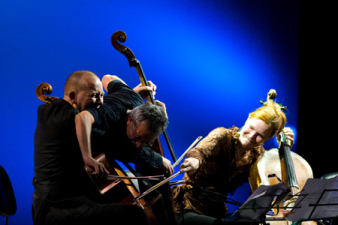
Their collective performance was an interesting blend of classical, jazz, contemporary and folk music -- some sort of “From Bach to Blues” with a touch of humor and another of emotion. Their virtuoso use of bow and pizzicato techniques along with percussion on the strings and body of their instruments showed that each of them, whatever style they may be specialized in, is above all an open musician for whom creativity has no boundaries.
Reiseger was again the link between two genres, the following day, during a late morning concert that took place in the forest covering Monte Limbara. His cello supported the voices of the Cuncordu e Tenores de Orosei (a traditional Sardinian a capella male vocal ensemble) and that of Molla Sylla (a Senegalese singer and m’bira player with whom Reijsger often plays). Their global project, called “Requiem for a Dying Planet,” was endearing, but the link between the two traditions seemed at times rather artificial, and resting mainly on the ability of the Dutch improviser to adapt to one or the other.
The most convincing actualization of a tradition was arguably that of soprano sax player Gavino Murgia. His quintet was the main example of a European jazz that’s usually much more exposed at TIJ, and the presence of two prominent French musicians (Franck Tortiller on vibes and Michel Godard on tuba and electric bass) in his band showed that it was open to a large vision of Mediterranean culture. Dancing moods, lyrical improv and the warm soprano sound of Murgia were the mainstay of this performance and the virtuosity of the musicians, on tricky uneven rhythms for example, never allowed it to indulge in the frequent clichés of this type of music.
How will TIJ carry on with its third decade of original music programming in rural Northern Sardinia? We will need to wait until the next theme and next program are published, of course, but Fresu gave us a hint: “I can’t tell you about the next themes, but we already have chosen four. All I can tell you is that they will be related with the problems of environment, so the next editions will be even more centered on places out in the country, where music can be played without using machines, even if we still use the main stage in Berchidda. After all, that’s where the ‘human architecture’ of the festival has it roots.”
Environmental concern and human architecture? After all, isn’t it what the Sardinian people have been after ever since they built these mythical stone towers that are the symbol of the island, back in the Bronze Age? These towers, whose remnants are scattered in the countryside, are called nuraghe, and sometimes, around mid August in the neighborhood of Berchidda, their stones vibrate to the sound of a music that’s hardly one century old. It’s called jazz.
This blog article was posted by Thierry Quénum.
Tags:

Wow it's a very interestin' blog ! I've read it yesterday ! And today again but more deeper ! I like so much Caine ! I'd like meet him... J.