The Jazz.com Blog
August 27, 2008 · 0 comments
Jazz and Hip-Hop (Part Two)
Is the marriage of jazz and hip-hop a happy coupling of kindred spirits, or a doomed relationship of incompatible parties? Jared Pauley offers his perspective and presents a mini-history of the courtship between these two styles below in the second and final installment of this two-part article. For part one, click here. T.G.
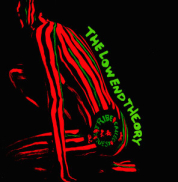
Groups like Gang Starr, De la Soul, A Tribe Called Quest, and the Jungle Brothers were hip-hop acts who all possessed an affinity for jazz music. A Tribe Called Quest and Gang Starr in particular embraced jazz not only as subject matter but from the musical end as well. Gang Starr appeared on the soundtrack to director Spike Lees 1990 movie Mo Better Blues, a film about young jazz musicians surviving and thriving in New York City. Featured on the song Jazz Thing, along with emcee G.U.R.U. and DJ Premier, was the late great pianist Kenny Kirkland. In 1991, A Tribe Called Quest released their second album, The Low End Theory. It featured the songs Verses From the Abstract, with bassist Ron Carter providing the bassline, and Jazz (Weve Got).
Also during this time, British-born Maurice Bernstein and South African-born Jonathan Rudnick founded Giant Step, a promotion company that eventually became a record label and produced shows featuring live instrumentalists such as Greg Osby alongside live turntables.
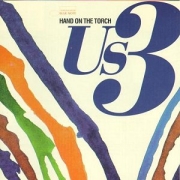
The early 1990s represent the largest attempted cross pollination between hip-hop and jazz artists. In 1991, trumpeter Miles Davis began working on what was his last album, Doo-Bop, with hip-hop producer Easy Mo Bee. Davis wanted to create an album that represented the summer sounds he heard from his window in Manhattan. In 1993, Philly-bred hip-hop act Digable Planets released their debut album Reachin (A New Refutation of Time and Sound), which featured samples from the likes of Herbie Hancock, Grant Green, Sonny Rollins, the Last Poets, Art Blakey, and Rahsaan Roland Kirk. In November 1993, Blue Note Records artist Us3 was given permission to sample anything in the catalog for their album Hand on the Torch. The result was their Herbie Hancock-sampled "Cantaloop (Flip Fantasia)," which was one of the biggest singles of the decade.
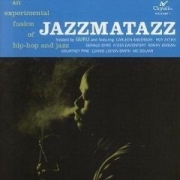
Additionally in 1993, Gang Starr emcee G.U.R.U. began his series of releases dubbed Jazzmatazz, which paired the emcee with jazz musicians. The first volume featured such musicians as Donald Byrd, Branford Marsalis and Roy Ayers. Saxophonist Branford Marsalis formed his own group called Buckshot LeFonque and released several albums during the decade, with 1994's eponymous release, featuring the track "Breakfast @ Dennys," being the most memorable -- because it featured Gang Starrs DJ Premier on many songs from the album. Throughout the rest of the 1990s and the new millennium, many artists, including Medeski Martin & Wood and Christian McBride, began to tour with deejays, most notably with DJ Logic.
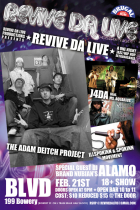
This brings us to the current day where collaborations between jazz and hip-hop artists continue. Particularly here in New York City, the practice is alive and well through the efforts of hip-hop emcees Mos Def and Q-Tip from A Tribe Called Quest, as well as jazz pianist Robert Glasper and trumpeter Roy Hargrove. New companies have surfaced over the last two years that promote jazz and hip-hop artists in a live context, most notably Berklee alumnus Meghan Stabiles Revive Da Live. In conjunction with Revive, Glasper and his group the Experiment, which features drummer extraordinaire Chris Daddy Dave, bassist Derrick Hodge and saxophonist/keyboardist Casey Benjamin, have backed the likes of Q-Tip and Mos Def at different venues around the country.
Now some may ask how this qualifies as jazz? I counter that the two cultures have come to such a stalemate that it was only a matter of time before further experimentations occurred. Revive Da Live has also produced shows for Q-Tip where he was backed by the Roy Hargrove big band, and Mos Def performed in June of this year at Carnegie Hall with poet Gil Scott-Heron and a big band featuring young jazz musicians Stacey Dillard and Marcus Strickland.
How should the jazz tradition deal with the musical efforts of jazz and hip-hop artists since the 1990s through today? Some will say that its not jazz if it doesnt swing, even though other elements, including improvisation, are present in these shows and recordings. As I stated earlier, to ignore the experimentations of jazz and hip-hop artists is to neglect how the word jazz came to its current meaning. If we applied the same double standard in use since the 1970s, we could simply dismiss this as some new genre, jazz-rap or a variant of fusion. I strongly disagree with this approach. I feel that the tradition is riper than ever to be redefined, and as critics, writers and musicians its our job to make sure the legacy of jazz gets its proper and objective treatment. With so many young jazz musicians growing up listening to hip-hop and other styles of music, the traditional definition of jazz is only going to be further put to the test.
This blog entry posted by Jared Pauley.
Tags:

Comments are closed.