The Jazz.com Blog
August 04, 2008 · 0 comments
Life at Gypsy Jazz Camp (Part Two)
While the rest of us were catching up on Summer chores or taking the kids to see The Dark Knight, Bill Barnes was enjoying an idyllic life at Gypsy jazz camp. Here Django is bigger than American Idol, and on even the hottest days, Nuages are in the air. Check back soon for the third and final installment of this exploration of the surprising new millennium popularity of an Old World tradition. (Click here for part one in the series.) T.G.
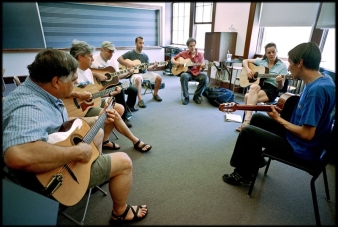
Applied Djangology (photo by Frederic Moretto)
I arrive at Smith College on Friday afternoon, three days into the camp, one of the weekend participants. Checking into my second-story dorm room, I get eerie feelings of dj vu. The accommodations are Spartan-bare wood floors, an unmade single bed piled with one pillow, folded sheets and a blanket. My window looks out onto a grassy, wooded courtyard area separating the two crescent-shaped Georgian residence halls where we are housed and where many of the classes and workshops take place. Boola, boola, Im back in college.
Its a steaming, torrid afternoon in Northampton. Many of the classes are being held out on the courtyard lawn, with groups of five to twenty-odd musicians clustered under the shade of ancient oaks. The steady pulse of la pompe rhythm reverberates off the brick walls, interwoven with subtle strains of color from the occasional accordion. Conflicting violin, mandolin and guitar solos compete for airspace. Classes are wrapping up, jams are starting to form.
Passing one group playing a Manouche standard under the tutelage of the master instructor, I hear a guitarist providing backup suddenly get lost in the middle of someone elses solo, unraveling the rhythmic foundation and derailing the entire ensemble. As the piece disintegrates, the instructor asks, in a distinct French accent, Okay, what just happened? The red-faced culprit shakes his head, murmuring something about losing his concentration. As I wander out of earshot, the instructor, who I suddenly recognize as the acclaimed guitar master Stephane Wrembel, begins to deconstruct the last few bars, with some wry comments on more supportive playing.
Unlike the conventional view of the rhythm guitarist as a technically inferior musician to lead players, in jazz Manouche a solid rhythm guitar player is highly esteemed. The la pompe technique (the pump in English), considered the bedrock of the traditional Hot Club sound, seems deceptively simple but takes a surprisingly long time for many experienced jazz guitarists to master. Few do it better than Mathieu Chatelain, who co-founded the progressive Lensemble Zaiti with 23 year old guitar sensation Adrien Moignard. Mathieus clinic on rhythm technique is one of the most popular classes at the seminar.
GOING GYPSY: a guide to resourcesSo, you want to explore the world of Django Reinhardt and jazz Manouche? These resources will get you started in the right direction. |
|
SUGGESTED RECORDINGS: The Best of Django Reinhardt (Blue Note) Djangology (Bluebird) In Solitaire (Definitive Records) Bireli Lagrene, Gipsy Project (Available through Gypsy Jazz.net) Selmer #607 (Available through DjangoBooks.com) The Rosenberg Trio Live at Samois (Available through DjangoBooks.com) Jimmy Rosenberg, Angelo Debarre and Bireli Lagrene: The One and Only (Available through DjangoBooks.com) |
|
BOOKS: Biography, History: Django: The Life and Music of a Gypsy Legend by Michael Dregni Gypsy Jazz: In Search of Django Reinhardt and the Soul of Gypsy Swing by Michael Dregni Django Reinhardt by Charles Delaunay Gypsies by Jan Yoors Bury Me Standing: The Gypsies and Their Journey by Isabel Fonseca Instructional Books/CDs (Available through DjangoBooks.com): Guitar: Gypsy Picking by Michael Horowitz Gypsy Fire by Andreas Oberg Violin: Gypsy Violin by Matt Glaser Never BeforeNever Again by Joe Venuti. Instructional DVD/Books: Jazz Manouche: Technique & Improvisation, Vol. 1-4 (DVDs) by Denis Chang (Available through DjangoBooks.com) |
|
WEB SOURCES: Info and Products: DjangoBooks.com; great forum, books DVDs, CDs, instruments and accessories GypsyJazz.net: more books, DVDs, CDs instruments and accessories Django Station: French jazz Manouche website Gypsy Guitars: great source of info and instruments- Romani.org: Romani info and history- Jazz Guitar: Gypsy guitar licks from Bireli Lagrene- Selmer 607 project website: Videos of the session and other resources Luthiers: Acoustic Guitars.com Shelly Park AJL Guitars Castelluccia Guitars Holo Guitar Olivier Marin Luthier (Spain) |
Andrew Lawrence has been buzzing like a worker bee all week, keeping things moving seamlessly. Still, he is gracious enough to stop and chat, answer a few questions and to introduce me to Lensemble Zaitis leader. The group is gathered around a laptop computer, where the final moments of a soccer match between France and the Netherlands are being played out. Robin Nolan and his bass player, Simon Planting stop by in time to witness Frances loss. Nolan and Planting are from Amsterdam, but, in deference to their disappointed French colleagues, manage to contain their enthusiasm. They have just returned from a rehearsal in preparation for their own concert this evening.
I have an interview with Adrien scheduled for this afternoon and wonder how Im going to communicate with my rudimentary conversational French. Much to my relief, the interview goes well, as he had picked up enough English to cross the barrier. I can now relax a little and look forward to the concerts and master classes I have on my itinerary. [Editor's note: Look for this interview on jazz.com later this month.]
The weekend concerts have been the anchor of this event from the first time the Robin Nolan Trio performed here in 2004. Robin has been a concert and teaching staple of the program ever since. Years ago he had befriended and studied with Sinti guitarists living in the Netherlands and had authored some of the first really accurate instructional materials on the Gypsy style, helping to propel this worldwide movement forward among the gadje. [Gadje = Romani term for a non-Gypsy. Check out the "Gypsy Jazz Glossary" here.] His trio heads the lineup for tonights concert, which also features the Django in June All-Stars, an ensemble of players from the teaching staff. The Friday night concert is only two hours away, held in, of all places, the Helen Hills Chapel, a traditional white-sided New England church on the Smith College campus.
The chapel lacks air-conditioning and is packed with the jazz Manouche faithful, most dripping with sweat in the close, oppressive air of the sanctuary. As the sun goes down the occasional breeze brings some relief but only the music can take our minds off this early summer New England heat wave. Andrew Lawrence introduces the faculty ensemble, including Simon Planting on bass, doing double duty this evening, as he is the foundation for Robin Nolans trio. On guitars we have Denis Chang, one of the top instructors in this style, Jean-Philippe Watremez, a new addition to the camp faculty who lays down a powerful la pompe. One of the more fascinating instruments at the clinic is the accordion, here represented by the astounding Vladimir Mollov. Leading the All Stars is Matt Glaser, a friend to the late Stphane Grappelli, who has written some of the more effective books on swing violin. Not only is he a wizard on violin -- hes also known to be somewhat of a wit. In his opening remarks he cracks wise on his partially accurate prediction prior to the event that most of the participants would be 50-something males, all wearing Hawaiian Shirts which they believe to be a reasonable alternative to exercise. I join in the laughter, until I suddenly remember arriving this afternoon wearing -- you guessed it -- a Hawaiian shirt.
Despite Matt Glazers dismal prediction, the seminar has drawn people from all over the USA and Canada, some from as far away as the UK and Germany, all age groups, genders (okay, a higher percentage of 50-something males than I had expected) and different social spheres coming together in a common quest for the spirit of Django and what his music represents. Theres even one twenty-something rocker from New York, garbed in the prerequisite black metal-head uniform, complete with leather, studs and body-piercing. He is candid in his goal regarding the camp experience: I just want to play faster.
Earlier I had joined in a conversation between a photographer and a precocious young violinist named Sarah. An engaging, independent fourteen year-old, she seemed comfortable with the older participants and delightfully unaffected. When asked what drew her to Gypsy jazz, she answered simply, Stphane Grappelli -- I love his playing. She also admits that this style is just fun to play.
The conversation turns to post-EU France, our photographer friends homeland. When I go back to Paris, I invariably become sad. It has changed so much. The changes are so subtle that you wouldnt notice -- but I do. The whole world is in a state of flux, which may explain, in part, the newfound attraction to this timeless, evolving music without national boundaries. On one level, jazz Manouche has the appeal of nostalgia; at the same time, it brings a fresh, acoustic perspective to contemporary jazz, melding the mournful soul of the Sinti, the Manouche and the Gitano with the passions of the Pigalle, the blas of bebop and the fire of fusionpyro (without all the pedals). As the song goes, everything old is new again.
The Django in June All Stars, a group which didnt exist prior to this event, are surprisingly tight, playing a wide range from traditional Gypsy Swing numbers to the bebop Rhythm changes standard, Oleo. Denis Chang demonstrates his facility with both Gypsy and mainstream jazz guitar techniques while Vladimir Mollov does what I previously thought would be impossible -- burning up the accordion on Sonny Rollinss bop masterpiece. Matt Glasers violin soars effortlessly above it all; he delights the crowd with his tongue-in-cheek vocal on a bouncing Some of These Days, a number in which staff member John McGann offers yet another revelation: that, in his hands, the mandolin can swing.
During intermission, enamored concertgoers are sipping wine on the church steps and heaping praise on the ensembles set. I overhear one of the local townspeople commenting on the positive feel of the music, calling it joyous jazz, seemingly a contradiction in terms that, in a perfect universe, would be an oxymoron. Lights blink in the vestibule -- the Robin Nolan Trio is about to take the stage.
Robin Nolan, always a Django in June favorite, opens with a powerful version of the popular Gypsy standard, Swing Gitan. It is immediately apparent why his playing has generated such enthusiasm. Few guitarists seamlessly integrate jazz Manouche, mainstream jazz, rock and blues with such lan. His set includes tunes representing a variety of styles; a bluesy Charlie Mingus favorite, Nostalgia in Times Square, a lovely valse he had written for his young daughter and a heart-wrenching version of Djangos Clair de Lune, with able assistance from violinist and fellow clinician Jason Anick. Throughout the concert Robin delivers an inspired performance con brio, with ample support from bassist Simon Planting and guest backup guitarist Ted Gottsegen on the pump.
For me the evening is all but over as I return to my room, but for much of the camps staff and participants, the real fun is only beginning. Within an hour from the concerts end, small groups of musicians set up folding chairs on the lawn of the courtyard. Like some predestined single-cell organism, each group becomes an impromptu ensemble, with one bass, one or two accordions, mandolins and violins and any number of guitars. Soon four or five different groups dive into their favorites, their intermingling Byzantine patterns flowing through my dorm window in an illogical but somehow congruent jazz Manouche stew.
I am tempted to run down with my guitar and join one of the jams but decide against it. My gut is telling me that, as a newcomer to this style with absolutely no la pompe skill, I have not yet earned the right to be there. The jams continue on for hours and I drift off to sleep on an addictive, soothing river of Gypsy rhythm; a seemingly endless pump-chomp-pump-chunka-pump-chomp, through which the bittersweet lines of Swing Gitan enter my dreams.
This is the end of part two of Bill Barnes blog article. Click here for the third and final installment in this series.
Tags:

Comments are closed.