The Jazz.com Blog
August 06, 2008 · 8 comments
Remembering Jerry Graff
Jeff Sultanof is an astute commentator on jazz matters, and one of jazz.com's resident experts -- especially when the discussion turns to big bands and jazz arranging. His recent contributions to these pages include Dozens on Gerald Wilson and Stan Kenton, and we are looking forward to publishing his forthcoming piece on the Birth of the Cool recordings. Below Sultanof shares a personal tribute to his friend and mentor Jerry Graff, who passed away earlier this year. T.G.
On February 14, singer / arranger / conductor Jerome Graff quietly passed away in his home in Encino, California. For those who knew him, and they included hundreds of singers and instrumentalists he'd worked with, wrote for and conducted all over the world, he was a major figure. His vocal arrangements and musical presentations garnered standing ovations. His musical sketches were photocopied and studied by arrangers of many generations, including some of the big names in the field. Such orchestrators as Larry Wilcox and Ron Roullier, both of whom scored his work, thought he was one of the best musicians they'd ever worked with.
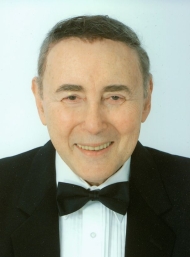
And he is a great example of a man who had a tangential but profound relationship to jazz in subtle ways. I knew him for over thirty years as a teacher, mentor, friend, and confidante. I learned harmony, form, vocal group writing, professionalism, production, engineering and any number of other things from him, but as I learned more about American concert and popular music, I began to understand that he'd touched American music profoundly. And his story needs to be told.
Jerry Graff was born in Brooklyn and was convinced to major in music at Brooklyn College. He never missed the Fred Waring radio program, where he heard the brilliant choral arrangements of Kay Thompson, whose post-war act with the Williams Brothers was one of the highest paid in the country (she can be seen and heard in the movie Funny Face with Fred Astaire; one of the numbers from her act appears on a Milton Berle DVD). He was also a big fan of Six Hits and a Miss, as was Mel Torme. During Jerry's college years, he and his future wife Judy were members of the Robert Shaw Collegiate Chorale.
He was a member of the Special Services Unit during World War II, a group of actors, singers and musicians which included Allen Ludden, Carl Reiner and Hal David. It was during this time that he composed and orchestrated incidental music for a non-Broadway production of The Glass Menagerie. He also put together a vocal group with a Hawaiian woman and three men called The Beachcombers. After the war, he brought a test record of his group to Robert Shaw, who was helpful in getting them hired by bandleader Johnny Long. While a major name, Long's band was certainly not as popular as Dorsey's, Shaw's or even Charlie Spivak's, yet Long's post-war recordings for Bob Thiele's Signature Records show the ensemble to be better than historians have acknowledged. Jerry's first recorded arrangement was "Hawaiian War Chant" with an instrumental background by Julian Work. Other recordings include "Unless it Can Happen With You" and perhaps their finest record with Long, "Easter Parade." They made other recordings with Leroy Holmes on MGM, and while these are hardly jazz, the vocal work can only be described as stunning.
Eventually The Beachcombers came to the attention of Jack Entratter of the Sands Hotel in Las Vegas, and their glory years began. In the 50s, The Beachcombers were the main attraction in the lounge of the hotel, where they were seen and heard by every star appearing in Las Vegas; the group also performed in the main auditorium as an opening act. To this day, people who went to Vegas during this time get excited when I mention The Beachcombers and have warm memories of their performances. Jerry's arrangements were so popular that such stars as Lena Horne commissioned material from him. The late Gene Puerling told me how much The Beachcombers influenced him (he was the vocal arranger/leader of the Hi-Lo's and Voices Unlimited, the two most influential groups in the vocal jazz movement in high schools and colleges), and Bob Alcivar also raved about their sound and Jerry's arrangements in particular. Alcivar would later put together an impressive jazz vocal group called The Signatures, and would write for The Association and particularly The Fifth Dimension (originally a jazz vocal group). Alcivar told me that without question, The Beachcombers were the finest lounge act in Vegas during the fifties, and one of the best vocal groups he ever heard.
And yet their recordings during the early fifties never really showed what they could do; a recording with the Dorsey Brothers Orchestra of "You Could Make Me Smile Again" went nowhere (although Jerry told me with pride that one of his heroes, Victor Young, was in the studio when it was made and loved the recording), and a single on RCA ("Don't Call Me Coach, Call Me George") was a topical novelty, based on a football coach's life, that also failed to make a dent in the marketplace.
Enter Frank Sinatra. A big Beachcomber fan, he'd asked for his own record label within Capitol Records when he signed the group and produced a single, "Hey Ho"/"Hank'rin for You." The record was slowly taking off when Capitol informed Sinatra that if they gave him his own label, then every other Capitol artist of stature could demand the same thing. Sinatra was furious and vowed that he was finished with Capitol. End of promotion for The Beachcombers. The group was never told what happened, and it wasn't until many years later that I was able to find out the truth.
Once that record died, the morale of the group did as well. A deal for an album on Verve Records to be arranged and conducted by Buddy Bregman was voted down. Jerry walked out, and got a call to lead the vocal group for what would turn out to be the last year of the Nat King Cole television show on NBC, where Jerry's arrangements were orchestrated by Nelson Riddle. The Jerry Graff Singers can be seen on-camera in some numbers from the show that have gotten into circulation on Public Television and DVD.
With few other prospects on the West Coast, Jerry moved back to New York with his family. He told me it was like starting all over again. But luckily word quickly spread of his abilities, and Jack Pleis, musical director for Decca kept him busy as a group singer. He was soon to work with vocal group legends Elise Bretton [one of the singers on Billie Holiday's Lady in Satin and co-composer of "For Heaven's Sake (Let's Fall in Love")] and Lynn Roberts (the last female vocalist with the Dorsey Brothers Orchestra, who later toured with Benny Goodman and Mel Lewis). He became a contractor and sang on hundreds of recordings. In 1973, I began going to recording sessions and rehearsals with him to observe, ask questions and learn the music business. To list whom I met and worked with would be an exercise in name-dropping I don't wish to indulge in because this article is his show, but I will say that he only worked with the best in his field. Eventually he asked me to supervise some of his recording work, and I produced a CD called Life Dreams which was only distributed privately. This CD was made at the Capitol Tower in Los Angeles, and recording there is one of my most cherished memories. I later orchestrated one of his arrangements for Lynn Roberts for the Palm Beach Pops, another amazing experience.
Jerry was well known for his special material for acts of all types, and for over thirty years, he would review every arrangement he wrote with me, first to explain what he'd written, later to solicit my opinion. ("Should this be two bars or four in this transition?" he would ask. I would answer, and he would call me from the road to tell me if it worked). He made total amateurs sound like professionals, such was his gift, and when he worked with a professional performer, that artist sounded like a star.
His particular skill in changing keys and tempos within an arrangement would have made him an excellent teacher of harmony and form, because he could fully explain why he did one thing and not another. He prided himself that he'd won an argument with Nelson Riddle during a Nat Cole rehearsal over a modulation that Nelson did not think worked very well. His medleys were full of surprises, yet were always coherent and logical. They were journeys that listeners adored -- audiences applauded in six different places during his Christmas medley for Lynn Roberts when it was first written and performed. They still applaud in the same spots.
I learned about wonderful four and five-piece vocal groups because he would talk about them, little realizing that I would go out and find recordings of The Pied Pipers, The Stardusters, The Starlighters, The Dave Lambert Singers and many others. When trombonist Warren Covington bought the Pied Piper name, Jerry became the arranger and sang with the reconstituted group. I even got to sing with them when one of the members of the group was late to a rehearsal. Incredible . . . and the one way to really write good vocal parts.
I was not the only young person whom he encouraged. Perhaps his closest tie to modern jazz was his close relationship to the composer / pianist / professor David Lopato, the son of his best friend. Jerry did not understand everything David wrote or played, but he knew talent, and Lopato has since proven that he is an important voice in American music, and a gifted, perceptive teacher. Jerry was enormously proud of David and me, and during hard times, was there to help us keep going with kind words and strong hugs.
The show business in which Jerry blossomed changed quite a long time ago, and obviously popular music and jazz changed profoundly as well, but he kept going, and was still writing for and coaching singers when he died. He was thrilled when he heard high school jazz choirs singing arrangements by Gene Puerling with perfect intonation and excellent diction. He was touched deeply when I told him that I played The Beachcomber recordings to young children, who thought they were 'cool.'
Jerry Graff's life reminds us that many people whose names are not well known in historical circles need to be remembered for the contributions they made, and I hope there are others who will come forward to tell about those they knew or studied with who touched jazz, although perhaps in unheralded ways. There are many such people in the United States and also in Europe, and the record needs to be filled in, so their stories are not lost.
This blog entry posted by Jeff Sultanof
Tags:

Thank you for the stirring tribute to my Uncle and friend. It was a joy to read, and I thank you from the bottom of my heart.
My Uncle Jer was an amazing man. Music was his passion, and he really loved to encourage talent. I miss him profoundly. These beautiful words were a visit with him; one he would most relish and enjoy. Thank you.
This article was very interesting and informative for me. Although I knew Jerry all my life and was aware of many of his accomplishments, I was not aware of much of those outlined above. My dad and Jerry were best friends; and although never formalized, I thought of Jerry as my godfather. Before I finally got into show business, he was always happy to see or hear about solos or performances I gave. After I became a professional whistler, he was there to give me advice and reactions to songs, arrangements, or technique -- and always to kvell over any achievements -- usually communicated over a phone late at night since we were both nightowls. He was especially delighted to know my brother, David Lopato and I had collaborated on my debut CD and he enjoyed the fruits of that labor of love. Last, apropos of love, Jerry was a source of unconditional love and support in my life and I miss him.
Dear Jeff: I'm just reading your lovely tribute to Jerry, and am so glad that you took the trouble to do it. You knew him better than most of us, and you also have the skills and feeling for Jerry to do your sad but necessary service, on behalf of his many friends and admirers. Love and peace from Ron
I would like to thank you for this tribute to my Uncle Jerry. I spent many of my younger days with him and Aunt Judy in Queens and then a whole summer in Las Vegas 1956 making many happy family memories. Unconditional love and as my children would say the best hugs in all the world. We miss him.
Uncle Jerry was one of the most thoughtfull,kind,loving people I have ever known. Although I knew him on a personal level, his professional resume was somewhat of a mystery. Thankyou for filling in the blanks.You are right mom, I will miss those hugs.
I was a member of the group The Signature back in the 50s, and was a big fan of The Beachcombers. They were great in the lounge of the Sands Hotel in Vegas, and also were the opening act in the main showroom. Jerry Graff was great. The charts were really good. It was a fun time in my life. I really miss those days.
I met Jerry in Queens in 1993. He was a friend of my mother-in-law. He got my daughter her first agent. I did not know he passed on. He wa such a nice, funny talented man. We enjoyed his visits to New York after he had moved to LA.We will miss knowing he is there.