The Jazz.com Blog
September 10, 2008 · 2 comments
Television's Peter Gunn Turns 50
Fifty years ago this month, TV viewers were introduced to Peter Gunn in "The Kill," the first of 114 half-hour episodes of a jazz-drenched weekly crime drama that would run for two seasons on NBC and a third on ABC. When he wasn't battling crime, Mr. Gunn was digging some very cool sounds. In fact, wherever he went, jazzy music seemed to follow. Henry Mancini's score has long been considered a classic of the genre (check out this version by the Blues Brothers) and much beloved by jazz fans.
Well, maybe not all jazz fans. Our website's resident curmudgeon, Alan Kurtz, once again offers a dissenting opinion. He investigates the scene of this possible crime and charges its musical mastermind with grand theft audio. Readers are invited to deliver their own verdicts below or email them to editor@jazz.com. T.G.

It's the stuff of Hollywood legend. One day in 1958, staff composer Henry Mancini dropped by the Universal-International Studios barbershop when who should be in the next chair but producer/director Blake Edwards. "Hey," said the latter, "would you be interested in doing a TV show for me?" Interested! The 34-year-old Mancini, on notice that his services were no longer required, thought the most he could hope for at Universal was one last haircut. You bet he was interested. Edwards confided that, for his new private-eye series, he envisioned jazz as "an integral part of the dramatic action, fusing storyline and score." Jazz, he enthused, would be the "distinctive element to invest this series with something extra, something superlative."
Big-screen movies had long since conditioned us to the big bang of Crime Jazz much as Pavlov tutored his dogs. TV, however, would now cement the connection as immutably as some wiseguy in concrete wing tips with a reservation at the Riverbed Inn. The new wave of primetime crime dramas, pitched at adults who swilled cocktails and puffed Chesterfields in air-conditioned split-level suburbia, would pass off murder and mayhem as sophisticated entertainment. And for this, natch, they required music you could tap your toe to.
Accordingly, when NBC premiered Peter Gunn on September 22, 1958, it was a breath of smoky air, as suave leading man Craig Stevens breezed through the title role of a hip PI with a sexy, jazz-singer girlfriend. Rising to this challenge with an unfettered flair for mimicry, the resourceful Mancini gussied up the series' catchy theme with French horns filched from Claude Thornhill and twangy guitar glommed from rock 'n' roller Duane Eddy. And before you could say, "You're under arrest," trumpeter Ray Anthony scored a Top 10 hit with his quickie big-band cover of "The Peter Gunn Theme."

When an even grittier cover by Duane Eddy & the Rebels later twanged among the Top 100 for 11 weeks, it seemed like payback for Mancini's twang-theft in the first place. But by then, Mancini had bastardized Eddy's "Stalkin'" for Peter Gunn's "Spook!" Some shoplifters work so fast, even video surveillance cameras can't catch them in the act. In any case, Duane Eddy got off light with only two swipes from Mancini, whose primary marks were jazzmen George Shearing and Count Basie.
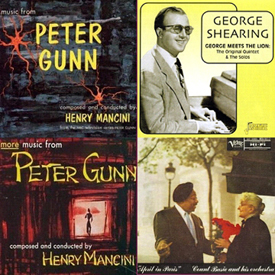
As evidenced by both The Music from Peter Gunn (1958) and More Music from Peter Gunn (1959), Mancini habitually infringed Shearing's velvety quintet patent, especially on "Soft Sounds" and "Brief and Breezy," either of which would have been at home on a Shearing LP. Other Shearing knockoffs included "Lightly," reverse-engineered from "Rugolo Meets Shearing" on Pete Rugolo's Adventures in Rhythm (1954), and "A Quiet Gass," a variation of Mancini's own "A Profound Gass," proving Mancini could even imitate himself imitating Shearing. Another favorite target was Count Basie. Mancini's counterfeit Count appeared in puffy pastiches of Neal Hefti arrangements recorded by Basie: "Dreamsville" (cf. 1957's "Li'l Darlin'"), "Slow And Easy" (cf. 1953's "Softly, With Feeling") and "My Manne Shelly" (cf. 1958's "Cute").
Not that Mancini, an equal-opportunity impersonator, confined himself to picking one pocket per song. He often created a potpourri of pilferage, such as "Peter Gunn," where boosted Basie licks back an ersatz Duane Eddy, or "A Profound Gass," where bogus Basie segues to sham Shearing. Nor did he limit his larceny to jazz and rock 'n' roll. "Not From Dixie" has a mock Guy Lombardo ending, and "Timothy" is a cloyingly cutesy takeoff on Mitch Miller's hit "March From The River Kwai and Colonel Bogey" (1958).
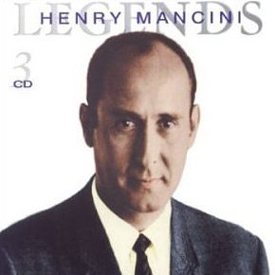
Tellingly, Mancini refrained from describing himself as a jazz composer. And with good reason. He was a Hollywood hack who cannibalized jazz without coming anywhere near its unsanitized heart of darkness. Ironically, with the success of Peter Gunn, the Klepto Kingpin of Crime Jazz himself became the object of widespread imitation. According to Gresham's Law (which itself sounds like a 1950s crime show), bad commodities, being cheaper to mass produce and thus more plentiful, drive out the good. In such a market, copycats are rewarded. Nobody obeyed this law more profitably than Henry Manciniunless it was the network decision-makers driving the crime-jazz bandwagon. Besides Peter Gunn, TV's late-'50s crime spree produced M Squad, Mike Hammer, Richard Diamond, Naked City, 77 Sunset Strip and Staccato. These formulaic series all featured well-dressed detectives and their easily detected adversaries cavorting to finger-snapping soundtracks. Crime might not pay, but crime jazz did.
And as chief cashier of this burgeoning enterprise, Henry Mancini skyrocketed overnight from pink-slipped composer scrounging for one last haircut to Hollywood Honoree of the Hour. When, in 1959, the National Academy of Recording Arts & Sciences presented its first annual Grammy awards, establishing the music industry's counterpart to the Oscars, The Music from Peter Gunn (which, like its sequel More Music from Peter Gunn, was still charting in Billboard's Top 10) won the coveted Album of the Year award, and Hank took home an additional Grammy for best arrangement.
Also in 1959, Mancini's theme song was one of eight Peter Gunn nominations at TV's annual Emmy Awards, where hip comedy team Nichols & May daringly spoofed such silliness on its own turf. Gliding onstage in a designer gown, Elaine May added her congratulations to the legions honored that year for creative excellence. "But what about others in the industry?" she implored, singling out those "who go on, year in and year outquietly and unassuminglyproducing garbage."
With that she summoned a thrilled Mike Nichols to accept his statuette as the "Most Total Mediocrity in the Industry." If, at that moment, Henry Mancini instinctively arose as well, he could be excused, for it did seem like they were calling on him.
This blog entry posted by Alan Kurtz.
Tags:

Let's face it. A majority of the music composed for television borrows from whatever is the prevailing pop of the time. It always seemed to me, however, that Henry Mancini was not a hack but someone who adapted these styles into themes that themselves became iconic. As a matter of fact, many of them were later recorded by highly-respected jazz artists such as Phil Woods and Sarah Vaughan (the latter of whom devoted an entire record to Mancini's music, including songs from Peter Gunn and Mr. Lucky).
Not so much risible as actually offensive. Mancini was a musician to his fingertips and a melodist of genius. Very highly respected and loved man (and by Shearing amongst many).