The Jazz.com Blog
September 16, 2008 · 0 comments
Tito Puente: The Complete 78s (1949-1955)
The broad rubric "Latin jazz" encompasses many diverse recipes. Often three or more continents appear in the mix of these exciting hybrids. The marriage of Brazilian traditions with cool jazz and impressionist harmonies from Europe produced bossa nova, just as the intersection of Afro-Cuban traditions with the bebop vocabulary served as a fertile area of exploration for an earlier generation.
But here is a peculiar combination that may have been the most influential of them all. Take Cuban music of African origins and transport it to New York where it is mixed with elements of jazz and played by American musicians of Puerto Rican extraction. Thanks goodness there aren't anti-miscegenation laws in the music world. Otherwise we wouldn't have the benefit of this invigorating, if convoluted, genealogy for turbocharged Latin music of the modern day.
When tracing this history of Afro-Cuban music played by Puerto Rican musicians in New York, the figure of the late Tito Puente stands out. This seminal figure is sometimes called the "King of Latin Music" or "the King of Timbales" or even the "Sultan of Salsa." Puente, like many others, had reservations about the latter term, which is a commercial category rather than a distinct musical tradition. "The only salsa I know comes in a bottle," he once said. "I play Cuban music." Yet countless salsa musicians look to Puente as a pioneer and source of inspiration. No matter how you want to name or categorize it, Puente's influence hovers over the bandstand.
Puente's background was more varied than most fans realize—many, I imagine, may only know him as the composer of "Oye Como Va." A child prodigy born in Spanish Harlem in 1923, this famous future timbalero also studied saxophone, and played piano, marimba and vibes too—at a time when the latter instrument was unknown in Latin music. He sang in a barbershop quartet, was a skilled dancer, and studied orchestration and theory at Juilliard. He also immersed himself in the famous "Schillinger System"—a labyrinthine and mathematical approach to music education popular among many of the great autodidacts of 20th century American music, from George Gershwin to B.B. King. (It also shaped the philosophy of Lawrence Berk, founder of Berklee, which—many forget—was original known as the Schillinger House of Music.) And, yes, he was a master showman too. In other words, the label "percussionist" scarcely does justice to the broad musical perspective Tito Puente brought to his craft.
His stint with Machito in the early 1940s gave him exposure in one of the most forward-looking bands of the era. Here Puente revolutionized the role of the timbales by bringing them to the front of the bandstand, and playing them while standing up. Widely emulated today, this shift to the forefront of the ensemble was both a musical move and a symbolic statement presaging the future shape of Latin jazz.
Puente served in the U.S. military for three years during World War II and received a Presidential Commendation for his involvement in nine battles, then resumed his performing career in post-war New York. Puente worked with a variety of bands, but his decision to sign with the fledgling Tico label in 1948 was a major turning point in his career.
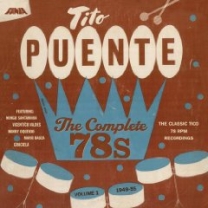
The new release issued last month, Tito Puente: The Compete 78s: 1949-1955, documents this crucial moment in the history of Latin music. Sad to say, many of these tracks have never been made available previously on compact disk. Nor did Puente record many LPs during this period—his Puente in Percussion and Dance Mania albums were still in the future. Puente's creative energy in the late 1940s and early 1950s was preserved primarily via 78 rpm disks. In fact, the compilers of this reissue was forced to transfer many tracks from old 78s in private hands, since the original masters were not available.
For the most part, the sound quality here is more than acceptable, especially when one considers the challenges involved in a reissue of this sort. And the music is riveting. Puente's second 78 for Tico, "Abaniquito" with vocals by Vicentico Valdés and featuring Mario Bauzá on trumpet—included on the reissue—was one of the first crossover mambo hits. English-language disk jockeys, such as Dick "Ricardo" Sugar of WEBD, began featuring this song, which spread like wildfire along the East Coast. Before long, jazz fans listening to Symphony Sid's influential broadcasts were hearing the music of Tito Puente, and starting a love affair with his music that would last the rest of his career.
Other highlights of Tito Puente: The Compete 78s: 1949-1955, include "Tito's Mambo," featuring the bandleader's timbales, "Tatalibaba," later recorded by Celia Cruz, and my favorite, "Mambo La Roca," which Woody Herman later adapted into "Mambo Rockland." What a delight to have this music easily accessible again in this new compilation—especially when so much of this leader's work is still hard to find. (Amazon currently lists only one copy of Puente in Percussion for sale, a second-hand item listed at $299.99!) Puente's devoted fans will want to have this collection, and those who aren't familiar with this artist could do worse than making his acquaintance via this retrospective look back at his early work.
This blog article posted by Ted Gioia.
Tags:

Comments are closed.