The Jazz.com Blog
September 17, 2008 · 0 comments
Jazz Diplomacy for Troubled Times
Jazz fans are justifiably proud to see their favorite music show up at Lincoln Center. But they should be even prouder when musicians, under the auspices of Jazz at Lincoln Center, take their art form on the road to many of the most troubled spots on the globe. The Rhythm Road, a program that has shared the best of American music with people in more than sixty countries, does just that. Jazz.com's Tim Wilkins reports on this little known but important outreach effort below. T.G.
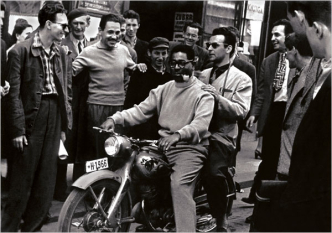
Dizzy Does Diplomacy (Zagreb, 1956)
What does it take to travel the Rhythm Road? Ask any of the more than 100 musicians who have visited the world's most remote and conflict-ridden corners over the past three years as ambassadors for American music, they'll tell you.
"It takes a lot of heart," says Maya Azucena, a singer who visited Burma, Sri Lanka, China and the Philippines earlier this year. "It can get rugged out there." Her band seemed to stay one step ahead of disaster on their tour. They narrowly avoided bomb blasts in Sri Lanka, a capsized ferry in the Philippines, earthquakes in China and a cyclone in Burma, all in areas where they had performed.
But rather than stand by, Azucena helped organize benefit concerts for these victims upon her return to the U.S., and has remained in touch with new-found friends. Like other Rhythm Road veterans, she sees the program not just as an opportunity to tour exotic locales, but to create lasting relationships. "We're not these big people who just show up on stage and perform, then leave," said Azucena. "We're building connections."
The $1.3 million program, which is funded with U.S. tax dollars and administered by Jazz at Lincoln Center (JALC), has already sent performers to more than sixty countries on five continents. Once there, American musicians jam, teach, learn, and hang out with the locals.

Singer Maya Azucena in Kunming, China
"When you have musical intelligence, that crosses boundaries," Azucena added. "That's what blew my mind every single night." Indeed, these tours are not for the weak of heart. Rather than play for embassy staff on the ambassador's lawn, the Rhythm Road prefers to send its artists into war-torn and isolated areas where few outsiders are seen or even allowed. In addition to China, Burma and Sri Lanka, other recent stops on the Rhythm Road include Kyrgistan, Turkmenistan, Cyprus, Yemen, Saudi Arabia, Mali, Rwanda, and the Democratic Republic of the Congo.
It may surprise some that a program sponsored by JALC promotes more than just jazz. Since its inception, the tour has sent out latin and urban music groups, and this year for the first time will include blues, bluegrass, zydeco, country and gospel. The State Department asked JALC to broaden the program's mandate beyond jazz, hoping to reach a full range of audiences overseas. The State Department also chooses the countries where performers are sent every year. "It's about America's vernacular musics," says Adrian Ellis, JALC's executive director. "That was their choice, but we were pretty happy to embrace it."
Indeed, the Rhythm Road represents one of the ways in which JALC, and for that matter, U.S. diplomacy, are quietly changing at the grassroots. "It's important for people to understand the United States through our culture, which really allows for diversity and freedom of expression," said the State Department's Deputy Assistant Secretary of State for Professional and Cultural Exchanges, Alina Romanowski.
The terrorist attacks of September 11, 2001, she says, heightened awareness within the government about the role culture can play in improving the image of American culture abroad. Since then, the State Department's budget for cultural diplomacy has grown from less than $1 million in 2001 to more than $8 million today.
The Rhythm Road is a revival of the State Department's "jazz ambassadors" program, launched in 1955 to improve the image of the United States overseas, as a response to the Soviets' Cold-War cultural diplomacy. The Cold-War version of the program focused on sending some of the era's best-known performers, such as Dizzy Gillespie, Duke Ellington, Louis Armstrong, Dave Brubeck and Benny Goodman, to perform large concerts in foreign capitals.
The Rhythm Road, however, places far more emphasis on interaction, so performers spend more time in each country, and conduct workshops wherever they go. "This is much more about exchange," says Ellis. "The musicians come back subtly changed, and enriched by the experience, just as hopefully the audiences are."
According to Ellis, the underlying philosophy of the program is the same, even if the shift to a grassroots approach is new. "They're sending us to areas where, clearly, there are issues around the standing of American culture," he said. "That's what cultural diplomacy is all about."
Artists keep a grueling schedule on the four- to eight-week tours, and may perform in several towns on the same day, as well as meeting local musicians and students. But in exchange, they gain unique insight into cultures where Americans are rarely seen.
"You see more things than you would if you went there on your own, wrestling with tour managers and all of that," said Alvin Atkinson, a drummer who has visited more than a dozen countries with the program. "You get a chance to really see what life is out there, and that's beautiful." Veterans of the program acknowledge they learn as much as they are able to teach in their workshops, which reach out to local professionals as well as novices.
"When you're with master musicians in a place you've never been, it's good to let them do their thing first," says Atkinson. "It's important for them to remember that Americans came there, and they had that kind of fellowship." Atkinson has changed his own teaching as a result of what he has learned on the Rhythm Road.
"I used to say that rhythm comes from Africa, and harmony and melody come from Europe," said Atkinson. "Now I say that the rhythm, harmony and melody from Africa fused with rhythm, harmony and melody from Europe. They collaborated, and that's how we got this jazz concept."
Others, such as saxophonist Chris Byars, draw from their knowledge of the rich and varied history of jazz to surprise audiences overseas. For his tour of Montenegro, Cyprus and Saudi Arabia, he created a special presentation on the music of trumpeter Gigi Gryce, who converted to Islam and changed his name to Basheer Qusim. "Saudis were amazed to learn that this great American jazz musician was a Muslim," said Byars.
At other times, such as in Dashoguz, Turkmenistan, it was Byars who had to stretch his ears to adapt to the local culture. "Playing at tune in 11/8 gives you about 400 chances to get lost," Chris said about his efforts to learn Turkmen folk music.
"We're not going to build a fence around the bandstand," he added. "Out of the audience comes this guy with his dumbek, and starts doing some pretty cool finger drum techniques. By the third tune, he's trading eights with (drummer) Stefan (Schatz) and bringing the house down."
JALC's contract to recruit, train and support these musicians has just been renewed, so a new crop of musicians will hit the Rhythm Road next spring. Like the trips by the first generation of jazz ambassadors, such as Ellington and Gillespie, the Rhythm Road has already had a lasting impact on both audiences and performers. We can look forward to discovering the surprises that lay down that road for all of us as jazz reinvents itself again, from the grassroots.
This blog entry posted by Tim Wilkins
Tags:

Comments are closed.