The Jazz.com Blog
September 02, 2008 · 12 comments
Hip Hop is to Jazz as Termitz R2 Wud
A few days ago, jazz.coms Jared Pauley championed the fraternization of jazz and hip-hop in this space (see part 1 and part 2 of his article). But not everyone is excited by a dose of hip-hop in their jazz. In particular, Alan Kurtz, our resident curmudgeon, confers a resounding Bronx cheer upon that borough's heaviest-hitting export since the New York Yankees. Below, Mr. Kurtz tries to take the hip out of Mr. Pauleys hop. Who wins this debate? I will leave it up to you to decide. Readers are invited to add their own yeas or nays below or email them to editor@jazz.com. T.G.
"Opinions aside," commented my jazz.com colleague Jared Pauley, "maybe it's just a generational thing." We were discussing Us3's "Cantaloop (Flip Fantasia)," which Jared had lately reviewed, assigning it a score of 95identical to the rating our editor-in-chief Ted Gioia gave Herbie Hancock's original "Cantaloupe Island." To me, there's no comparison. "Cantaloupe Island" (1964) is a classic. "Cantaloop (Flip Fantasia)" (1993) is a knockoff. (Ted Gioia, by the way, professes to like Us3's recombinant muskmelon. There's no accounting for taste.)
For those who haven't sampled it, "Cantaloop" is a rap ransacking of the Blue Note vaults grafting sound bites from defenseless jazz recordings onto a mechanistic drum track that "improves" Tony Williams's original measured groove by accelerating its tempo and eliminating all traces of rhythmic nuance. But wait, I'm getting ahead of myself. First we are suckered in by the pipsqueak piping of Birdland's midget MC Pee Wee Marquette, introducing Art Blakey's A Night at Birdland Vol. 1 (1954). However, instead of allowing us to actually audit Mr. Blakey and his illustrious sidemen (including Clifford Brown and Horace Silver), Us3 pulls Pee Wee's puny plug and jump-cuts ahead 10 years, whence they invade "Cantaloupe Island" with the swashbuckling flair of Caribbean pirates scenting buried treasure. How right they were! In 1994, "Cantaloop (Flip Fantasia)" became a surprise crossover hit.
Partisans claim this raid brought jazz to millions of young ears that otherwise might never have heard it. The question is, though, what did they hear? Surely, apart from royalties, hip-hop rip-offs were not what jazz originators had in mind. Ever gone to a movie where folks behind you talk all the way through? Well, that's how motor-mouth rappers treat jazz, ruthlessly dismantling (with the emphasis on dis) its musical architecture and tirelessly talking trash over what's left. And in any event, hip hop stimulated little interest in jazz. To the contrary: as rappers won enormous fame and fortune, jazzers watched their music plummet in the charts to depths formerly occupied only by kazoo concertos and Lithuanian polkas.
Proponents of the hip-hop/jazz hybrid nevertheless hold that it's part of jazz tradition. Yet in doing so, they display a highly selective knowledge of said tradition. They cite, for instance, Gil Scott-Heron's work in the early '70s as pioneering jazz rap because his most famous rant, "The Revolution Will Not Be Televised" (1970), was backed by bongos and congasas if that automatically transforms raw street poetry into jazz. And in extolling this supposed landmark, they conveniently overlook their seer's nearsightedness. "In 1992," writes media scholar Todd Boyd of the L.A. riots following the acquittal of 4 cops charged with assault in the videotaped beating of black motorist Rodney King, "the revolution was televised, and it proved quite entertaining at that." (Except, presumably, to the 53 people killed during the 6-day telethon, including 25 African Americans; or to white motorist Reginald Denny, beaten by blacks on live TV; or to citizens stuck with the tab for $1 billion in damages.)
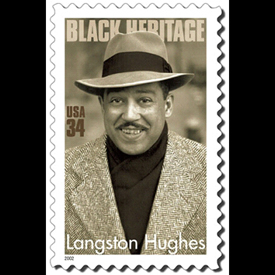
In any case, jazz rap was hardly revolutionary. By the time Gil Scott-Heron came along, spoken-word artists had been reading to jazz for decades. His Royal Hipness, Lord Buckley, recorded with L.A. jazz musicians in 1951. A few years later, Langston Hughes laid down his Weary Blues, half with Red Allen's All Stars and half with the redoubtable Charles Mingus, for the Verve label in New York.
Meanwhile, Fantasy Records caught West Coast poets Lawrence Ferlinghetti and Kenneth Rexroth declaiming live at The Cellar in San Francisco, accompanied by local jazzmen. Fellow beat poet Kenneth Patchen traveled up the coast to Vancouver, Canada, for a similar gig, and south to Hollywood for Kenneth Patchen Reads His Poetry with the Chamber Jazz Sextet. Not to be outdone, Chicago hosted Word Jazz by Ken Nordine and the Fred Katz Group (actually the Chico Hamilton Quintet incognito for contractual reasons). All this transpired during the short-lived Jazz & Poetry fad of 1957-1959.
Speaking of which, let us not forget (try as we might) the inimitable (though who'd want to?) Jack Kerouac, recording his Blues and Haikus with Al Cohn & Zoot Sims in New York during 1958.
Predictably, like rap years later, none of this poetic folderol had any lasting effect on jazz, nor did it win converts to the cause. Far from being innovative, jazz rap merely restages an experiment that fizzled the first time around and didn't deserve a second chance.
Moreover, the premise that hip hop belongs to the jazz tradition is especially suspect on musical grounds. Hip-hop belongs to a tradition, alright; but that would minstrelsy, not jazz. Its most assimilated starse.g., DMX, Ice Cube, Ice-T, LL Cool J, Mos Def, Queen Latifah, Snoop Dogg and Will Smith (aka Fresh Prince)are more thespians than musicians. By and large, hip-hop practitioners don't sing, they rap. They don't play instruments, they mix and scratch. They don't compose, they compile samples. Indeed, just as bygone flowerings of artistic expression came to be known as the Renaissance and Romanticism, historians may someday dub our own era the Remix. In this age of electronic cut and paste, art is not created, it is re-created, stitched together from disused scraps like a latter-day Frankenstein monster. This may work for rappers, but to paraphrase Dr. Fronkensteen in Young Frankenstein, "Hip-hop tracks are Tinkertoys compared to jazz!"
If objectively applied, the musical benchmarks refined by generations of jazz creators would shame hip hop into abject embarrassment, even when performed by jazzmen of genuine stature. Listen, for example, to Miles Davis from 1955 through the mid-'60s. Then, if you can stomach it, check out "The Doo-Bop Song," his 1991 collaboration with producer Easy Mo Bee, where Miles sounds like the Herb Alpert of hip hop, noodling weak-lipped over and around aggrandizing raps from his toadies. "The Doo-Bop Song" is a long way from "Concierto de Aranjuez," albeit an easy journey because it's all downhill.
Frankly, the only way to wrap rap into the jazz tradition is to exempt it from the sophisticated criteria we routinely use to evaluate other styles. This is a form of blackmail. "We are tired of praying and marching and thinking and learning," rapped Gil Scott-Heron in 1970, distilling what would become the hip-hop ethos. "Brothers wanna start cutting and shooting and stealing and burning." But jazz, unlike hip hop, requires study and patience, not looting and pillaging.
And besides, why should jazz fans embrace insurgents who so flagrantly dis the music we love? Even when rappers try to give jazz its props, their tributes are a travesty, such as Gang Starr's "Jazz Music" (1989). Over the drudging monotony of DJ Premier's synthetic beat, MC Guru spiels a cartoonish history of jazz from its jungle origins to Dizzy-Bird-&-Miles. This tired tale was told to better effect in 1954, when Langston Hughes narrated The Story of Jazz for the Folkways label. Of course Hughes had the advantage of reading to vintage discs by Louis Armstrong, Jelly Roll Morton, Duke Ellington, Count Basie, and Dizzy Gillespie.
MC Guru, by contrast, is backed by DJ Premier's canned snippets of an out-of-tune piano and what may be the four most sour notes ever afflicted on an alto saxwhich four notes are periodically recycled with a sadistic lack of mercy. Oh, and did I mention the fellow grunting throughout? Straining at the stools, apparently. Although what that has to do with jazz history is beyond me. Most galling about this mockery is Guru's self-congratulatory smugness. "They gave it to us," he says of jazz's progenitors. "That's why we give it to you." This Boston-born rapper of Trinidadian descent, then all of 23 years old, gives it to us? Whoa, thanks very much. I always wondered who gave us jazz.
Oh, what the hell. Perhaps my colleague Jared Pauley is right. Maybe it is a generational thing. Youth naturally craves phat beats around which to choreograph their primal mating rituals. Hip hop satiates that demand. Why shouldn't jazz get in on the phun? No doubt the sooner old fogies like me stop holding out for artistic excellence and a cultural acumen beyond the violence and vulgarity of urban free-fire zones, the faster jazz will shed its pesky identity and be grated, ground and scrunched like sausage la hip hop for mindless mass consumption into the Grand Def-ecation of American Musick. But, as Dizzy-Bird-&-Miles are my witnesses, I pray that never happens.
This blog entry posted by Alan Kurtz.
Tags:

So, Alan you simply dismiss EVERY single contribution ever made from hip-hop artists to jazz music and vice versa. According to you, hip-hop artists don't sing, they rap. Producers don't compose, they sample. First off many different hip-hop producers ACTUALLY PLAY musical instruments. Maybe if you delved deeper into history and checked out different artists you might be willing to open your mind a little bit. Second, just because someone RAPS and they don't sing, why does that disqualify it from being significant if done over a jazz performance? You obviously don't like GURU or his contributions to music but just because you don't like it doesn't merit such a scolding review of his work. And please, help me define artistic excellence. Since you are the all-knowing critic who says no wrong.
"But jazz, unlike hip hop, requires study and patience, not looting and pillaging." Also, what the hell does this mean. So what you're telling me is that jazz music requires studying and patience but that hip-hop requires none. You couldn't be more far from the truth. I really don't think responding to you is worth any more of my time because no matter what I say you'll simply dismiss it because you have a pre-conceived notion of what you call jazz. I guess jazz died in the 1960s with people like you and everything else since is just a bunch of garbage because it doesn't fit your rigid definition.
Jared, I regret that you were offended by my guest blog, in which I humorously took issue with your argument while not attacking you personally. You, by contrast, sarcastically refer to me as "the all-knowing critic who says no wrong" and angrily demand, "What the hell does this mean."
My blog means what it says. And in the tens of thousands of words that I've written for jazz.com, I've never claimed to be a critic, much less all-knowing.
I'm sorry that you believe responding to me is not worth any more of your time. I had hoped we could have a reasoned exchange without infantile name calling such as "all-knowing critic" and "people like you."
But I must confess that I'm not surprised that a devotee of hip hop is reduced to sputtering pique when confronted by derision. Hip-hop adherents are fearless in trash talking others, but mighty thin-skinned whenever the tables are turned.
I don't really feel offended Alan, it's just the language you use to describe your feelings and the way you simply dismiss everything as a trivial, that's all. I was more pumped full of madness when I responded last night. No hard feelings but I've devoted much of my energy to this topic and I just feel it deserves more analysis.
I'm surprised that there's no mention of "New York, New York" by George Russell, featuring Jon Hendrick's rapping -- from 1958! Bob
While I don't agree with Mr. Kurtz on his overall opinion, everyone's entitled to their opinion and if somebody tells me they don't like Sun Ra, then I won't lash out at them just cuz I love Sun Ra. In fact, I agree with Mr. Kurtz on his assesment of Cantaloop (Flip Fantasia). However, I think he either overlooked or failed to mention several great hiphop jazz tracks. I wrote a whole post on this on my blog, http://survivalofthecool.blogspot.com but please, let's offer examples instead of just badmouthing.
My entire first two blog posts contain examples of jazz and hip hop tracks. I should have mentioned other older tracks like Babz Gonzales' "Christmas Rap." I wasn't familiar with the George Russell and Jon Hendricks track. Thanks for the information.
In the close to three decades I have been listening to Jazz as a religion, I have always maintained an appreciation for 'fusions' of many types. Thus, if I were the author of this blog post, I would never have been that venomous and dismissive of Hip-Hop-Jazz. My mainstay is Straightahead Jazz - I need that swing for sustenance, man. But being a Caribbean man, I also revel, if not crave, the danceable grooves of Hip-Hip Jazz, Calypso-Jazz, Reggae-Jazz and the lot, as a respite even. At such times as I would have listened to US3, I never tried to equate their "Cantaloupe" with Herbie Hancock's. I just bobbed my head to the beat and judged it for what it was worth. Then I would go right back to the standards and any of a number of Jazz incarnations that hold up rather than plagiarise the tenets of the idiom. This, however, is a wholesome debate. But keep the tone down. We should all lighten up a bit. But yes, I know it is hard for the purists. I know; I am one of them. And oh! I really love Quincy Jones' "Back on the Block." Israel Woodshed Entertainment Collective
I really enjoyed reading both blogs about this touchy subject. I would like to think that I'm a pretty big hip-hop fan along with being a huge jazz fan. However, 95% of the jazz/rap crossover is GARBAGE! I would first say that Cantaloop and a lot of the digable planets stuff doesn't even fall in this catagory. Us3 had a pop/hip-hop tune with a jazz sample in it. There are a TON of tracks like that today that we would not bring into the jazz/rap catagory. Because "Cantaloop" was so successful, and because many jazzheads recognized Cantaloupe Island and even the opening to that famous Blakey CD from the Birdland announcer, we saw this as possibly a cool new fusion! I remember I was probably 10 years old when I started getting into jazz with Duke Ellington and Charlie Parker. I had a subscription to BMG or Columbia House and I had heard all these great things about Miles. Their 'featured selection' at the time was the Miles "doo-bop" album so I got it. I just started to play the trumpet and wanted to check out one of the greatest jazz trumpet players of all times, so i got this Doo bop tape and.......It would be years before I would ever give this Miles guy a listen after that. I had heard enough good rappers, and this was horrible. I knew then that that record was horrible, and I hadn't even heard Miles' other stuff yet to show the comparison. People would say, "you have to hear Kind of Blue, the Prestige sessions, etc." and I said I'm not listening to Miles. Buckshot LaPhunque, the jazzmatazz stuff, and there would always be projects with rappers you never heard of, trying to rap about how cool the jazz cats in the olden days were with their zoot suits. Or these rappers using words like swing and jam session, or dropping names of Bird, Diz, and Miles, when rappers should really mention names other than Rakim and KRS, or Biggie, Tupac, and other dead rap legends. Looking at Common, one of my favorite "MC's", he did a pretty decent freestyle on a Roy Hargrove RH Factor CD, and he also uses Nick Payton nicely on an album playing a kinda up beat sticatto New Orleans thing processed with a hissing Victrola sound. But those examples work because the live musicians were recorded and mixed to sound like hip-hop production. Having a rapper rhyme over a couple of choruses of a Charlie Parker tune is just embarrassing.
Personally, I live for the day when Massive Attack & Portishead start sampling the London Improvisers Orchestra. Jazz/trip-hop fusion, anyone?
Do you people not know of Robert Glasper the jazz pianist. He plays traditional similar to Mulgrew Miller but he also plays hiphop loops like tracks from now dead producer J Dilla and converts them to live jazz. Not to mention 'Revive da Live' Live hiphop interpreted by jazz musicians.
Hi All, This is a wide ranging discussion of much interest to me. The core issue seems to be "Who owns art?" or, "Is any art original?" Jazz, rap, and hip-hop are improvisational art forms - no different than Andy Warhol using soup can labels to create images, George Harrison borrowing heavily from the Chirelles when making "My Sweet Lord". Iggy Pop copping from Gershwin's "Porgy and Bess" when making his tune "I love Girls". David Bowie hijacking Iggy's lyrics for his hit "China Girl" [for which Iggy got loads of royalties. Bowie did him a favor.], Bob Marley excerpting the words of Emperor Selassie's speech to the UN when making his song "War". The list is endless. The core question is: What is original art? If a child rips up a print of Renoir and makes a collage of it, who's art is that - the childs or Renoirs? That is what remixing is all about. Making different unique versions of existing material. The famed reggae producers King Tubby and Lee Perry would regularly use recorded studio material and mash it up into "versions" which would be played at dancehall parties and further improvised upon by the MCs, the DJs, and the toasters. The result was a different creation, unique and original. If one wants to build a box, they don't have to grow the tree, saw the wood. They can simply go get the materials they need to build the box. The same is true with music. Two artists could receive the same set of raw materials and make totally different creations. Regarding the rap/hip-hop discussion. Many good names were mentioned. The Cantaloup material was seminal. My favorite quote from that album is jazz trumpeter Donald Byrd saying: "If it weren't for rap music, there would be riots in the streets." Word! Rap is a form of oral expression, an emotional release valve for social tensions. Marvin Gaye's "What's Goin' On?" or Gil-Scott-Heron's "Revolution" are poignant social commentary, as is Public Enemy's "Fuck Tha Police." Better to have disenfranchised citizens spitting lyrics about their troubles than them going 187 on a M-F'ing cop. As one who used to dismiss rap lyrics and sampled music as puerile, I had to be educated. I borrowed a set of turntables, and tried to scratch and sample some LPs, with miserable results. I wrote some lyrics in a simple A-B rhyme scheme, and couldn't deliver them. Creating rap and hip-hop is craftmanship, and requires skills. Anyone who has seen DJ Logic on stage with Vernon Reid, performing incredible feats with turntables and guitar, knows that African music has come a long way, and is still growing like mad. Respect the skills. Stop wondering where the raw material comes from. It comes from our roots. As my friend says: "All songs come from Jah. I am just the messenger." Peace, G