The Jazz.com Blog
September 24, 2008 · 0 comments
Is Jazz More Popular Than Democracy?
As we count down to November's U.S. presidential election, our web site's resident curmudgeon, Alan Kurtz, compares the relative appeal of jazz and democracy, with surprising results. Is jazz in its homeland truly more engaging than the ideal government hatched by the Greeks 2,500 years ago? Or has Mr. Kurtz taken leave of his senses, as is his wont from time to time? Readers are invited to cast their own votes below or email ballots (please, no hanging chad) to editor@jazz.com. T.G.
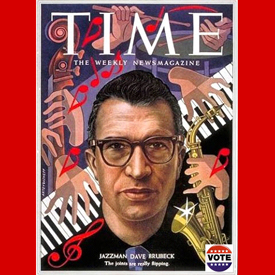
"Jazz," reports Time magazine, "which used to account for a tiny percentage of sales among the major record companies, has become a big moneymaker for the big labels." Of course, that was in 1954, as part of Time's cover story on Dave Brubeck. The situation is now less salubrious. Last July, blogging on NewMusicBox.org, a webzine dedicated to contemporary music, New York-based composer/bandleader Darcy James Argue deemed jazz "a marginal art form" whose CD market share is "hovering around two percent." Live performance prospects appear equally bleak. "Jazz musicians are accustomed to scrabbling," Argue observes, "but dwindling freelance opportunities plus disappearing venues, scuttled ventures, and changing music policies have all contributed to a scene where it's not uncommon to see world-class jazz musicians fiercely competing for the privilege of playing pass-the-hat gigs."
Yet, demoralizing as this is, jazz lovers may console themselves with a startling development freshly dug up by jazz.com's dogged snoop, namely me. Jazz is more popular than democracy!
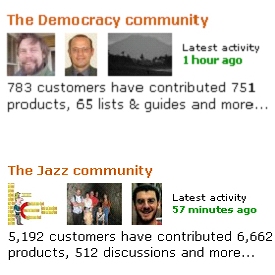
The first hint of this shocking revelation arose from a casual comparison of two of Amazon.com's many virtual communities, where customers conduct spirited exchanges on topics of communal interest. The Democracy community numbers fewer than 800 members and has generated a paltry two colloquies. The Jazz community, by contrast, boasts more than 5,000 participants who've engaged in over 500 discussions. By this gauge, jazz is six times more popular than democracy!
Perhaps it should come as no surprise. After all, there's abundant statistical evidence that most U.S. citizens distrust democratic institutions. According to the American National Election Studies, a research collaboration of Stanford University and the University of Michigan with funding by the National Science Foundation, respondents in public-opinion surveys who expressed high trust in government fell from 75% in the early 1960s to less than 50% ten years later, and (except for a spike following 9/11) have never recovered a majority. At the same time, the proportion of voting-age adults who even bother to register has progressively declined. Electoral turnout rates in the U.S. are routinely put to shame by newly emerging democracies across the globe. The postindustrial societies of the European Union, Canada and Japan likewise surpass, and sometimes double, the anemic U.S. rates. The only established democracy with comparable low turnout is Switzerland.
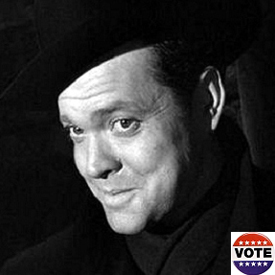
Cynics will no doubt jump-cut to The Third Man (1949), the classic British film noir where Orson Welles as Harry Lime quips: "In Italy for 30 years under the Borgias they had warfare, terror, murder and bloodshed, but they produced Michelangelo, Leonardo da Vinci and the Renaissance. In Switzerland they had brotherly love; they had 500 years of democracy and peace; and what did that produce? The cuckoo clock."
Apart from the fact that cuckoo clocks originated not in Switzerland but in the Black Forest region of Germany, the USAwith its government of, by and for the peopleis actually closer to the untidy Italian fecundity in Lime's narrative than to his purported Swiss sterility. In our tumultuous 232-year history, we've had far more warfare, terror, murder and bloodshed than brotherly love, democracy and peace. And we've produced Thomas Jefferson, Thomas Edison and Thomas "Fats" Waller. All of which suggests either that (a) the U.S. has never been a democracy or (b) the nexus between democracy and creativity is even fuzzier than Harry Lime's knowledge of cuckoo clocks.
Interestingly, the Film Noir community outnumbers the Democracy community at Amazon.com, although neither has generated more than a couple of discussions apiece. "This democracy forum," exhorts one of its few vocal members, "ought to be buzzing with action, ideas and agendas." Instead, the only buzzing heard is the snoring of a forum with no quorum.
Amazon's Jazz community, on the other hand, is livelier than a hornet's nest. Its most popular thread, "What About Jazz Since 67," has generated nearly 1,600 comments. Other topics run the gamut from serious ("Hard drug addiction. Why?") to frivolous ("Spoonerisms"). We prefer the latter, which fittingly has nothing to do with spoonerisms. Rather, contributors unashamedly proffer dreadful wordplay on standard song titles, such as:
"You Stepped Out of a Drain"
"I've Got You Under My Sink"
"You Took a Bandage Off Me"
"Don't Buy a Round Much Anymore"
"I Get Along Without You H.G. Wells"
Which brings us in a roundabout way back to Orson Welles, who unleashed mass hysteria with his 1938 Halloween Eve radio broadcast of H.G. Wells's The War of the Worlds, excitedly dramatized in the guise of breaking news about Martians invading New Jersey in search of toxic chemicals to fuel their spaceships.
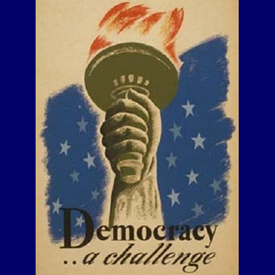
If those pushy tourists from the Red Planet had bothered to look around during their terrestrial foraging, they might've noticed the FDR administration's understated WPA poster reminding citizens during the Great Depression that democracy is a challenge. Quickly consulting their Earthling-to-Martian dictionary, our interplanetary visitors would've learned that "democracy" derives from the Greek ?????????? (dimokratia), meaning popular government, a concept from 5th-century BC denoting political systems in such Greek city-states as Athens. Bent on a hostile takeover, however, the Martians had no more interest in such matters than do present-day Americans, for whom "popular government" is an oxymoron.
But, hey, the Greeks never said it would be easy. And jazz fans should, of all people, recognize that popularity is an unreliable indicator of value. Perhaps some of those 5,000+ members of Amazon's jazz community ought to mosey on over to the Democracy forum and jazz up its moribund discussion. Hell, maybe the rest of us could get involved ourselves by registering and voting and unpopular stuff like that. Who knows where it would lead?
This blog entry posted by Alan Kurtz.
Tags:

Comments are closed.