The Jazz.com Blog
September 28, 2008 · 1 comment
Remembering Richard Sudhalter
The jazz world is mourning the loss of Richard Sudhalter, a pioneering jazz historian and cornetist who passed away last week. Below jazz.coms Jeff Sultanof shares his recollections of Sudhalter and thoughts about his legacy. T.G.
The news of Richard Sudhalter's passing was particularly sad. I considered him a dear friend who enriched my life in many ways beyond our love of jazz. He wrote one of the great texts in jazz history in recent years, only to be dismissed and attacked by some members of the jazz community who should be ashamed of themselves. His long-term illness after a stroke was ironic in that it robbed him of written and verbal communication while his mind continued to function.
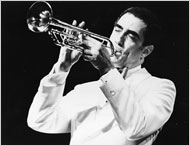
There are many obituaries and tributes to be found since he left us, so it is easy to learn the basic facts about Richard. I will refrain from delving into his history too deeply. This column is devoted to the man I knew.
I first met him through Bill Kirchner, who has been responsible for my meeting and befriending many players, writers and historians in the jazz community. Bill and his wife Judy had a party at their apartment, Richard was there, and I immediately told him of my immense respect for his writing and his playing. The conversation started with jazz and the players he loved, and went on to European history when he was a correspondent for United Press International, with a few twists and turns in between. I gave him a lift to the city in my car just to get to talk with him some more.
He had an apartment in New York City, but it was for convenience. He told me that he wasn't entirely comfortable in the various places he'd lived in the city or the other four boroughs. He invited me to spend a weekend at his home on the north fork of Long Island, which was a long drive east. When I came out to visit, the area seemed like something out of a different eraa small town in the middle of nowhere where his home was a short walk away from the ocean. Richard said that this place reminded him of Cape Cod and other places in New England where he grew up.
That first visit was filled with more discussion and illustrations from his extensive record collection, which now resides at the Institute of Jazz Studies at Rutgers University. He held test pressings of rare recordings from the thirties, many of which were alternate performances that were never issued. My head spunto hear a mint Brunswick recording from 1932 with Don Redman and Bing Crosby is something that I wish all jazz fans can experience firsthand.
We discussed his collaboration with Philip R. Evans which resulted in Bix: Man and Legend, long acknowledged as perhaps the first modern biography of a jazz musician on the same level as a detailed examination of Beethoven or Mozart. It is safe to say that the level of scholarship for biographies of jazz musicians changed overnight after the book was read and absorbed by fans and historians.
Richard told me he made one major error in the writing of the volume: he created a dialogue that might have been said by some of the people represented, based on his interviews with them (one of them was Bix's girlfriend Ruth). This gave the book a novel-like approach at times that he felt detracted from the work. He wanted to correct some of this at a later date. Alas, the book went out of print, and Evans refused to discuss a reprint or an updated version. Richard could never understand Evans's bitterness, and the result was that Bix: Man and Legend became a collector's prizean important, influential book which is now almost impossible to find without paying a lot of money.
When we met, Sudhalter's book Lost Chords was at the printer, and he was excited about it. The ideas behind the book were simple: many of the pioneers of jazz who happened to be white were forgotten or minimized. There was a great deal of sharing and interaction between black and white musicians even in that era of race prejudice; interracial jam sessions did take place, as well as black and white musicians socializing and sharing what they knew. Lester Young had great admiration for Jimmy Dorsey, so did Charlie Parker. Billy Strayhorn and Bill Finegan became great friends and admired each other's work tremendously. White musicians added a great deal to the music of jazz, and Richard felt that some writers had forgotten the large contributions they made.
Lost Chords was the result of ten years of research, and it was huge; over 900 pages. It was almost cut down because Oxford University Press thought the book too big to publish as submitted. It was an 'angel' who gave Sudhalter the money to have his complete vision made available.
From the start, the book generated strong reaction. I believe it to be one of the most important volumes on music I've ever read, regardless of genre, but many did not think so. Some reviewers spent more time on the premise of the book than what was in it, and they determined that Sudhalter was a racist. Richard knew that the book would encounter negative press in some circles, but he was unprepared for the anger and insults he had to endure. Ultimately people read the book, understood it, and purchased the companion two-CD set with many hard-to-find recordings that reinforced the ideas he wrote of so eloquently.
The hardcover edition went through two printings, incredible for a huge volume of music history, and the paperback did as well. The book seems to be out-of-print now, a situation which needs to be corrected. Sudhalter regretted the casual treatment of Benny Goodman in this book, but I and others assured him that Benny was hardly forgotten and didn't need the space that Louis Panico and Jack Purvis did. (And yes, if you don't know these names, their stories may be found in Lost Chords).
When Hal Leonard Corporation let me go some months after 9/11, Richard recommended me to the director/owner of Five Towns College in Dix Hills, New York, and I was hired to teach music business courses, a gesture of help and friendship too rare in this world. I would eventually lead the college's jazz ensemble as well. Richard came to my rehearsals and even brought his horn to help out. I asked him if he would bring in his arrangements from the Paul Whiteman library for the band to play. I wrote up new, edited scores of several and gave him copies; he'd never seen scores of some of them.
Although the band never got to play music of this vintage, the experience of making new scores gave Sudhalter and I plenty of opportunity to discuss and analyze parts of them. The music in the Whiteman library warrants a book-length study of its own. Sudhalter called it "the original lab band of its era. Whiteman would play anything and everything. There is some really adventurous music to be found in his collection." Whiteman is also found in Lost Chords.
Richard thought he'd been lucky because he got to the hospital within fifteen minutes of his stroke. I visited him a few days later, and even though his speech was slurred, his memory was already starting to return. Unfortunately, when he was diagnosed with Multiple System Atrophy, he knew his remaining days would be experiencing the indignity of his body slowly breaking down, and he told me he was sorry he didn't die when the stroke occurred.
Benefit concerts were given to assist him financially, and he was moved by the support, love and respect from many people all over the world. Terry Teachout, in particular, was very close to him in his last years and helped him immensely, and Sudhalter's wonderful companion Dorothy Kellogg was always there for him as well. For most of us, we simply waited for the day when Sudhalter's misery would end, and it finally did on October 19th.
Richard was an excellent cornetist, and his recordings will live to illustrate another important facet of his talent. He made no bones about embracing an older style of jazz in his music, and once told me that Bobby Hackett's playing exemplified what he was trying to do. The solos of both men were elegant yet deeply moving if you took the trouble to listen. I am particularly fond of Richard's collaborations with composer/pianist Roger Kellaway, an old friend from Massachusetts. Both Sudhalter and I agreed that Roger is an incredible, underrated talent, and Richard loved making music with him.
This column only gives highlights of some aspects of our friendship. I was blessed having him in my life, and will never forget his kindness, love of language, and the depth of his insights into music, politics, and life. He leaves two daughters and his beloved companion Dorothy, but he also leaves many people throughout the world who have been touched by his many gifts.
I will miss him.
This blog entry posted by Jeff Sultanof
Tags:

This particular line in Jeff's very touching piece referring to Sudhalter and Bobby Hackett is especially cogent."The solos of both men were elegant yet deeply moving if you took the trouble to listen". People tend to jump to conclusions -as they did about "Lost Chords" without really taking the trouble to listen or carefully read, in this case. Indeed you can't always judge a book by its cover. I'm gladdened to see the outpouring of obits and recollections on Dick Sudhalter or Richard M. Musician, writer, thinker, keeper of the flame or just the guy who loved fried clams and marmite, he had style, elegance, passion and wasn't afraid to express an opinion. He paid dearly for that sometimes,but what got him through --especially in this last year or so was his keen sense of humor. Thank goodness we can laugh at life.