The Jazz.com Blog
September 29, 2008 · 0 comments
The Berklee BeanTown Jazz Festival
The Berklee BeanTown Jazz Festival, now in its eighth year, was almost overcome by bad weather this last weekend. But a few indoor events managed to preserve the jazz spirit despite the downpours. Roanna Forman reports below in the first installment of her two-part article. T.G.
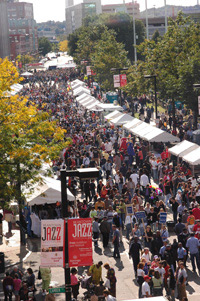
Last week, from Thursday, September 25 through Saturday, September 27, I was set to spend my money on two great concerts, and then get a full free days worth of jazz on the weekend. It was Bostons eighth annual BeanTown Jazz Festival, the closest thing us Northeasterners have to Carnival. Lately its been renamed the Berklee BeanTown Jazz Festival, as one of the powerhouse jazz colleges in the country has lent its resources, name, and marketing power to the event.
I kept a little diary for the blog, so here goes.
Thursday, September 25
The kickoff concert, at Berklees student-run Cafe 939, showcased two fine Berklee students who record on the schools Jazz Revelation Records. They leave you thinking: if this is the beginning of their careers, where will they end?
Pianists Manami Morita and Evgeny Lebedev both brought different, but great, colors to the cafes stage. In this charming, professional-quality performance space that many privately owned jazz clubs would die for, coffee and cookies are served, not martinis. (Bostonians reading this would get a kick out of knowing that the Cafe 939 is about three city blocks from its predecessor, the Jazz Workshop, where the artists these students hear on recordings played to live audiences until the seventies.)
Both pianists were excellent. Manami, with electric bassist Zak Croxall and drummer Thomas Hartman, is a petite twenty-three-year-old Japanese dynamo whose opening standard and remaining originals were sophisticated beyond her years, lilting, with a steady groove. So high energy that she rises from her seat as she builds her fast-paced solos, Manami enjoys the bright upper registers and the percussive capacity of the piano, and her drummer follows nicely along.
She started the set with a chromatic line meandering up and down the keyboard that led to a fast-paced version of Caravan. In an original ballad that began with meditative voicings, Manami showed a softer, pianistic side. The bass player folded pretty, diatonic lines around the melody and at one point seemed to quote Everyone Knows Its Windy. Obviously having a ball, Manami played an original pop song, calling out, It needs lyrics; anyone wants to write lyrics, let me know! She has a beautiful melodic sense, and the song might be about lovers parting and coming together again. The sound never lost the groove as it changed moods. One very gospel-like piece showed how well the band understood this sound. As Manami led with descending tremolos, her bass player took the sound to church with credenzas, and finished off the tune just right.
Unlike Manami, Russian-born Evgeny Lebedev plays in the middle to lower registers of the instrument. Hes a larger, slower-moving person, but hes equally skilled a musician. Tinges of Eastern Europe are obvious in his playing at times, but so is Keith Jarrett. Lebedev is definitely classically trained: you could hear it in his left-hand motifs and in the counterpoint of a fugue-like introduction to If I Should Lose You, which opened the set. Again, in contrast to Manami, who had a loose me-and-my-friends approach to the presentation, Lebedev and his sidemen emerged from the green room more formally.
In Lebedevs Russian Dance, soft lyricism and interwoven lines build almost to a gallop. Moving the solo into a sustained groove, Lebedev and the band stayed there, with drum rolls by Lee Fish, (drummer for Collage, tenor player Mike Tuckers debut album) and very fast bass lines by Hynwoo Man.
While there was some funk, the arrangements were essentially straight ahead. The band supported Oleg Ostopchuks fluid tenor solos well, although the mix did drown him out a little. For his encore, Lebedev chose Peace, which he opened solo piano. The tenor added bluesy overtones to this jazz ballad, then the piano put in heavy left-hand arpeggios as underpinning. It was a fitting message with which to end the evening.
Friday, September 26
The Drum Summit, at the Berklee Performance Center, featured Cindy Blackman and Terri Lyne Carrington in a high powered evening of fusion. I had thought the two artists would play part of the show togetherboth sets of drums were set up onstage. But that was only to save time between sets. Each drummer brought out her own group.
Thanks to the great acoustics and big screen projections of the musicians, you could follow their moves and fingering from any point in the hall, which holds about 500 people. It was just about full.
Blackmans band gives her a lot of room, backing her up with grooves and only stepping out for solos. Her beat chases the players like a freight train. They are all solidly built men, and their physical stature reflects the musical solidity they need, to contain Blackmans relentless ferocity. She looks possessed when she plays, and her licks sound more like gunshots than rolls a lot of the time. Mostly, the band laid down booming repetitive grooves, sometimes of two chords, and the soloist took off over them. Tenor player J.D. Allen had plenty of room to move out over the trance-like repetition under him. When the band switched to a ballad, Blackmans brushes complemented it with a chestnut melancholy and a heart-breaking intensity. Owing either to the soundboard or the pianists expertise, the single bass notes of the piano introduction resonated like an upright. The band moved the song into a big unison funk line.
Special guest guitarist David Gilmore did some fine guitar work. The lines, though fluent, were rock and post-modern that youd expect with this style, but Gilmore did a great job, and the crowd loved him. Backing the band up, he switched to funk rhythms on a solid-body.
For her final solo, Blackman banged her drums with a primitive ferocity that increased as the pace picked up. You almost pitied the drumheads. She explored the melodic framework of each drums capacity with individual and combined rolls, then brought the band in with a hulking rock line. Slowing the line down, she beat it out in unison with the others, and brought the set to a final, orgiastic finish.
This concludes part one of Roanna Formans coverage of the Berklee BeanTown Jazz Festival. Check back soon for part two.
Tags:

Comments are closed.