The Jazz.com Blog
January 13, 2009 · 0 comments
James Carter in Boston
Neither snow nor rain nor a two drink minimum can prevent Roanna Forman from covering the Boston jazz scene for jazz.com. In recent weeks, she has reviewed Dominique Eade, Laszlo Gardony, Roy Hargrove, and the Berklee BeanTown Jazz Festival in this column. Below she reports on James Carter's performance at Scullers on Saturday. T.G.
James Carter is bigbig in stature, and big in talent. The 39-year-old multi-instrumentalist put out a spit-polish early set at Scullers Jazz Club in Boston on January 10. But while this reeds wunderkind played wunderfully, his organist and drummer didnt provide a rising tide to lift him higher.
Carter, who never saw a reed instrument he couldnt play, including the entire saxophone family, and contrabass and bass clarinet, started at age 11. By 16, Carter apparently gave his music buddy at Michigan's Blue Lake Fine Arts Camp, first tenor Kelly Bucheger, a near nervous breakdown when he eased past Bucheger as soloist while playing from the second tenor book. (Check out the details at James Carter Ruined My Life, from Kelly Buchegers Jazz Pages.) Carter would play and listen incessantly, Bucheger recalls, and yes, fall asleep with his sax in his mouth, while trying to work things out.
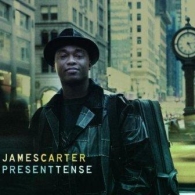
Hes still trying just as hard, and making great music. In his Boston show, switching between soprano, baritone, and tenor saxes and flute effortlessly, Carter promoted his new CD Present Tense along with other material during a mix of ballads, funk, (overly fast) bossa and high-energy grooves. The set, like Carters career, reflected a reverence for the past and a solid foot in the present. For instance: a 1993 alumnus of Julius Hemphills Five Chord Stud, Carter went on to include 1944 Stomp and Ellingtons The Stevedores Serenade on his own CD a year later. In 1995, his Conversin with the Elders proffered a mini-jazz history course with composers from Benny Moten to Anthony Braxton.
Carters long-time admiration for Django Reinhardt, captured in his CD Chasin the Gypsy, continued in his latest release Present Tense with Pour Que Ma Vie Demeure, the shows first number. After a raspy solo opening on soprano, whose force was either stylistic choice or opening jitters, the saxophonist was smooth as silk, squawky as a pissed-off goose, and garrulous as William F. Buckleyall on command. Gerard Gibbss B3 solo on Demeure didnt make musical sense to methat he didnt swing it was understandable, but he chose an almost music-box tone that undermined the songs finesse. Carter put back the smoothness that this beautiful Django ballad needs when his turn came to play.
Gibbs, whose bass pedals were sometimes jarringly louder as he started, definitely got greasy on tunes that called for it, just the way youd expect him to be sliding around on the B3. In Theme in Search of a TV, which dished out funk over a hard-hitting New Orleans fatback, he laid down some good runs and nice polyrhythms, with tasteful shouts and kicks by the trio. Leonard King added plenty of punch, but he is not a subtle drummer; I would have liked more colors and sometimes less cymbals. Then Carter came in with supple, intelligent lines on the baritone, melodic and funky at the same time, and he hit his stride. Beefy and deep but ready to wail, his baritone sax fits him best.
Picking up the flute on Many Blessings and Horace Silvers Silver Serenade, Carters playing was pretty and precisebluesy, sometimes breathy, always clean. He seemed to play the instrument, relatively small-looking in his large hands, in an off-handed way, dashing off lines that hed physically and musically struggle to execute on the larger reeds.
Besides the B3, where he generally played with grace, grit, and fluidity, Gerard Gibbs also used electric keyboards. The crowd, unlike me, enjoyed his use of effectsvibes on Silver Serenade and trumpet on Many Blessings, which, despite their musicality, seemed tacky. Let keyboards be keyboards, I say.
Carter plays with intensity, and naturally the volume level rose with him, although sometimes subtleties were lost and I hope that the musicians could hear each other. Falling into the volume trap is a common problem in music today, even jazz. Thats a pity, because jazz turns on nuance. Carters players generally calmed down behind him, except in high-energy tunes like Gigi Gryces Hymn of the Orient, the last number, where youd expect them to take it out, and up.
But the show, like the bandleader, was a crowd pleaser all the way. Carter is definitely a showman. Pulling the finish on Demeure up to a mighty high note, even for a soprano sax, or producing notes on a baritone that youd swear come from a tenor, the theatrical, physical Carter characteristically demonstrated his prowess with his instrumentshes one of those musicians who sets himself technical challenges, and, once met, proudly displays them in performance. Of course, you have to be careful that pyrotechnics dont undercut musicality; Carter walks that line nicely.
A performer who gives 150% on the bandstand, Carter seemed to be exhorting himself in his final solo to keep pushing in each phrase as he reached for what he wanted. Just like when he was 16, trying to work it out. Might he be better served in that quest with players who stretch him more?
This blog entry posted by Roanna Forman
Tags:

Comments are closed.