The Jazz.com Blog
January 18, 2009 · 1 comment
Remembering Jan Savitt (Part One)
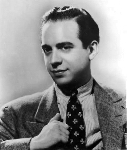
Few jazz critics know big band music better than Jeff Sultanof, a regular contributor to jazz.com. Below he makes a case for Jan Savitt (1907-1948), a Swing Era star rarely heard these days, but whose charts were first rate, and who was a pioneer in fronting an integrated band back in the 1930s. This is the first installment of a two-part article, which Jeff is dedicating to Gene Lees. T.G.
During the 1920s through the 1940s, jazz-based sounds made up much of the popular music of the United States and even many European countries through the medium of big bands. The great majority of these ensembles had soloists who improvised, and many of these men (and a few women) became important voices in the jazz world. Some went on to solo careers later on. Good art tends to retain its power through the years, and that is why the big bands continue to speak to many of us. Of course very few individuals back then thought of the music as art; listeners and dancers just liked it, some loved it. A few had disc or wire recorders and preserved it when the music was broadcast during the afternoon and late at night. Many wrote about it, accurately and inaccurately for magazines. Record labels flourished recording important and minor bands alike.
Although most readers of my commentaries on this website and elsewhere are aware that I write about, edit, conduct and preserve music from all eras, orchestral and chamber concert music as well as big bands and small jazz groups, the big band era has long been a fascinating puzzle for me, one where the pieces continue to come from new and old sources and fit into place in unexpected ways. It is continually proven to me that the big band era was the birth of the American composer on many levels (Ellington, Henderson, Carter, Burns, Rugolo, Sauter, Finegan, Russo and many others must be considered important composers, not just jazz composers), and even though I love quite a number of modern bands led by such diverse figures as Bill Holman and Sam Rivers, it is the ensemble music of the 1920s through to the 1950s that continues to warrant my attention, and the need for the clarity of its musical language and history must be a priority before all of the first-hand information about it disappears forever. Too many of its participants are already gone as it is.
When the U.S. entered World War II, the music industry was about to embark on a very dark period as well. Musicians were drafted, and bands decimated. In August of 1942, James Caesar Petrillo called a ban on commercial recording which very few musicians supported. He wanted more money for his musicians to compensate for the free use of recordings on local disc jockey shows. Even President Roosevelt tried to intervene, to no effect. Thanks to the ban, the documentation of a great deal of outstanding music was lost forever. The most well known ensemble for which there are no recordings was the Earl Hines band of 1943, which was a hotbed of modern experimentation. The musicians who played and sung in the ensemble make the blood race today: Charlie Parker, Dizzy Gillespie, Sarah Vaughan, and Billy Eckstine are the names that come to mind immediately. In addition, the bandleaders knew that without new records of new songs, the popularity of their ensembles would be hit hard, and something new would probably take their places. They were right.
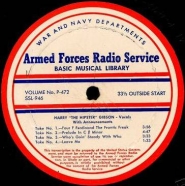
But by 1943, the U.S. Government got involved by recording many hundreds of broadcasts by bands known and unknown. They didn't do this to save the music. They did it so that the music could be re-broadcast overseas to servicemen and women to bring them a piece of home. They also distributed discs of well-known radio shows such as those hosted by Jack Benny, Bing Crosby, and Fred Allen. Bands often broadcast for no money to fill airtime; there were no commercials, and such shows were called 'sustaining.' Bands were happy to do these broadcasts because they were free publicity, especially since these broadcasts publicized a current gig at a hotel or ballroom. The organization known as the Armed Forces Radio Service recorded the broadcasts off the air, cut them down to fit 30-minute intervals, mastered them onto 16" vinyl discs, and pressed them for distribution around the world. Because the musicians were not paid for their efforts, these discs were supposed to be destroyed upon use. Luckily for us, hundreds, perhaps thousands of them survive. They preserve much music that helps to fill in the gaps of what was played for the listening and dancing public, thereby enhancing our understanding and appreciation of the ensembles as well as the popular entertainment of the day.
These discs have been fodder for bootleggers since the sixties. Some of the resulting LPs back in the days before the CD had excellent sound because the AFRS engineers did a good job, and the discs used as sources for the LPs were in great shape. However, in many other instances, the source discs would be in horrid condition, and the collector was faced with a dilemma. Even the labels which usually had good quality product occasionally released a real dud, but the band was well-known, or the band was not-so-well-known and this was one of the few broadcasts of it in existence. You took what you could get. In the mid-eighties, computer noise reduction programs such as No-Noise and CEDAR cleaned up many of the scratches, pops and digs found on the AFRS sources, and the sound would often be remarkable in comparison to the originals. And that is where my story about more new pieces of the big band puzzle commences.
For many of us, The Big Bands by George Simon was the book that opened this magical world for our discovery and enlightenment. From 1939 through 1955, Simon was editor-in-chief of Metronome magazine, but had been on the scene from the mid-thirties onward. He had known and written about every major and many minor bandleaders, and even though he was opinionated, his judgments were usually accurate. One of the bandleaders who warranted a full chapter in the book was Jan Savitt, a prodigy on the violin who seemed to be the last person who would lead a big band.
Savitt studied at the Curtis Institute of Music and was a member of the Philadelphia Orchestra by the age of nineteen. He led a string quartet and became a musical director at WCAU in Philadelphia, a CBS affiliate, leading a dance orchestra there. By 1937, he moved over to KYW, part of NBC. By that time, the orchestra had made its first records and Savitt would soon quit the radio station to make his band a national attraction. To be sure, reviews of the orchestra pointed out that it had a tendency to play too loud, but it was exciting, and its stylistic 'gimmick,' a shuffle rhythm played by the piano with the rest of the rhythm section playing in four, helped to popularize the band. Savitt also had a major attraction in the person of George Tunnell, professionally known as Bon Bon. One of the few black singers to sing with a white band for an extended time, the fact that he was called Bon Bon reflects the racist nature of things during that era. Tunnell suffered many indignities while with Savitt, but he loved the band and the band loved him.
Savitt's Bluebird recordings were good, but his Decca recordings from 1939-41 were even better. A CD of radio transcriptions from 1939 is available on Hindsight Records, and a CD of broadcasts on Jazz Band has also been released. Two comprehensive CD collections on Jasmine and Audiophonic are currently available, so this band is more than adequately covered for those who want to hear it. While not on the same tier as the Goodman, Shaw or Miller bands, Savitt had some big hit records ("720 in the Books" and "It's a Wonderful World" are the best known today) and played important venues. Since he was exempt from the draft due to high blood pressure, he could look forward to more years with the same format. But since he was an excellent violinist, and Harry James and Tommy Dorsey were now featuring large string sections, Savitt made his move. In July of 1942, he changed the sound of the band with the addition of a small string section, and managed to squeeze in a recording date for the band with vocals by none other than Gloria DeHaven. George Simon raved about this new ensemble, and the band continued to play the best theatres, hotels and ballrooms.
This blog entry posted by Jeff Sultanof. This is the first installment of a two-part article. For part two of this article click here.
Tags:

A very evocative piece of writing. Thank you. I'm pleased to see the Swing Era being accorded such emphasis in the development of jazz and American music. When swing was such a social phenomenon - so many musicians playing, so many composers writing, so many people listening and dancing - how can it not be a significant artistic phenomenon? What is popular is often derided for being so - but how magical it is when popularity and quality coincide as they did during the big band era. I wish more modern day practitioners looked back at these times in more detail - there is much to learn from those years still I am sure for the future of jazz and popular music.