The Jazz.com Blog
January 21, 2009 · 0 comments
Remembering Jan Savitt (Part Two)
Below Jeff Sultanof continues his re-examination of the music of bandleader Jan Savitt (1907-1948). Recently released CDs featuring mid-1940s radio broadcasts of Savitts band make clear that this ensemble deserves more respect and a second hearingor perhaps first hearing would be a more appropriate term, given how few jazz fans today know about this unheralded artist. (For part one of this article, click here.) T.G.
For many years, the appraisal by critic and historian George Simon in his book The Big Bands was pretty much the only thing we knew about Jan Savitt's WWII orchestra, thanks to the AFM recording ban. By the seventies, the Savitt name was recognized by jazz historians, some fans, and the musicians who played for him. During that time, a label named Joyce released a few LPs from AFRS broadcast transcriptions of the period. I had one of these LPs, and the sound was so bad, it was hard to get an idea of how the group really sounded (it has subsequently been issued on CD). What made the Savitt group even more tantalizing was the fact that Frank Sinatra toured with the orchestra for live appearances at theatres, not once but twice. Even then, in the early days of his solo career, the Chairman of the Board worked with only the best (Sinatra was a pallbearer at Savitt's funeral).
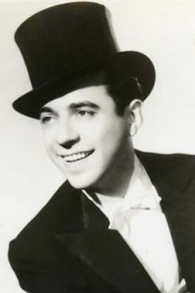
But just recently, I became aware of an organization called Radio Archives, a company that has been creating a database of radio broadcasts and making several of them available. While they are certainly not the only company in business to sell old-time radio programs, they do have a number of items that are not as easily marketable by other companies. In their catalog are a few 10-CD sets of big band broadcasts from AFRS sources and network transcriptions (networks would routinely record programs off the air for various purposes. RCA has a batch of professionally recorded big band broadcasts in their vault made by their parent company, NBC. Many of these have now been released).
One of these collections had two Savitt broadcasts from the Hotel St. Francis in San Francisco recorded on July 23 and 27, 1944. Another collection had a program from the Hollywood Palladium dated October 4, 1945. At $40.00 a setwhich also includes such bands as Les Brown, Harry James, Count Basie, Woody Herman, Charlie Barnet, Bobby Sherwood, Boyd Raeburn, Lee Castle and Louis Primathis was an easy purchase.
Finally, broadcasts of this Savitt ensemble are in active circulation in excellent sound, and the band can be heard in all its glory. I am now convinced that this was one of the strongest bands of that period.
As I imagined, information on the band is hard to come by. The often-unreliable Tom Lord discography has scant data on these broadcasts; one of them may be mis-dated, and the other two are not listed at all. For the Hotel St. Francis broadcasts, the vocalists are Buddy Lyons, Buddy Welcome and Helen Warren, Warren being the best of the bunch. However, a far better singer named Jo Anne Ryan graces the 1945 broadcast. Although there are no strong improvisers, the arrangements are routinely excellent, and the pity is that it is anybody's guess who wrote them. These broadcasts not only show off an excellent band, they give an indication of the repertoire played during a dance gig from that era.
The July 23, 1944 broadcast (Lord has this as June) was previously issued on Joyce in poor sound. The titles played are:
On the Alamo
Apple Blossoms in the Rain - vocal Lyons
Is You Is or Is You Ain't My Baby - vocal Welcome
"Poinciana"
I'll Be Seeing You - vocal Lyons
When Johnny Comes Marching Home Again
I'll Walk Alone - vocal Lyons
9:20 Special
Indiana (Incomplete)
On July 27, 1944, the titles heard over the airwaves and for later rebroadcast by AFRS are:
On the Sunny Side of the Street
The Song is You
Swingin' on a Star - vocal Welcome
Forget-Me-Nots in Your Eyes - vocal Warren
Indiana
Ten Days With Baby - vocal Warren
Baby, Won't You Please Come Home - vocal Welcome
Kansas City Moods
How Blue the Night (Incomplete)
The October 4, 1945 Palladium broadcast is the best of the three musically. The war was over, the musicians were back from the fighting, and Savitt probably had his pick of excellent musicians. This band swings hard, and the song lineup is quite telling. Here it is:
Exactly Like You
Autumn Serenade
Lilybelle - vocal Jo Anne Ryan
Lullaby of Broadway
Someone to Watch Over Me - vocal Ryan
On the Alamo
It's Been a Long, Long Time - vocal Ryan
When Johnny Comes Marching Home
Poinciana (Incomplete - Dubbed from the July 23, 1944 broadcast).
Clearly, by 1945 the Savitt book is built on standards; there are a number of current pop tunes on the 1944 broadcasts, but these are not what the listener remembers after hearing all these performances. There are fabulous arrangements of Indiana (reportedly by Savitt himself), Lullaby of Broadway and On the Alamo. The one current song which is arranged quite well is Poinciana. To be sure, before the war, bands played hits from earlier times (these songs were not called standards then), but the record companies and publishers were so hit-crazy that most broadcasts were made up of current songs and already-established hits identified with the band. It is interesting that in 1944-5, the only piece of music Savitt played that was a pre-war recording of his was "Kansas City Moods," a Benny Carter composition.
While Savitt's was not the only band to play new arrangements of older material (Harry James' broadcasts were filled with new settings of older songs), publishers were clearly not knocking down his door to play their new songs by 1945, probably because he did not have a recording affiliation after the AFM ban ended. Why this excellent band was not recording for a major label is an intriguing question which will probably never be answered at this late date.
Or the opposite may have been the case: like Artie Shaw, Savitt may have been put off by the constant barrage of poor songs offered to him by publishers. Interestingly, Shaw's 1945 band book was also built on standard songs Shaw personally liked, and most of that book was recorded by RCA Victor.
Whatever the reason, by 1946, the strings were out and Savitt led a more conventional band, recording a few sides for the soon-to-be-defunct ARA label, and making a few films which are very difficult to see today. Savitt would have disbanded when many other leaders decided to do so, but he had tax problems and had to keep a band on the road to pay off the IRS. The Savitt story finally ended on October 4, 1948 when he died of a cerebral hemorrhage while on the way to a gig. He was only 41 years old.
It is tempting to think of what Jan Savitt would have accomplished had he lived. With his background, he was a natural for a music supervisory job at a network or a record label. And we are more certain of this based on the excellence of the ensembles he led, both on radio and on the road. There is no question that his WWII ensemble was particularly special, and the evidence is there so that anyone can hear it for themselves.
The gaps sometimes get filled in......the pieces of the puzzle keep turning up and fit together somehow. All we have to do is keep looking and know what to do with them when we find them.
This blog entry posted by Jeff Sultanof
Tags:

Comments are closed.