The Jazz.com Blog
January 26, 2009 · 3 comments
Joshua Redmans Double Trio in Concert
Joshua Redman released his latest CD Compass on January 13, and is featuring the unconventional bandwith no chordal instrument, but with two bassists and two drummersfrom that recording in performance. Ralph Miriello caught the Redman "double trio" in concert at the Highline Ballroom in Manhattan, and reports below. Check back soon for Ted Panken's interview with Mr. Redman in these virtual pages. T.G.
Its a cold Wednesday night and my youngest son wanted to go and see some jazz with me before he returned to college this weekend. With a careful perusal of the available offerings we settled on Joshua Redmans performance at the Highline Ballroom at West 16th Street in lower Manhattan.
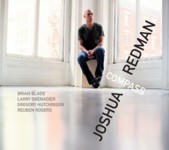
Redman would be performing with his double trio group that he used to make his latest release Compass, recorded last year and released a few days ago. This would be only his second live performance with this assembly of musicians (the first was the previous night at Highline), and I was particularly interested in seeing what he was trying to accomplish with such an unorthodox musical line-up. In a recent interview Redman was quoted as saying initially I threw it out, thinking this is just a crazy, bad idea. But it kept popping back into my head, and at a certain point, I said even though reason tells me to stay away from this, it was an instinctual thing, and it was worth giving it a try.
The Highline Ballroom was a fortuitous choice of venue, despite the three hundred seats that were billed as being available on a first come first serve basis, the place was packed and it was standing room only when we arrived at seven thirty for an 8:30 PM show. The Highline is a relatively large venue for a jazz concert with a generous elevated performance stage that easily measures forty feet across and fifteen to twenty feet in depth, judging from my perch. Just prior to the start of the show my son and I were able to team up with some other standing pairs and procure a table of six that had been reserved but luckily opened up.
Redmans group consisted of Larry Grenadier and Reuben Rogers on upright bass, Gregory Hutchinson and Brian Blade on drums, and Redman on tenor and soprano saxophones. The opening number was a Redman composition titled Identity Thief from Compass, and the song featured Redman on tenor in a spirited and exuberant mood. His double trio played alternately; each bassist and drummer taking turns laying down the rhythm behind Redmans explorations. Redman was almost giddy in his excitement as he played, occasionally raising his leg and twisting his body in a lithe, dance-like exhibition of enthusiasm. After the opening song it became apparent that his excitement was a combination of his being able to perform his music live with this group of fine musicians and the residual effects of the uplifting Obama inauguration from the day before. When the power-driven dual trio is allowed to let loose it presents an awesome display of rhythmically-charged poly-tonality. .
The second offering was a tune he wrote for drummer Gregory Hutchinson titled Hutchhikers Guide and here the group switches to the single trio format with Hutchinson on drums and Grenadier on bass. Redman, for his part, played his tenor mostly in the middle register and his skill resided in his loose and fluid melodic explorations. He is neither gruff nor screechy in his tone despite his ability to evoke honks and squeals as the mood suits him. It is no small feat to perform without a chordal instrument cementing the melody line and supporting the lead instruments exploration of harmonic possibilities. The task of keeping the melody alive lies squarely on Redmans shouldersor at times on one of the bassistsand they did a masterful job of keeping the music on course while still treading into outlying areas that extend to the limits of the songs melodic center.
On Insomnomaniac, a herky-jerky, stop-start adventure that brilliantly captures a dream-like excursion into musical restlessness, the trio exchanged bassists, with Reuben Rodgers now providing the alternating fast/slow oscillating bass lines and the hard driving Hutchinson demonstrating his Gatling gun-like snare and tom shots to great effect.
The difference between drummers couldnt be more apparent than when Redman deftly changed to the floating Brian Blade for his eastern sounding Ghost. Redman switched to soprano here and Blade beame the texturalist that is his strong suit. It is a pleasure to watch Brian play as he dances over his drum set with a child-like joy instantaneously discovering what new percussive accent he can lend to Redmans tune. Joshuas emotional core came through clearer on his soprano work and he was wonderfully expressive when he played soprano on this and later on Little Ditty. Hutchinsons strengths lie in his thumping, hard driving ability to lay down a definitive rhythm and break it at will in a commanding, jagged way. When the two drummers were driving together in Little Ditty it was his lead that drove the song.
The only two tunes that were not Redman originals were a wonderful rendition of Gil Evanss Time of the Barracudas, where the band was in full swing, and the encore which was the Redman rendition of Beethovens Moonlight Serenade. The latter was done in a slow, deliberate, almost somber chamber music-like way.
Besides the obvious comparisons that can be drawn when watching two musicians playing the same instrument on the same bandstand, perhaps the most interesting part of this evening was watching the two bassist and the two drummers feed off of each other so viscerally when they played together. This was not a competition or a demonstration of showmanship, but more a celebration united under the banner of Redmans music. The musicians were clearly inspired by their counterpart and it was obvious to the appreciative audience that they were witnessing a sumptuous musical banquet.
Redman not only provided laudable leadership by daring to try such a musical adventure, but also provided a majority of the material that was used to bring this all together. He must be applauded for his fearlessness; although there were times when I found myself more engaged by the comparisons of the players and the nuances of their individuality than I was with Redmans performance. Yet he must also be praised for his compositional acumen and his ability to orchestrate these disparate musical voices into a one unified musical statement. A rousing success by any measure.
This blog entry posted by Ralph A. Miriello.
Tags:

Raplh Miriello's pieces always manage to translate without alot of fat artists' sounds into vernacular for us debutant jazz listeners. Thank you
great post! jr
Thanks man :)