The Jazz.com Blog
October 01, 2009 · 1 comment
Danilo Perez in Boston
Roanna Forman, a regular contributor to this column, recently reported on guitarist Julian Lage and delivered no fewer than 14 separate reviews on the Tanglewood Jazz Festival. But she apparently is ready to come back for more music. Now she turns her attention to pianist Danilo Perez. T.G.
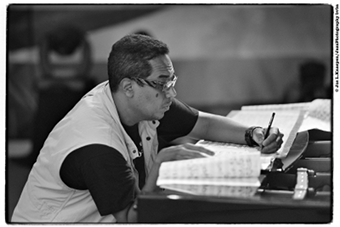
Globalization may have been dangerous for the world economy, but its done great things for jazz. Ask Danilo Perez. The Artistic Director of Berklee College of Musics Global Jazz Institute added alto saxophonist Rudresh Mahanthappa of India and eclectic percussionist Jamey Haddad to the non-stop Afro-Latin motor I heard at Scullers last week.
Favoring a recuperating ruptured Achilles tendon, the pianist, his trio, and guest musicians were all about the groove. Whether it was fat, funky, polymetric, repetitive, developed, or taken up by different instruments, it was a steady motor for soloists and the ensemble. All solos, even the altos, were defined by and bound to that pulse. And it was all directed by the solid feel of Perezs left hand.
Participatory, democratic and optimistic about the audiences pitch, Perez started by asking everyone to hum a note. The sax player picked up on mine, riffed on it to begin in Indian scales, then expanded that to rapid lines and sheets. Mahanthappas sound complemented the trios earthy, solid sound well, as Haddad played accents on tambourine, triangle, and other more exotic toys.
Jamey Haddad, who has collaborated with artists as diverse as Esperanza Spaulding, Joe Lovano, and Paul Simon, is a peripatetic museum of percussion effects, some specially adapted, like a spring drum tempered with maracas. Haddad also uses Moroccan grass brooms on his hand drums, a djembe and a kanjiraan Indian drum from the tambourine family. His last solo of the evening showed off an ocean drum, whose translucent head revealed pictures of fish. Haddad plays it with a small rake to magnify the ocean-like sounds of the small metal balls inside.
Danilos injury in no way impaired his hands. A chunky, dark left hand underpinned his right-hand runs on Suite for the Americas. In trades his lines were in perfect sync with other instruments. Clean cadences and full harmonies set up a solo piano piece, which Perez dug into with cluster chords played with the forearm up to the elbow. Monk-influenced phrasing, modified Eddie Palmieri riffs, and post-modern lines kept the momentum strong throughout the set, and Perez worked out harmonic and rhythmic problems with inventive counterpoint and walking intervals, lifting by runs to accented notes. Drummer Adam Cruz had the virtue of not overplaying, although with a dynamo like Perez that might be hard to do, and bassist Ben Street gave a good, fat bottom to the overall sound, with solos that stayed in the lower parts of the register.
As the set ended, I reflected on the two acts that had appeared on the same stage on consecutive nights. The firstJulian Lage, light, lithe, using string instruments for melody, harmony, and color, driven by the insistent knock and splash of the cajon. The otherDanilo Perez, a generation older, an established star, grounded and pulsating to complex Afro-Latin rhythms and advanced harmonies. Aesthetically you might prefer one over the other, but jazz embraces and synthesizes the two, and thats its greatest strength.
This blog entry posted by Roanna Forman
Tags:

Pianist and composer Danilo Perez has forged a wide path for himself and his music in a relatively young career. When one takes a look at his recorded output, it's easy to see, the best is yet to come from this young musician. http://ezinearticles.com/?Acai-Force-Max-Review---Does-Acai-Force-Max-Really-Work?&id=2926642