The Jazz.com Blog
October 27, 2009 · 2 comments
The Brooklyn Big Band Bonanza, or, Revenge of the Six-Way Mustache
Tim Wilkins, a regular contributor here, recently attended the Brooklyn Big Band Bonanza, a blowout event with so many large jazz ensembles on hand that the musicians almost outnumbered the audience. His report is below. T.G.
Are big bands cool? Darcy James Argue doesn't think so. "It's a dorky way to make music, and always will be," he told me.
This may surprise some who know Argue as the bandleader whose 18-piece group, Secret Society, has been called "a wholly original take on big band's past, present and future," and who has been compared to Ellington by Newsweek.
Argue thought for a second, then qualified his answer: "Maybe there are enough dorks out there to make some interesting things happen."
Enough dorks turned out a hundred and fifty in the audience, plus sixty or so on stage - to make interesting things happen at the "Brooklyn Big Band Bonanza" at The Bell House, a converted warehouse in the once-desolate Gowanus industrial zone last Monday. Argue put together a bill with two local bands, his own and Travis Sullivan's Bjrkestra, and Andrew Durkin's Industrial Jazz Group (IJG), visiting from the West Coast. Plans to include another local band, led by saxophonist Andrew D'Angelo, fell through.
It is to Argue's credit that he has used his notoriety, which has grown since his CD release Infernal Machines and the Newsweek article this spring, to draw attention to other bands and leaders who like him try to reimagine large-format jazz.
"It's taking something old and kind of fashioning it into something cutting-edge," he told me the day after the show. "Having this very kind of old-fashioned way of making music, the jazz big band, and taking the core of that and reconfiguring it for the 21st century."
The evening had many surprises, foremost of which was the level of enthusiasm and imagination in a genre which has always been precarious for financial reasons, even in the best of times.
"Big bands are part of the romantic ideal," said Adam Schatz from Search and Restore, a nonprofit which helped put on the show. "It's the artist saying, 'We're going to transcend logic; we're going to put aside common sense for a minute and just do this thing.'"
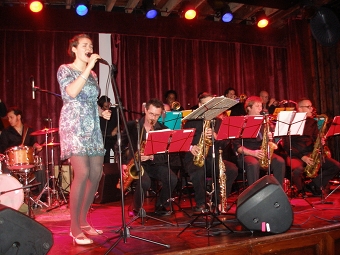
First up was the Bjrkestra. Sullivan, an alto saxophonist, formed the group in 2004 to recast songs written by Icelandic singer Bjrk as jazz. The idea is more than a gimmick: Bjrk's harmonies are minimal yet unclichd, much in the way Hoagy Carmichael's or Joni Mitchell's are. Her lyrics are also full of potent self-disclosure, which speak more directly to contemporary listeners than some saccharine "neo-standards," which ape the conventions of jazz singing from the past.
Of course, none of this would matter without the Bjrkestra's superb arrangements and execution. Against a backdrop of dance and electronica-inspired beats, the band's soloists, especially Sullivan and baritone saxophonist Carl Maraghi, confirmed how well Bjrk's harmonies invite jazz, and in particular intervallic, improvisation. The band's singer, Becca Stevens, was simply astonishing as she twinned her own unerring musical sense with the emotional honesty of Bjrk's lyrics. Midway through the set, she switched to a more forgiving vocal mic, but she hardly needed to her intonation was as precise as a jeweler's blade. Most of the numbers she and the band performed, like "Hyperballad" and "Alarm Call," can be heard on their 2008 Koch CD Enjoy!, but this a group best heard live.
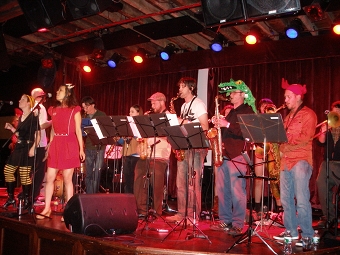
Next up was the Industrial Jazz Group. There's nothing even remotely "industrial" about the IJG, which combines Zappa-esque whimsy with Situationist satire, complete with funny hats and partial (male) nudity. The band's 16 pieces ripped through unpredictable-sounding charts full of abruptly shifting moods and tempos.
"It's more like structural improvisation," Durkin told me. "There's enough of a tune so that everyone knows where we're going, then I try to subtract some things so there are spaces, so they can own it and it sounds like it's being created on the spot. It's harder to play than it sounds."
To understand the IJG, imagine what Charles Mingus would have sounded like if he ran a house band for the sketch comedy show Laugh-In. The band's shirtless bass player, wearing a Roman centurion's helmet, wiggled incessantly while two singers offered running commentary in faux-operatic tones, encouraging audience members to wear the fake "six-way mustaches" they tossed into the crowd, and to have "Dinner at Applebee's, then f**k all night!"
"I like that kind of Rabelaisian kind of side to it," Durkin said. "Part of it is an attempt to let our hair down a little bit; to not be quite so serious about playing music. We're not purists."
Durkin's nod to Franois Rabelais, the sixteenth-century French creator of the carnivalesque novel, was no surprise: he holds a PhD in literature from USC, where he started the band as a quintet nine years ago. In fact, many these "dorks" seem quite literate: Durkin and Argue are prolific bloggers, and Argue frequently compares his music to "steampunk," an artistic movement which, as he explained it, "takes tropes from Victorian literature" to imagine a world where outmoded technologies like the steam engine, or the 18-piece big band are still vital. But on Monday night, thanks to the virtuosity and conviction of the players, these big bands radiated their own vitality; no tropes were needed.
Argue's compositions are full of gothic harmonic twists and a driving, rock-inspired pulse. This heady mix can sound muddled in a less-optimal performance space, as it did when I heard them on a hotel stage at the last IAJE in Toronto, but the high wooden ceiling and broad stage of the Bell House, which normally books rock bands, was ideally suited to these large groups - moreso than any comparable venue in New York. For the music's sake, I hope they will book more jazz events in the future.
Secret Society is an A-list of New York's younger instrumentalists, which includes trumpeters Seneca Black and Ingrid Jensen, and saxophonist Erika vonKleist. The group was augmented for the set by others including tenor saxophonist John Ellis, who offered one of the evening's most memorable solos.
The band played several charts from Argue's CD release, including "Phobos," "Zeno," and "Transit," his homage to Chinatown's cheap bus service between New York and Boston, well known to Berklee students and alums.
Then came the anarchists. As Secret Society streched out the last chord to "The Perils of Empire" and the crowd began to applaud, a cacophony of honks rippled up from below the stage. Five or six bearded men in army fatigues stormed in, looking as if they were back from an anti-WTO protest, molotov cocktails in hand. Instead, they pulled out baritone saxophones and indulged in Braxton-esque multiphonics, sowing sonic havoc as they wove through the crowd. One of them tossed a camouflage hat up onto the stage, where the Secret Society's bari man, Josh Sinton, grabbed it and and joined in. The renegade horns then wended out into the street, where the joyful cacophony continued.
These were members of the Baritone Army, an ad-hoc group led by Stefan Zeniuk, who recruits bari players to form musical flash mobs, startling patrons at McDonald's, in subway stations and at other public venues around the city.
"Dude, it was awesome, I loved it!" said Argue, who knows Zeniuk but had no idea he planned to crash the party. " It was one of those those kind of crazy, memorable moments that can only happen at live shows."
Zeniuk's flash intervention ended the evening on a high note of hilarity, a fitting cap to a concert which demonstrated that even oft-wooly big bands can defy expectations. Indeed, the main thing these bands had in common, aside from their unfailingly high levels of musical craft, was their sense of fun.
"We're just trying to have a good time, and we're hoping people are gonna enjoy the show and have a good time," said Durkin. "And we think there's a way to get people to love jazz that maybe don't typically listen to it."
Schatz agreed that fun is a key to developing a new and younger audience for jazz, and big bands in particular. Another is to make the music affordable, which he tries to do by keeping tickets under $20 and opening shows like the Big Band Bonanza to all ages.
"Everyone who's on stage is visibly enjoying themselves; that's why they do it," he said. "It's a great example of the music winning out against everything else."
For me, the Brooklyn Big Band Bonanza answered another important question: where, since the demise of the IAJE, can you go to hear insanely great lab bands, with no respect for authority, but great jazz chops and ideas to burn? Just head down to an abandoned warehouse in a city near you, and look for the guys and gals wearing six-way mustaches: they'll tell you.
(Editor's note: a previous version of this article mistakenly identified the Bjrkestra's baritone saxophone player on Monday night as Lauren Sevian, who played on the band's 2006 CD release.)
This blog entry posted by Tim Wilkins
Tags:

Correction! The bari sax player in the Bjorkestra for this show was Carl Maraghi, not Lauren Sevian. She's on the CD though! Thanks for a great article and account of the evening though Tim. We had a lot of fun!
A bari sax army! we need that kind of thing in Pittsburgh, I wonder if they every get arrested