The Jazz.com Blog
October 05, 2009 · 6 comments
The Once and Future Strings
When electric guitar first showed up in the jazz world, most fans treated it as a novelty effect. But after the impact of Chicago blues, rock-and-roll and other related styles, the plugged-in guitar has become the defining sound of contemporary music. Along the way, it has emerged as the path by which many new fans gain familiarity with jazz. Bill Barnes looks at this situation below in the first installment of a three-part article on the state of the guitar in jazz and its potential for the future. T.G.
The ubiquitous guitar has long been an instrument of the masses, comfortable, expressive and familiar to listeners of all tastes and backgrounds. As such, it is the ideal gateway instrument to jazz. With its unique genre-spanning properties, no other polyphonic instrument is as accessible, versatile or malleable.
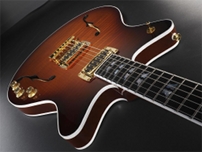
Entry-level guitars are available in any price range, and, like the piano, comparatively easy for young fingers to play. Unlike the piano, guitars travel light and take up hardly any room. It has been the de rigueur accessory to the activist folkie, necessary equipment for the leather-clad rocker and a principal voice for the perfervid bluesman. While the reasons for taking up the guitar are as varied as the styles played on the instrument, there has been a tendency for many guitarists who begin to outgrow the technical limitations of a particular genre to gravitate to the art of jazz. I was one of those who made the leap.
The Christmas of 1958 was perhaps the most special Santa drop of my childhood. That morning, under the aromatic balsam with its glowing, oversized lights, shimmering tinsel and German glass ornaments sat my very first guitar, a Silvertone flattop acoustic. It was a gift from my older brother Ken, who had promised to buy me a guitar of my own if I ever learned how to playbut until then I was to keep my grubby eight year-old hands off his gorgeous Espana classical. Taking the bait, I snuck into his room at every opportunity, constructing simple chords by ear until I was able to master the historic Ballad of Davy Crockett, much to my brothers chagrin.
Lionizing the king of the wild frontier in first position triads is hardly an auspicious beginning to a jazz guitarists career, but in rural 1950s North Carolina, there was little available inspiration beyond Elvis and Chuck Berry, who I assumed were the defining boundaries of the instrument. My musical development was haphazard, migrating from folk music to rock & roll, then to R & B. I was well into my teens before I discovered the unlimited possibilities of jazz, and then only after I had begun playing with older, more sophisticated musicians, mostly university students from other parts of the country. It was a gradual, meandering progression, crossing the chasm between Louie, Louie and Louis Armstrong. I mention this only because my story is far from uniqueits the way many aspiring guitar players stumbled into the art of jazz. But not any more- the digital age has now leveled the playing field.
Until recently there were few educational resources beyond Berklee for jazz guitar other than private studies, the dry, tediously rote Mel Bay method books and, of course, the painstaking analysis of solos from vinyl LP records, which could be slowed to half-speed. A fledgling jazz guitarist could spend hours deciphering lines, practicing modes and scales, picking the brains of other guitar players. Fortunately this situation has improved by leaps and bounds. The advent of affordable digital recording technology and the Internet have opened a floodgate of recording options, instruction videos, student-teacher interaction and connectivity, transforming the way we learn the craft, write the music and the way we do business.
Digital music file-sharing allows musicians in different hemispheres to work on recording projects together in the comfort of their homes. More albums are being released in digital format only, as more music buffs migrate to their iPods. Record stores, nightclubs, recording studios and concert halls are becoming subjugated by traffic on the information superhighway. This new techno-musical universe presents both opportunities and challenges, but as new batches of musical larvae emerge from their cocoons, it is the stage upon which the next act will be played.
Jazz education and jazz guitar in particular are entering a new, exciting eraYouTube, MP3 portability and a plethora of Internet networks supporting jazz guitar are increasing the exchange of ideas and accelerating the learning curve. Interactive online instruction websites have increased the free exchange of knowledge making top level instruction a mere mouse click away. A guitar student in Bucharest, Mexico City or Osaka can interact with and study under the same cutting-edge instructors as the kid in Brooklynassuming he has a decent computer, a digital video recorder and high-speed Internet access.
There are a number of jazz guitar instructional sites on the Internet, but I would like to mention three interactive courses I feel offer the most bang for the buck. For a mainstream, thoroughly technical approach, the Mark Elf Guitar Conservatory and the Jimmy Bruno Guitar Institute offer richly detailed, methodical lessons on theory and guitar technique, along with valuable tips extracted from their considerable experience.
Both of these teachers are highly acclaimed virtuosi with impressive professional pedigrees. Elf has been a university instructor, frequent clinician for Clark Terrys jazz camps and has recorded or performed with a Whos Who of jazz legends, from Dizzy Gillespie to Jack McDuff. Brunos credentials include a world tour with the Buddy Rich Orchestra and long stints with Frank Sinatra, Doc Severinsen, Anthony Newley and Lena Horne, as well as an impressive discography. Both guitarists sites offer incentives for improvement and individual master class video feedback, along with extensive accompanying sheet music with tablature.
But the website that I find the most intriguing is from Swedens fiery young guitar phenom, Andreas berg. Andreas Guitar Universe is a user-friendly interactive site offering a fast-track, streamlined method incorporating bergs aggressive technique with a common sense, ear-oriented approach to playing. I want you to learn to play whats in your head, not just whats in your fingers, he says in one of his lessonsand quite convincingly shows us how its done, no tricks, no secrets.
I love his logical, no-nonsense approachutilizing the fretboard much the same way the Gypsy players do, relating modal phrasing to the underlying chord structure without being overly concerned over positions. I try to get the students to hear everything they play and learn how to visualize the whole fretboard instead of just learning different positions. This site is also unique for its comprehensive instruction on Gypsy jazz, blues, funk, rock and special techniques like harp harmonics, bass line-chord comping and sweeps. Barely in his thirties, berg hasnt accumulated the same decades of road work as Bruno or Elf, but in terms of knowledge, technique and versatility, he is very much an old soul and his playing speaks volumessolid technicality seasoned with street-smart, monster chops.
As jazz completes its first decade of the millennium in a boiling cauldron of new technology, migrating tastes and shifting markets, the old, woody sound of the archtop is enjoying a resurgence of popularity among young players. The buoyant, crunchy swing of Django Reinhardt has a growing mob of jazz Manouche enthusiasts, the lines between jazz, blues and R&B continue to meld and new generations of guitarists are helping to keep the fires of bebop, fusion and mainstream burning.
But live venues are closing, working musicians are competing with synthesized gadgetry and recorded music revenues are shrinking. The transition to a digital universe has increased musicians capacity to study, write, record and communicate, but has also created a bit of collateral damage. To be fully realized, jazz needs to be played and heard live and, unfortunately, at least here in the United States, the size of the audience is shrinking.
This is the first installment of Bill Barnes three-part look at the evolution of the guitar. Click here for part two.
Tags:

ONE THING I ALWAYS NOTICE, IS THAT EMPATHY, OR INTERPLAY, OR REALY LISTENING IS NEVER DISCUSSED,
Mr. Barnes, While I can see how some people experience some of the Mel Bay methods as "dry" and "tediously rote," those fundamentals are very important in establishing good technique and a necessary knowledge base for a beginning player. However, if that is not your cup of tea and you are beyond the basics, please realize that Mel Bay offers many different jazz guitar books and DVDs by many different authors which are anything but tedious and dry. Here is a sampling of some in just the last five years, everyone from Frank Vignola to Bucky Pizzarelli to Ben Monder to Kurt Rosenwinkel to Vic Juris: http://bit.ly/13ZRFl Online learning sites can be good and highly accessible most anywhere in the world, but it can take years to master many of the lessons taught. With Mel Bay books and DVDs, you get to keep it forever and only pay for it once. Just something to consider. Thank you for your well written article highlighting jazz guitar. Your story of Christmas morning brings back memories of getting my own first guitar. :-) -Steve Simmons Mel Bay Publications, Inc.
In response to the comment by Steve Simmons, I had not intended to disparage Mel Bay publications, which have been valuable resources over the decades. I particularly recommend Stephane Wrembel's "Getting Into Gypsy Jazz," along with the above mentioned books. My point was that back in the 1950s, as an child without a guitar teacher, I found the Mel Bay method books a bit overwhelming. However, they have evolved with the times as well, and continue to be a valuable resource for many students of jazz guitar.
There may be quite a few ways for you to learn the guitar, but you should consider all the options available before choosing the best way to learn this amazing stringed instrument. One option is to buy some learn guitar software or DVDs, since it will give you independence and allow you to learn by your own accord and in the privacy of your home. There are a few great software titles that are commercially available and they will give you detailed instructions on how to learn the guitar. These software or DVD titles will take you through everything you need to know, like holding the guitar, reading chords and notes, and so on.
I personally revised the new Modern Guitar Method. It is called the Modern Guitar Method Expanded Version. I wonder if you have even seen it? If not, please play through grades 5 through 7. You will find some fairly remarkable studies dealing with quartal harmony, position playing, chord melody soloing, jazz voicings and harmonized scales. I feel there is no method out there that compares with this new Mel Bay Modern Guitar Method/Expanded Version.
I resisted making a comment when a recent feature, "History of New Orleans Music in 100 Tracks", had truly glaring omissions and equally inexplicable inclusions. Now, however, I have to ask why there has not been a single mention of Lonnie Johnson in the first two installments of this focus in jazz guitar. I think Charlie Christian would have been as perplexed as I am.