The Jazz.com Blog
October 08, 2009 · 11 comments
Hentoff on Jazz: The Jewish Soul of Willie "The Lion" Smith
Nat Hentoff, a regular contributor to this column, not only writes about the legendary figures of jazz, he also knew most of them on a first name basis. Here he turns his attention to a pianist born as William Henry Joseph Bonaparte Bertholoff Smith. But for those who worked the 88 keys for a living, he was simply "The Lion." T.G.
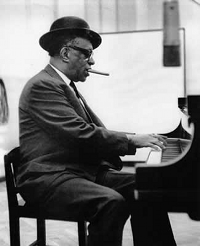
In the morning, the first thing I see in my office is Willie "The Lion" Smith at the piano, wearing his derby, with a cigar jutting challengingly from his mouth. Soon after I became part of the New York jazz scene in the early 1950s, one of my great pleasures was to pick up the phone at home and find "The Lion" calling just to chat. That other grandmaster of stride piano, James P. Johnson, once said, "When Willie Smith moved into a place, his every move was a picture." So were his stories on piano, his compositions, and on the phone.
In March of 1958 the head of Contemporary Records, Les Koenig, asked if there was anyone I wanted to record for his label. I quickly made my way to Nola Studios on West 57th Street, where Mat Domber of Arbors Records now does a lot of his recordings, with Willie and the equally formidable and, like Willie, endlessly melodic pianist Luckey Roberts. The resulting album, "Luckey and the Lion: Harlem Piano," has been reissued on CD by the Concord Music Group.
"He was a myth you saw come alive," Duke Ellington said of Willie, whom he considered his main mentor. But I thought I knew a lot about the man until Michael "Spike" Wilner a jazz pianist, scholar of stride piano, and the owner and manager of the now-legendary Smalls Jazz Club on West 10th Street in Manhattan, sent me his book of revelations: "Willie 'The Lion' Smith / 8 Piano Compositions / Transcriptions and Essay by Michael 'Spike' Wilner."
Most startling to me was something about which I had a clue in the 1950s, but stupidly never followed up on. Willie and I had the same internist, and among the displays on this doctor's wall was Willie's business card, written in English and Hebrew. I figured this was Wilie's antic wit at play perhaps a nod to the Jewish managers, bookers and record executives in the jazz business. Was I wrong!
Willie's mother, Spike Wilner writes, was a laundress, and her son delivered the clean clothes to her customers, including "a prosperous Jewish family that treated Smith as one fo their own," much like the Jewish family in New Orleans that bought a young Louis Armstrong his first horn. Every Saturday, when a rabbi came to the family's home to teach Hebrew classes, Willie was welcomed to join in.
What fascinated Young Willie, Wilner writes, was "the chanting of the rabbi." Reading this, I was a boy again in an Orthodox synagogue in the Roxbury neighborhood of Boston, in mandatory attendance during the High Holidays. My guess is that the chanting rabbi Willie heard was also a cantor, or chazzan, who sang, often with improvisations, the Jewish prayers.
As I wrote in my memoir "Boston Boy," published by Knopf and Paul Dry Books, the chazzan's voice penetrated so deeply into my very being that I almost shouted aloud, as I did on a Boston street when I first heard jazz. I didn't shout in the shul so not to embarrass my father. But it was this same chrechts - the soul cry of human promise, transcendence and vulnerability - which I later found in the blues, Billie Holiday, Charles, Mingus and John Coltrane, just to name a few of the jazz chazzans I have known.
The rabbi who reached Willie as I had been reached, Spike Wilner continues, "took special pains to teach him alone." At 13 and I had to stop reading to fully grasp this Willie Smith "had his bar mitzvah in a Newark synagogue."
Wilner quotes the Lion himself: "A lot of people are unable to understand my wanting to be Jewish. One said to me, ' Lion, you stepped up to the plate with one strike against you and now you take a second one right down the middle! They can't seem to realize I have a Jewish soul and belong to that faith." (Editor's note: In his 1965 autobiography, Music On My Mind, Smith also states that his birth father, Frank Bertholoff, was Jewish.)
This Lion of Judah actually later became a cantor, or chazzan, himself at a Harlem synagogue of Black Jews!
What I would have given to have heard him there! Although I've been a Jewish atheist since I was twelve, I would have become a member of that congregation. Had there been any objections, I'm certain Rabbi Smith, with the vibrant life force of his stride piano, would have told the objectors to learn the interconnectedness of us all from music.
He knew as he once said "Music doesn't stem from any single race, creed, or locality, it comes from a mixture of all these things. As does The Lion."
Spike Wilner includes, in his book, Duke Ellington's recollection of the first time he heard The Lion play piano: "Actually everything and everybody seemed to be doing whatever they were doing in the tempo The Lion's group was laying down. The walls and furniture seemed to lean understandingly one of the strangest and greatest sensations I ever had. The waiters served in that tempo; everybody who had to walk in, out or around the place walked with a beat."
In my youth, a Yiddish soul brother was called a "landsman." I always thought of Willie as a soul brother. If I'd listened intentently enough, I would have caught in his often jubilant stride rhythms an ageless touch of Jewish klezmer swinging.
Why was he called The Lion? During World War One, Willie served in an all-black batallion, the 350th Field Artillery. One time, while fighting in the trenches for 49 days without a break, he volunteered to man the "Glorious 75" the big, ungainly and deadly French 75-millimeter cannon, which was decisive in the Allied victories at the Marne and Verdun. Having been cited for bravery, Willie was called "The Lion" by his colonel.
Back in the States, The Lion wore a derby "because the rabbis did." Underneath, on the Holy Days, was his yarmulke. In my anti-Semitic Boston boyhood, wearing a yarmulke could have gotten you bashed in the teeth as "a Christ-killer." But Lord help anyone who would have tried to mess with The Lion.
This blog entry posted by Nat Hentoff
Tags:
I'm thrilled that Nat Hentoff is here at Jazz.com. His scope is vast and deep and THE NAT HENTOFF READER, a collection of his essays, occupies an honored place in my personal music library. Over the years I had bought additional copies for gifts to friends and family members. Nat is one of the all-time great writers of jazz. This article struck me for a fairly odd, personal reason. As a child, one of my favorite recordings was a 10 inch LP record my father owned, by a pianist called Willie "the Rock" Knox. It was a couple of decades before I discovered that "The Rock" wasn't a black ragtime player- he was actually Dick Hyman, a Jewish multi-style pianist and composer. In the light of Mr. Hentoff's piece on The Lion, I find the irony of that discovery all that more palpable.
Nat Hentoff, wonderful journalist and jazz authority is to be commended for making that wonderful LP with Willie and Luckey Roberts. It has some of their best performances of the 1950s. I also thank Nat for having me on his WBAI-FM jazz show during that period. Mike Lipskin student of The Lion
I had heard tha louis armstrong had worked for something like 5 cents and hour and got a pay advance to buy his first horn for a whopping 5 dollars, could you please shed light on my potential misunderstanding?
Mr. Hentoff is a national treasure--and here's one more reason why. I knew Ruby Braff fairly well and he once said: "I've played a few false notes in my time--but Nat has never written one false word. I love that man." And for those who knew Ruby, you know that his praise was as rare as sanity on Fox News.
I had the now cherished experience of having a private piano lesson from Willie "the Lion" Smith. This occurred in (I think) the early "50's when I was a high school student just getting hooked by jazz. The setting was Nola studios in NYC - close to Lindy's restaurant. There was an empty practice room with a piano upstairs from street level. Willie started by saying "before you take a lesson from me you need to know who I am." I was then treated to a one hour private concert. There was absolutely no teaching involved but it is a wonderful memory.
Nat, Many thanks for your soul! I relate, perhaps in part because I, too, came up in temple. Maybe now I'm just realizing the connection. Maybe both blacks and Jews (not to exclude others) know humility. I'm most curious about the black/Jewish connection, which goes way back. Yes, in New Orleans, Armstrong worked for the Karnofskys, who helped raise him. But Joe Oliver also worked for a Jewish family; and some of the "District" honky tonks, where jazz got started, were owned by Jews. Not to mention that almost of all of South Rampart Street-- New Orleans' black mainstem in the early 1900s, adjacent to where Buddy Bolden played at "Funky Butt Hall"--was lined with Jewish tailors, pawn shops, etc. Armstrong, in fact, purchased his five-dollar horn from Jake Itzkovitch's pawn shop. Then of course we have all the Jewish songwriters--Harold Arlen, Yip Harburg, Gershwin, Berlin...the list goes on. Arlen's father was a cantor. In two New Yorker articles, Arlen said, "I know damned well now that his glorious improvisations must have had some effect on me and my own style." Arlen's songs--including five Cotton Club revues--came to the world through the performances of Cab Calloway, Duke Ellington, Jimmy Lunceford, Ethel Waters, and more. In an 1814 slave journal, the Guinean author Olaudah Equiano, after calling his people "almost a nation of dancers, musicians, and poets," describes "the strong analogy...which appears to prevail in the manners and customs of my countrymen and those of the Jews." What's the deal?? Peter Gerler
Nat Hentoff's heartfelt comments about Willie the Lion Smith are a welcome addition to Jazz.com. Sadly, Concord Music Group has deleted Luckey and the Lion from their catalog (except as an MP3), so those who don't already own it will have to search elsewhere for a copy.
A great article - I also have always liked Nat Hentoff and have read several of his books. I may look for the CD mentioned in the article. I find the Black-Jewish connection very interesting, especially given the apparent antipathy between the groups today (as can be seen with prominent personalities such as Jesse Jackson and Al Sharpton and was evidenced as well by my Jewish trumpet instructor of many years). It's a pity that even here you have totally irrelevant attacks on Fox News. To quote Bugs Bunny - what a maroon. :-)
Absolutely fascinating - especially to someone like me, a fan of both N.O jazz and stride, here in the UK. I had always wondered why The Lion's style was so (subtly) different from, say, Fats and the Duke. Now I know! It is ikely that all religious musical styles will be accepted by each other, long before there will be no more clashes of the beliefs themselves. Roll on the day!
thanks for the piece. please clarify: "the lion's" father was jewish, but not his mother? did he convert orthodox? it sounds like he didn't but was very connected to the people,community etc. he certainly seemed to consider himself a jew. are there any other references about his jewish identity?
we enjoyed reading your article, you totally knocked it out of the ballpark! I have sent a link to my friends, and will definately be back for more reading.