The Jazz.com Blog
November 09, 2009 · 0 comments
The Anatomy of a Jazz Festival
Below we conclude Stuart Nicholsons two-part article on the inner workings of the Molde Jazz Festivala hugely successful event that brings 100,000 visitors to a city with only 25,000 residents. For part one of this piece, click here. T.G.
Certainly, away from the big festival stage it is impossible not to notice the striking diversity of the Molde Festival programme. All genres of jazz are represented, from New Orleans through to futuristic electronic jazz using laptops and samples. That has been the tradition before I took over in 2001, says Jan Ole. We try and put together a program that shows the whole history of jazz, from New Orleans music to music you might hear in the future. Elvis Costellowhen he came to the festival he was playing with Allen Tousaint. They did this project which was based on the Hurricane Katrina, so it was a modern, New Orleans based program they did [on the big festival stage]. And then we present artists that have been influenced by jazz. Stevie Wonder, for example, who we have presented, has influenced jazz musicians and jazz musicians have influenced him.
Sting used to play with jazz musicians in the 1980s, and started off as a jazz bassist, and Jamie Cullum who is now more a pop star than a jazz musician, is also a guy who is influenced by jazz. What happens is that a lot of young kids come to the festival and see that guys they like are playing things influenced by jazz, and they start checking out the jazz concerts, its a kind of education thing bringing those kind of acts to the festival.
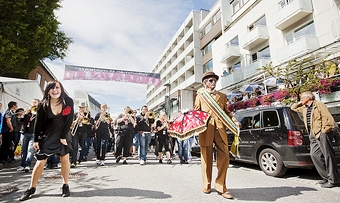
It has been widely reported, most recently in the NEAs Survey of Public Participation in the Arts, that audiences for jazz are getting older. Yet there is no shortage of young faces at Molde, and a feature of the festival is the way it works with young people. The Arvelyden is a workshop for kids of all ages held every weekday of the festival at 12.30pm with the artist-in-residence Arve Henriksen; while every morning at 11.30am there is a street parade through Molde, featuring a school children.
Jan Ole explains the festivals philosophy: At Molde we have a big childrens recruit program for playing and coming to the festival. Then theres a street parade starting every day of the festival at 11.30am with 70 youngsters who have four seminars throughout the year, learning how to improvise and play music. Then there are concerts for children during the festival. Here we try and give them a mix of what they can hear at a real concert, and what they are used to hearing on childrens TV or something like that. So we are sneaking the jazz elements into what they are used to. We also have a freestage just outside the Town Hall, where the youngsters are allowed to play. If they have a band, or they play alone, they can perform. And were co-operating with the schools in Molde, we have teachers going out in the music lessons to prepare them to play on the freestage.
This year we have a special project with Arve Henriksen [the festivals artist in residence] called The Sound of Arve, a workshop where he and [keyboard player] Stle Storlkken and other musicians are doing samples, and the kids are doing samples of themselvesa kind of mini Punktand they are mixing samples themselves and we put them out on the website, so the kids can hear themselves on the Internet. Tonight we have a jam session to end the workshop series, where Arve and Stle and other musicians come in and join them. All for children, from small children to older kidsits open for everyone actually, school children like me!
Wherever you go in Molde, it is impossible not to notice the army of young, willing and helpful volunteers that help make the festival tick, from stage hands to sound mixers, from lighting engineers to ushers, from administrative staff to stage managers. I met one volunteer who was a doctor at the local hospital who annually takes two weeks holiday in order to help out in the festival office. From him I learned that volunteering was often a family tradition. A grandfather who originally volunteered for the festival in its early days might be working alongside his son or daughter plus his grandchildren.
Yes, this is often a family thing, confirms Jan Ole. We only have five full time festival staff retained by the festival the year around. Then we have 70 people we call key persons who are responsible for a venue, or a committee, and so on. And they work with us the year round, and they are volunteers. Then we have the volunteers who work just at the festival week, and they are 750, so altogether there are 820 volunteers and we have a waiting list, this year we had to say no to over 100 people. And we have some guys working from the first festival [49 years ago]. Two of the founders of the festival are still in the organisation, one of them is in the program committee and he meets me every week to discuss the program. Hes retired now so hes always checking all the jazz websites from around the world for talent, the ones I dont get a chance to read, and hes also on the board of directors of the festival. And then theres sons and daughters and so on. There are seventy leaders who recruit for their own committee, and the key persons, they are all recruiting their staff. Often being a festival volunteer is in families, the grandparents did it, then the parents then their children, jazz is very much part of the community.
Next year, Molde will celebrate its 50th anniversary, making it one of the longest consecutively running festivals in Europe. It seems as if their annual jazz festival has put this small town on the cultural map of Europe. Thats true, says Jan Ole. If you ask people all over the country about Molde, they will say two things. First jazz, and then roses. The climate here is very good for roses, there are always a lot of roses here! Currently, Molde has 25,000 people living here and during the festival between 80,000 to 100,000 people come to town either to go to the concerts, or check out the festival atmosphere, the free concerts and so on. These people are coming from all over the country, [the jazz festival] is a tourist destination, they come by plane, train, road and in the harbor people come by boat, to be part of it.
And looking at the festival program, there is little wonder they come in such numbers. Its a festival with a sure sense of its identity, exemplified by a dawn concert on the final day. In the 1960s there used to be a jam session in a small caf called Varden in the mountains overlooking Molde, explains Jan Ole. From the first session in 61 until the early 1970s it used to be jam sessions late at night, starting when the concerts end, so from 1am to 2am in the morning until 6 or 7 oclock in the morning they played up there.
In 69 Karin Krog [the Norwegian vocalist] was there and she and her husband came out at seven in the morning and the sun was rising, and later that day they drove back to Oslo and on the way they played Ida Lupino, the Carla Bley tune, on the car radio and Karin started to sing her own words. When they got home, her husband sat down and wrote those lyrics which became the song, Break of Day in Molde, and that was recorded as a single the year after. It has become quite a famous song in Norway, and it has been played a lot on the radio, especially around the festival time, and Norwegian Broadcasting always open with Break of Day in Molde, so last year [2008] I got the idea we should do a concert early in the morning, inspired by the song named Break of Day in Molde. So we did that on the last day of the festival at seven in the morning.
Karin Krog wrote a third verse to this song, and she sang it, with Arild Andersen on bass, who was on the original recording, and then Marilyn Mazur and some other musicians came in and did a concert at seven in the morning. It was amazing, 1,500 people were sitting up there having their picnic breakfasts. So it was quite a moment. Tomorrow at 7am, we have a special project with Arve Henriksen, Jon Balke, Terje Isungset, Svante Henryson and Therese Skauge and a dancer and they will do their version of Break of Day in Molde. So the slogan for the festival was Where music meets nature, so this was really a contact point between nature and music [since the concert was held in a performing space on the side of a hill surrounded by pine trees on three sides and a view of coast on the other].
What Sir Thomas Beecham would have made of music festivals today, let alone a jazz festival is anybodys guess. But if his adage of attracting trade to a town is trueand this is increasingly the reality for many festivals todayfestival producers must more than ever preserve their artistic independence from the pressures of commerce or the result will be safe, but unadventurous programming. Dictionaries describe a festival as a joyous celebration; a merry making; a musical entertainment on a large scale and Molde is exactly that. It shows how the not-for-profit jazz festival may be the way of the future, allowing festival producers to back their aesthetic judgement without having to watch the bottom line at every turn.
Clearly, with large amounts of public and private money at stake, they have to balance the books and not work at a loss. But, as Molde shows, using profits accrued here to produce imaginative and creative programming there, plus a long term audience development program is rewarded by public support. More importantly, it leaves artists free to develop their music without having to shape it to appeal to the profit orientated businessmen. Sir Thomas may well have approved.
This blog entry posted by Stuart Nicholson
Tags:
Comments are closed.