The Jazz.com Blog
December 16, 2009 · 0 comments
Remembering Ray Brown (1926-2002)
In conjunction with Christian McBrides Guest Artist Dozens, focusing on classic tracks by bassist Ray Brown, jazz.com is publishing Ted Pankens conversation with the two bassists from 1996. T.G.
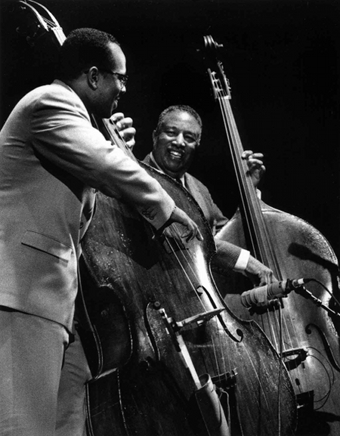
Ray Browns supple sound, elemental beat, harmonic wizardry, and ability to create striking melodic lines at any tempo made him the definitive bassist of modern jazz. During his 58 years as a professional musician, he played with virtually every consequential figure on the scene. In the first stage of his career, he played on the first Gillespie-Parker combo recordings ("Shaw Nuff"), later making such influential sides as "One Bass Hit," "Two Bass Hit" and "Ray's Idea" with Gillespie's seminal big band in 1946. He joined fellow Gillespians John Lewis, Milt Jackson and Kenny Clarke in the first iteration of the Modern Jazz Quartet in 1951, at which point he had been touring regularly since 1948 with singer Ella Fitzgerald, his first wife, and with Jazz at the Philharmonic.
Indeed, Brown's relationship with Norman Granz led to numerous sideman appearances for Verve and Pablo until the latter 1980's. A short list includes recordings with Louis Armstrong, Gillespie, Parker, Roy Eldridge, Coleman Hawkins, Lester Young, Johnny Hodges, Benny Carter, Ben Webster, Illinois Jacquet, Sonny Rollins, Milt Jackson, Bud Powell, Hank Jones, Phineas Newborn, Jimmy Rowles, Count Basie, and Duke Ellington.
Many of those recordings found Brown in a rhythm section with pianist Oscar Peterson, whom he met on Peterson's first Jazz at the Philharmonic concert in Montreal in 1949, and whose triofirst with guitarists Barney Kessel and Herb Ellis, and subsequently with drummer Ed Thigpenhe famously anchored from 1952 to 1966. In 1966, Brown came off the road, and settled in Los Angeles, functioning simulaneously as a musician and businessman. Over the next two decades he managed such artists as Quincy Jones and the Modern Jazz Quartet, contracted for the studios, co-founded the L.A. Four, co-owned a nightclub called Club Loa, and continued to freelance extensively.
In the mid-'80s, Brown returned to the road with pianist Gene Harris and drummer Jeff Hamilton. The trio recorded a series of albums for Concord and Paddle-Wheel, evolving an ensemble sound that blended harmonic sophistication with grits-and-gravy blues imperatives. Under contract to Telarc during the '90s, Brown continued to challenge himself, sustaining trio excellence with such hand-picked young talent as pianists Benny Green and Geoff Keezer and drummers Greg Hutchinson and Kareem Riggins, and organizing Super Bass in 1996.
When Ray laid the rhythm down, it was like a Mack Truck with a Rolls-Royce engine, Monty Alexander told me in a tribute piece that Downbeat ran after his death. He was the greatest support player, yet he wasn't about to be a nameless character in the background, just doing the pedestrian work.
Ray gave me confidence, Peterson remarked. I never had to wonder and worry about where things were going harmonically or rhythmically. He listened to each performance that everyone gave, and adjusted his playing to you on different nights, which not a lot of bassists do. He would walk different lines behind me, change the harmonic pattern, just to see what I would do.
If you isolated Ray's basslines and superimposed them over the chords in, say, a higher register, you'd find he was creating beautiful contrapuntal melodies all the time, Keezer said. I felt I had complete freedom to go whatever direction I wanted -- and I took it pretty far out.
Rays approach to teaching wasn't Try this scale on this chord, Clayton stated. Instead he would say, Check out what Oscar Pettiford did on this record, or what Israel Crosby did with this bassline from Ahmad Jamal. He turned me on to Eddie Gomez, Richard Davis and Scott LaFaro. People forget that Ray Brown played Bebop, and when it hit, people thought it came from outer space; more jazz lovers could not relate to it than could. And Ray continued to search and stretch and experiment. His later arrangements involved more unpredictable voicings, chord changes and melodic movement than things he did five and ten years before.
He saw at an early age with Norman Granz in JATP how to run a business and take care of the musicians, Jeff Hamilton noted. He related that Norman once pulled the entire tour off of an airplane because, even though hed bought a ticket for it, they wouldnt allow his bass on board. Rays pride and sense of self-worth influenced his business techniques. Well, if you don't want me for this amount, you must not want me very much. They would inevitably call back. Ray said, No, that was the amount you offered two weeks ago; now the amount is this. That kind of self-confidence came through every part of Ray Brown's personality, musically and doing business off the bandstand.
After he moved to Los Angeles, we started working a lot together, said Quincy Jones. We got closer and closer. After a while, Ray started to take care of booking gigs and travel. He was an astute businessman. Old school played everything. We all played chitlin' circuits. And you didn't sit around whining about what you had to play, man. You played it, and tried to make it all sound good. That's what I loved about Ray. That's where I think our chord struck, in being very curious about what the business side of it was and not wanting to be a victim. We wanted to be more in charge of our own destinies.
A man never plays more or less than they are as a human being, and Ray was a very confident, take-charge person. He played bass like that and lived like that. He ate 17 different dishes like that. Wherever we were, whatever was good, Ray knew what it was. Hed probably eat a 249-pound catfish if he tried! To me, he was the absolute symbol that if you empty your cup every time and learn to make it a habit, it always comes back twice as full. Give it up every time, man. Don't save nothin'. I learned more and more about that from him all the time. In everything.
On the final night of Super Bass debut gig at the Blue Note in 1996, Brown and McBride joined me on New Yorks WKCR for a discussion about his life and times. An edited version appears below.
[MUSIC: Ray Brown/Basie/Roker, "One" (1975); Ray Brown Trio, Con Alma (1993); Ray Brown with Dizzy Gillespie Big Band, One Bass Hit (1946)]
Id like to get things started by giving Ray Brown a bit of the third degree on his early years in music. Hearing Count Basie and Ray Brown together puts you in touch with two-thirds of your deepest musical roots, because when you were 11 years old or so, you got to hear the Basie band on a fairly regular basis, didnt you.
Oh yeah. I went down there every day...
This was at the William Penn Hotel in Pittsburgh. You sat under the piano, right near Walter Page.
Right, in Pittsburgh.
How did you find out that this was happening, and what was the cause of your interest at this time?
Oh, I knew everything about music. We had a lot of music in Pittsburgh. We had two theaters that had live shows 52 weeks a year. We had jam sessions at the union every night of the week, and the guys from the theaters came down there and jammed with the local guysThere was a big band in each theater, and a big band played a concert once a week in Pittsburgh. There was a ton of music.
What was the source of your being inclined to it? Was music in your family? Were your parents musicians?
No, they werent musicians, but they loved music. When I was a little kid my father wanted me to be a piano player, and he loved Fats Waller. We used to sit up and listen to Fats Waller, and hed say, Listen to that left hand; listen to that guy play. Of course, Fats Waller was fantastic, one of the best of all time. Then he came in with another record and he said, Yeah, I got another guy I like; youd better listen to this guy. Then he put this record on, and it was Art Tatum. So you get pointed in the right direction.
Did you have private teachers?
Yeah, I had piano teachers. The first one was kind of uppity. She would pass me in the street... Id be playing marbles, and shed stop the car and pick me up and say, All right, lets go. I had to go home and wash up and come in there. Shed inspect my nails. She was a very proper... I told my mother I didnt like that piano teacher. So my mother said, Well, what do you want to do? I said, Well, theres a couple of ladies... Theres a lady named Ruby Young I want to study with. Ruby Young had her own band. There were two bands in Pittsburgh at that time led by women. One was Gertrude Long and her Nighthawks, and this was Ruby Young and her band. So Ruby was teaching lessons.
How old were you when you started playing?
Oh, God. Young. 10, 11, somewhere around there. But anyway, I took my first lesson with Ruby Young, and after the lesson I said, Can you play some jazz for me?and she struck out then! I told my mother, Now, thats it. She just sat up and played some stride and everything, and then I was very happy. This is what I wanted to do and this is what I wanted to hear.
I gather you lived next door to a trombone player who played with Gertrude Longs Nighthawks.
Right. I used to go over and sit on the floor while they were rehearsed. I was around music all the time. And my father liked Fats Waller so much that when my folks gave parties, he hired a guy who looked like Fats Waller, who played very little piano, he sang a little bit, but he wore tails and a top hat just like Fats Waller, and my father would tell all the guests, After you get a few drinks, he sounds real good. [LAUGHS] This guy would imitate Fats Waller, singing Your Feets Too Big, sang all those songs, and he played the piano. My father couldnt get Fats Waller, but that was the best thing he could do. So there was music all the time in my house.
So come 1937 with the Basie band sort of on their workshop month preparing for their sojourn in the north, you were there regularly, huh?
Thats right. He had Sweets and Buck Clayton and Dickie Wells. All those guys were in the band. Jo Jones, Walter Page, Freddie Green. So I met all these guys when I was a kid.
Do you remember the interaction, things you asked them, what they said to you?
No. I just remember sitting there listening. So that record has two people who were very-very influential to me, Dizzy Gillespie (who we dont even have to talk about) and Count Basie.
But you werent playing the bass at all in 1937 when you saw Walter Page.
No, I wasnt playing the bass at all.
That happened when you heard Jimmy Blanton, I gather.
Well, it didnt happen right away, but I was aware of Jimmy Blanton, and then when I started messing around with the bass it became very prominent.
How did it come about that you made the transition from being a piano player to a bass player?
Well, it was very simple. I went to junior high school, and I signed up for orchestra, and they had about, I dont know, 28 piano players and they had 3 basses and only 2 bass players. So every day, there was a bass laying on the floor, doing nothing. And Im sitting over there waiting for my 15 minutes a week to sit down to the piano. Its difficult for teenagers to sit around all day and not do anything and stay out of trouble. So I asked the teacher, Hey, if I was playing that bass, I could play every day. He said, Thats right. Were looking for another bass player. I said, Okay, youve got one. And that was it.
Was there a good teacher there?
No-no. I just played it. Just figured it out. The schoolteacher showed me what... He had to show everybody every instrument. He tuned up everybodys instrument and he showed you, gave you five minutes maybe, and then you were on your own. But I was bringing these things home; I was practicing with the records. And I luckily played a lot with Duke Ellington, because the guy who was on that record sounded best to me. So I played with that record all the time. Any Duke Ellington record.
So Jimmy Blanton was the guy you played along with.
Daily.
When did you start gigging on the bass?
When I got to high school, a guy who I used to deliver papers to named Henry Foster was looking for some guys, and I said, Hey, I play the bass and my friend plays the piano -- a guy named Walt Harper. He hired both of us, and we started working with them on Friday and Saturday and Sunday, making $3 a night. That was a lot of money then. There were no taxes either.
What type of places would you play, and who was coming to hear you?
Just local people. I dont know... A lot of that stuff is dim now in terms of me giving you accuracy about the people showing up. All I can remember is playing and learning the tunes.
Was it piano-bass-and-drums...
Piano, bass and drums and saxophone.
Do you remember what kind of repertoire you were playing at the time? Did you ever have room for features for yourself?
Not really, no. But we played just the tunes of the day. Tea For Two and Satchmouth Baby and Honeysuckle Rose.
And all this time youre still going to the theaters to hear the big bands...
Oh yeah. Well, when I got to high school we started playing hookey to hear... We were listening to Lester Young, Bud Powell with Cootie Williams, Oscar Pettiford with Charlie Barnet, way before he ever joined Duke Ellington.
In Pittsburgh what was the top level of bass playing you could hear when you were coming up?
I guess the top bass players were a guy named Bass McMahon, who wound up playing with Eckstines band. Then a guy who wound up here in New York, who they called Crusher, named Carl Pruitt, and he was with Roy Eldridges band. They were the top guys in Pittsburgh.
Hearing Roy Eldridges name, and he being from the Pittsburgh area, makes me want to ask you which of the many famous musicians who emerged from Pittsburgh were you in contact with, were your peers when you were coming up.
Theres more famous people out of Pittsburgh, I think, than any place in the world, which is just ahead of maybe Philadelphia and Detroit. You go back to Earl Hines and Roy Eldridge and Maxine Sullivan and Billy Strayhorn and Billy Eckstine, and come up to Art Blakey and Erroll Garner and Stanley Turrentine and Tommy Turrentine, Mary Lou Williams, George Benson... Its a long list. Dakota Staton. Henry Mancini. Pittsburgh had zillions of bad dudes come out of there! A lot of people came out of Pittsburgh. So there was a lot of music in Pittsburgh. I think in towns (Philadelphia was like that, Detroit was like that) where theres a lot of music going on, I think it inspires young people to get into it.
Now, the only guy I ever had any contact with (I didnt know Roy or Eckstine or any of those people) was Erroll Garner, who was a few years older than us, but we used to play hookey, go over to his house and listen to him play the piano. He used to come by, this little band that we worked with... He lived around the corner, and on Sunday night we played this North Side Elks; hed slip in there around 11:30 and come in there and jam with us. It was a lot of fun when he showed up.
Was he playing the same then as later...
Well, he swung the same way. But he was playing more like Fats Waller then.
Did you get to see Jimmy Blanton play in person? Do you remember that experience?
I saw him at the theater, yes. The problems with the bass back in 1940-41, which is when Blanton was very prominent (or any other bass player), there were no amplifiers. There was a microphone in front of the band, and the saxophone player came up and played solos off it, the singers sang, and the leader would make announcements on it. I mean, there was just one microphone up there. Until Duke Ellington showed up and had a special mike on Jimmy Blanton standing in front of the band, you never heard the bass that well. I mean, you heard the guy playing, but you couldnt do anything fast on bass because nobody would be able to hear it. So Blanton was an oddity in the first place, and a lot of people didnt understand it. They said, Why does Duke Ellington have this guy up there playing all them bass solos? Hah! Yeah, sure.
From you, a quick evaluation how Jimmy Blanton changed the face of the bass.
Oh, he just changed it. From black to white. That big a change. Just picking it up, he was different. I mean, he had the best sound you ever heard. He played the best lines. He played the best solos. He did everything! And everybody was into Jimmy Blanton. I mean, I delivered newspapers to Carl Pruitts house, and I dont care when I went by his house; he was playing those records and practicing with the records just like everybody else. This must have been done around the world. Everybody said, What? They heard a guy play a bass like that... PSHEW!
Lets take you from Pittsburgh in a capsulized way to 1944 to New York and hearing Dizzy Gillespie. What were the circumstances of leaving Pittsburgh?
I would have left Pittsburgh before I finished high school, but my mother said if I did she was going to have me picked up by the police. So I had to finish high school. Schenley High School. What happened, really, Cootie Williams band was at a big theater downtown with Ella Fitzgerald and the Ink Spots and some dance team, Cook & Brown or something like that. It was a big show. They had Benson & Hedges hot record, Put Me In Your Brass Bed, or whatever the name is... Anyway, that show was hot. The bass player in that show got picked up by the Army because he didnt pick up his draft notice. They came and got him from backstage, put him in a truck and drove him off to the Army base. So now theyre looking for a bass player, and they got Crusher, Carl Pruitt, and he finished out the week. But somebody told them about me, and I went down there, and they tried the jacket on me -- and Carl Pruitt was too big, the jacket fit me, and they offered me the job. [LAUGHS] So I ran home and told my folks. I said, I got a job with Cootie Williams band. They said, You have no job. Youre going to school. And I cried and rolled over and died a few times. But my mother said, Youre going to finish school.
So you had to stay in Pittsburgh a little while more.
Absolutely. If you knew my folks, you would have stayed, too!
So after high school, then what?
As soon as I finished high school, I went on the road. I went to Buffalo with a guy named Jimmy Hinsley in 44.
Wasnt Hank Jones in Buffalo at that time?
Yes, thats where we met.
Ive read about you meeting after the show, drinking milkshakes and then going to hear Art Tatum after you were done.
Yes. What happened was, I got a room at the YMCA, and a couple of days after Id gotten there I was coming down going to someplace I was going. I used to take the stairs down, and you passed a door that was the door to the cafeteria. They had a piano, for some reason, in the cafeteria. And I heard what I thought was this record we had at home of Begin The Beguine by Art Tatum, which I knew very well. I played it many times. I knew it practically by heart. And I heard this record playing, and I stood outside the door and I said, Wow, theres that Tatum record, and I sat and listened to it and it played -- but when it got to the end there was some more playing! I said, Whoa!
I went through the door, and theres a guy sitting up there playing the piano. I walked over to him and said, Hey, man, that was that Art Tatum record, Begin The Beguine. He said, Yeah. I said, Oh yeah! That was Hank Jones. Thats how we met. So after that, every day I would bring my bass home, and we would go down to the cafeteria and play -- every day. We were on different jobs, but we just played together every afternoon.
What sort of things would you play?
Anything he wanted to play, and I followed him.
You were part of the first group of musicians where the general level of knowledge required seemed to be more. How much do you think your piano background helped you in dealing with the music you had to play later on?
Well, the piano has always helped me in music. The bass helps you hear the chord, but the piano then spells it out for you, in case you dont know what the other notes are. The piano plays all the notes. So between the bass and the piano you have everything.
Lets get you back on course to New York City. Youre in Buffalo with Jimmy Hinsley, you meet Hank Jones, youre playing in the cafeteria. The story I hear is that you were on the road with the Snookum Russell band, then you left that band and went to New York City. Snookum Russell was one of those band that had major figures before they became major figures.
Well, everybody in those days... There were a ton of big bands, and when you left school and went on the road, you normally went, in those days, with a big band, and you would play with the big band and then you would get better and you would move up to a better big band. Eventually, you would wind up with one of the major big bands, as you became better. Two guys who were in Snookum Russells band just before I joined it were was Fats Navarro and J.J. Johnson. Those are not too bad names!
What kind of music was he playing?
I guess you could call it almost a commercial jazz band. He covered the hits of the day. If Lucky Millinder had a hit with Bull Moose Jackson, Who Threw The Whiskey In the Well, we would be doing that. What happened was, I joined Snookum, and then he found out that I knew all of this stuff that Jimmy Blanton and Duke Ellington had done, so he started doing it between the two of us -- because he of course loved Duke Ellington. So he started featuring me doing the Blanton stuff. There was a saxophone player in that band named Charles Carman(?) out of Sandusky, Ohio, and this guy was a Lester Young freak. He knew everything Lester Young ever madeevery note! When I met him, and we were talking (after hed been in the band for a little while), he said, Do you know anything about Prez? I said, Sure. He said, What do you know about him? I said, Well, what do you want to know? He said, Do you know any of his solos? I said, Call one.
What you need to know is when I was going to high school we had a club of musicians, and every record that came out, as soon as it came out, youd buy it (and it cost like 29 cents, a 78), you had two days to learn any of the major solos on there, and if you didnt learn it in two days then nobody would let you in the house, because you had to sing it before you could get in the guys house. So you had to learn every solo off of every record.
So I said, Which one do you want to hear? He said so-and-so and so-and-so, and then I started singing it to him. I couldnt get rid of him after that. Now, Lester Young and Slam Stewart had these records with Johnny Guarnieri and Sid Catlett, and we started doing those thingsSometimes Im Happy, all that stuff. So we were covering everything.
So Snookum Russell was a stimulating experience.
Oh yeah.
But you left. Its a funny story Ive heard, there were four or five of you, they were going to leave the band, and they backed out...
Well, we all said we were going to go to New York and try our luck. We had been with Snookum about eight months, and were reading Downbeat magazine and reading about Coleman Hawkins and 52nd Street and all these things. We said, Weve got to go to New York. Because you had to go to New York to make it then. You couldnt make it anyplace else. You had to come to New York. I said, Well, then, lets go to New York. So five of us decided we were going to go to New York. And the night before we were supposed to leave, I started packing, I looked around, and everybody was sitting around. I said, Whats going on? One by one, they said, Naw... The other four guys backed out. So I started to back out, and then I said, No, Im going. I had talked to an aunt in New York and she said I could stay with her. So I said, Im going.
How did you travel?
On the train. Took two days.
What happened when you got here?
I went to my aunts, washed up, she gave me some dinner, and I asked her son, who was my age, Where is 52nd Street? He said, Well, youve got to get the subway to get down there. I said, Well, as soon as we eat, lets go down there. I want to see it. And he took me.
And who was on the Street?
Oh God, I cant remember every band, but it was frightening. I know the Downbeat, the second club on the right, had Art Tatum and Billie Holiday. Stuff Smith was across the street (I cant remember the other band). Benny Harris and Don Byas. There was one band that I went to see every night for a month (I didnt miss a set), which was a trio with Erroll Garner, J.C. Heard and Oscar Pettiford. Never missed a set. Never did miss a set. It was ridiculous. You would have died if you could heard that group, man. Obnoxious. But anyway, the third place there had Coleman Hawkins featured, and Billy Daniels was singing intermissions, and he was being accompanied by a piano player, and it said, Hank Jones. So I ran in there, and I asked if Hank Jones was around. They said, Yeah, hes back there, and I went back there, and we sat down and started to talk. While we were talking, Oh, theres Dizzy Gillespie coming through the door. I said, Oh yeah? Introduce me. I want to meet him. Because I had heard all his records and stuff. So he called Dizzy, and Dizzy came over, and Hank said, This is a good friend of mine; hes a good bass player; he just got in town. Dizzy looked at me and said, Can you play? I said, Well... I mean, what are you going to say? Hank said, Yeah, he can play. So he said, You want a job? And I said, Yeah! And he gave me a card and said, Be at my house tomorrow night 7 oclock for a rehearsal. I got up there, and there was four guys in thereBud Powell, Max Roach, Dizzy and Charlie Parker. Cant beat that. If you won the lottery tomorrow, it wouldnt be as good as that.
What happened then?
Well, I had a heart attack first, and then we started to play some music.
What did the music sound like to you? Was it along lines you were thinking about?
Like nothing Ive ever heard before. They played tempos and keys and songs that I had never heard of, and youre just standing there watching and trying to keep up. Dizzy and Charlie Parker played so good, it was a frightening experience.
Dizzy Gillespie was famous for showing musicians how to play the music that he developed. Did he do that with you at all?
He did that with all of us. He used to show Max a lot of stuff. They were very meticulous about what they wanted from the drums, especially Dizzy. But if youd ask him, then he would show you. I know after I had been with him for about three or four weeks, I said, How am I doing? He said, Well, youre doing pretty good, but you dont play the right notes. [LAUGHS] So I said, What do you mean? He took me over to the piano and showed me. He said, Now, this note is right. Then he played the chord and showed me. He said, You play this note. Its right. But thats not the note I want. They were using a lot of substitutions. So I would be playing a D, but he would want me to play a B. I didnt hear that at first, and then after he showed me I started finding out.
A few words about your relationship with and impressions of Charlie Parker.
Charlie Parker was unique. I dont have to tell anybody in their right mind how well this man played his instrument. But what you dont realize is, hes the only guy I ever heard who could cover everything. If you wanted to play Cherokee as fast as you could play it, he would eat it alive. If you wanted to play some swing, like Nows The Time or something like that, he would kill that. If you wanted to play a ballad like Bird with Strings, he would eat that up. And then, he was the best blues player you ever heard! He just covered everything. There was nothing he couldnt do.When you ask me for a few words about Charlie Parker, in a capsule thats covering it pretty well.
Did he always play fairly short solos? Was the way he plays on records or the various broadcasts with four or five choruses the rule, or did he extend...
He stretched out a few times. But Ill never forget what he told me. One night somewhere we were playing, and after one of the sets I walked up to him and I said, Bird, it feels so good when you play, why dont you play more? And he looked at me and he said, Raymond, if I played any more, Id be practicing. I do my practicing at home.
A few words about Dizzy Gillespie.
Wow, thats difficult. I dont know where to begin. He was responsible for a lot of things that happened to me. And he taught me a lot of things. This is something that we as musicians dont talk a lot about to people, but we learn many things from our mentors or people who we work for or who we admire or who are in front of us. You dont even realize how much youve learned from them. You carry it with you all your life, and then you pass it along. I just learned a tremendous amount of things from Dizzy Gillespie. Needless to say, he was a magnificent trumpet player, and he was a prolific songwriter, and he was a prolific arranger. But I just keep going back to his knowledge of music. Because in that band, which was a fantastic band that I just talked about... In fact, they picked up Milt Jackson a couple of weeks later. Dizzy organized all the music. He laid all the music down. What can I say? Its history!
Were you in there at the very beginning of the big band?
He had a big band before, but it didnt go, and he had to give it up. I joined him when he had given up the big band and was getting ready to start another small band. Thats when I showed up. Then when we came back from California, he told Milt Jackson and I, Listen, Im thinking of getting another big band, and if you guys want to stay with me, you let me know. So we both said, Absolutely! Then we opened up on 52nd Street.
What were the early rehearsals like? Is it true that Monk was involved...
Monk was the piano player in that big band before John Lewis.
Was that a similar experience to hearing Charlie Parker and Dizzy Gillespie in 1944 on coming to New York? Did it sound like anything youd ever heard?
No, not like any big band Id ever heard. Very exciting. The music, the writing, the approach was all different. The harmonies. The only guy who experimented with harmonies to that extent was Duke Ellington, and he was always ahead of his time.
How did your first and still famous features for the band come to be?
Well, most leaders look at a band and they see who they have there to exploit, who has some talent that they can feature. When he looked at this band, I guess it was Jackson and I, and James Moody who enjoyed a lot of the solo space along with Dizzy. Other guys got solos, but we got a lot of space.
It was a great opportunity to really develop your conception in a variety of ways.
Yeah, but all these things are designated by the leader. Its like Jimmy Blanton joins Duke Ellington, and six months later hes standing in front of the band playing solos all night. So Duke Ellington saw something and he was right. He was absolutely right! Heres a guy who had under his thumb at any given time, Johnny Hodges and Ben Webster and Harry Carney and Ray Nance and Cootie Williamsall those guys! But this was a diamond he had just discovered, and he did something with it.
In talking about Blanton before you were mentioning the difficulties bassists had in big bands because of the lack of amplification. Now, you had to play very fast with Dizzy Gillespie. Did you have amplification by that time? How did you deal with...
Well, I didnt play fast solos. We were just playing fast tempos.
CMB: Things To Come! [LAUGHS]
When I was talking about playing fast I was talking about the way Christian McBride plays now. 20-30-40 years ago you wouldnt have heard all those notes hes playing. Now you can hear every one of them.
But then, from what I gather, people heard you pretty clearly, and those are some tempos that havent been caught up with yet!
Were not discussing tempos, now. Were discussing solo lines. Thats a big difference. Nobody dared play anything that fast because you couldnt hear it. Oscar Pettiford played some magnificent solos, and you didnt really get to hear him until he joined Duke Ellington.
Id like to talk you about Coleman Hawkins and your impressions of him. I read a story that you and Hank Jones were trying to work out ways to trick him...
[LOUD LAUGH]
...on Body and Soul or something, and he just threw them right back at you.
Thats what I was talking about with all of the great saxophone players, how they differed. For instance, lets take Lester Young and Coleman Hawkins. We were on Jazz at the Philharmonic, and Coleman Hawkins was playing Body and Soul, which he had to play whenever he took his saxophone out. Hank Jones and I rehearsed in the daytime, we devised about 15 different sets of changes on Body and Soul. And it didnt make any difference. Whatever we played, he just ate it up! He just turned around, looked at us and said, Hmm, THBBF, and would go right through it. We just broke up. But it was good. This guy had a magnificent ear! On the other hand, Lester Young, you could play what you want back there. Doesnt matter. Hes playing little stories. He makes up melodies of his own, so hes not interested in the changes. He didnt miss the change, but then he had his own interpretation of how to do it.
CMB: What about that story you told me about Ben Webster, when you were doing one of those Jazz at the Philharmonics. That one wasnt as smooth, huh?
Well, but thats how you learn, though. Thats why I can play songs in all the keys now. Hes kind of responsible for that. They had a ballad medley on Jazz at the Philharmonic, and each guy would walk up... They had ten horns. Each guy would walk up two bars before the other guy finished and tell the rhythm section what he was going to play in what key. So Coleman Hawkins would say, Body and Soul in D-flat, then hed go out and play. Roy Eldridge would come by and say, The Man I Love, E-flat. It was just like that. Until you get to Ben Webster, and Webster would come up and say, My One And Only Love, B-natural. And wed be back there scrambling for those changes! So after the show was over, I would be in the back, packing up my bass, and somebody walked up behind me and hit me on my head. I turned around and it was Ben Webster. He said, You messed up the chords tonight. I said, Man, you were playing in B-natural. He said, Dont you have a B on that bass? Enough said. Christian likes that story!
CMB: Im sure weve all been through that a couple of times!
But its good for somebody to bring that to your attention. All it does is, it improves you as a musician.
All those saxophonists had very different sounds and different approaches to projecting sound. Ben Webster, for instance.
Oh yeah. That may be the best saxophone sound I ever heard in my life, just the sound he made coming out of that horn.
You once described it, I think, as he and Coleman Hawkins and Johnny Hodges had the most mature sounds that you had heard.
Well, Charlie Parker used to call Johnny Hodges the Lily Pons of the saxophone. Now, Lily Pons was a famous opera singer; what a beautiful voice. Thats what Bird called Rabbit, the Lily Pons of the saxophone.
Staying on various personalities, Hank Jones was obviously very important to you at that time.
We call him Mr. Piano. Theres just not a lot of people around who are that prolific on that instrument as he is. He plays everything well. I mean, hes sort of like I said about Charlie Parker; this guy just does it all. Magnificent player. Wouldnt you say so, Christian?
CMB: Oh, definitely. Id like to ask Ray about the short movie clip of Dizzy Gillespies Big Band, Jivin in Bebop? You were saying how Duke used to put Jimmy Blanton in front of the band, and Dizzy does that to you on the video where you guys play One Bass Hit.
Oh yeah. Well, they didnt have to put me up front, but I guess if youre featured on a tune, doing this movie the tendency was to bring the soloist up front. It was unusual for the time, but they did it even with a bass player.
CMB: Every note you played came through crystal-clear.
Such as it was.
Id like to talk to you about some of the drummers youve played with, since bass and drums are so interlocked. First of all, Kenny Clarke, a fellow Pittsburgher.
Thats right. I didnt name him, but I left out a lot of people. Kenny Clarke was a special drummer. I never will forget, I would come to work on 52nd Street... Because he was in that first rhythm section, Monk, myself and Kenny Clarke. He said, Now, I want you to stand behind the bass drum, because I want your bass notes to go through the bass drum so it doesnt come out BOOM-BOOM-BOOM. It will sound almost like a bass coming out of there. And he would come down early and have a damp cloth and wipe down his bass drum and tune it, and then tell me exactly where he wanted me to stand, because he said that makes the rhythm section sound better. Most guys arent that meticulous about music. He was special. And he could swing. Thats another thing about those Pittsburgh drummers. Art Blakey, PSHEW! Boy, those guys had some beat. They had a beat, man.
But we were talking about Hank Jones. We did a session, and I challenged him on this... I said, Do you ever remember a song that Fats Waller used to sing called Your Feets Too Big? He said, Hell, yeah, I knew that tune. I grew up with that. I said, Well, lets play it. And we played it on this record date. So this is just for Hank Jones. I hope hes listening, because hell fall out.
[MUSIC: RB/HJ, Your Feets Too Big (1976); RB/HJ/Bags, Nancy (1964); OP/RB/Ella, Street of Dreams]
That was Ray Browns selection of music with your first wife, Ella Fitzgerald.
Well, theres been so much since she passed away. Theyve done so much. Ive heard it on the radios everywhere weve gone, Europe and the United States. Weve just lost one of the best ones. A magnificent woman and a magnificent singer. One of the best who ever did it. I have great memories just for the fact that... The first trumpet player, and one of the best of all time, Mr. Louis Armstrong, he and Ella did a lot of stuff together, and I was fortunate to be on a lot of that stuff. But Ive been overly blessed to play with all the way back to Louis Armstrong and all the way up to guys like Christian McBride now. And Im just elated to still be able to go up on the bandstand and play. Its a great feeling! And to have gone through all of those people Ive played with. All of those saxophone players, Prez and Hawk and Ben and Sonny Rollins, Johnny Hodges and Bird and Cannonball. Sweets and Roy and Fats and Dizzy...Clark Terry. I cant name everybody. All the piano players Ive played with, all the guitar players, and all the drummers. Just Ive worked with almost everybody in this business, and thats a blessing. cant describe it. Its just too overwhelming.
Just a few words on how This Ones For Blanton came to be.
Well, I made maybe half-a-dozen sessions with Ellington, whom I had always wanted to play with ever since I was knee-high to a duck. But Norman Granz said to me, You and Duke ought to do some things like he and Blanton did. I said, Oh, I dont know about that! But I said, Well, lets talk about it. He tried for years to get us together. We were just in different places all the time. Duke was busy and he was someplace, and I was busy someplace. Of course, this was the last record he made before he passed, and I was fortunate enough to get in the studio with him. The second session we did, he was pretty sick. He had a fever. But he came in and played magnificently.
This blog entry posted by Ted Panken
Tags:

Comments are closed.