The Jazz.com Blog
December 02, 2009 · 0 comments
The Great Frim-Fram Mystery
During his exhaustive research last June into "The Strange Case of Nat King Cole," jazz.com's self-styled sleuth Alan "Woodstein" Kurtz uncovered startling evidence debunking the myth that the lyrics to Cole's 1945 hit "The Frim Fram Sauce" are, in a word, nonsense. That itself, contends Woody (as Alan is known among the select community of jazz investigative reporters), is nonsense. Although jazz.com is pleased to set the record straight, anyone with attention deficit disorder is strongly cautioned to consume the following morsels in short, skeptical bites. Bon apptit! T.G.

"Frim fram," the late William Safire wrote in 2002, "is one of the oldest terms surviving as slang, cited in John Heywood's 1546 book of proverbs: 'She maketh earnest matters of every flymflam' about a woman easily deceived. Flimska is 'mockery' in Old Norse, and flim 'a lampoon.' Thus 'frim fram sauce' is the oleaginous goo of deceit poured over some unsuspecting dupe." Sadly, the celebrated columnist and language guardian appears to have been afflicted with Emily's Ear, an auditory disability named after Gilda Radner's character on Saturday Night Live.
Emily Litella: What's all this fuss I keep hearing about flimflam?
Straight man: No, Miss Litella, I said frim fram.
Emily Litella: Oh, that's different. Never mind.
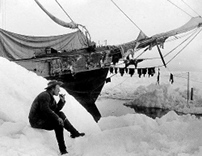
Citing an obscure 400-year-old book and a language archaic for six centuries hardly explains a 1945 song that never mentions flimflam. The fact is, frim-fram sauce dates back precisely to 1893, and not a day sooner. That year the vessel Fram"forward" in Norwegianembarked on its historic polar expedition. With a crew of 12 and a 5-year stock of provisions, intrepid explorer Fridtjof Nansen (1861-1930) sailed to the New Siberian Islands, where he allowed his 400-ton, 3 masted schooner to freeze into the icy Arctic Ocean on the untested theory that powerful currents would carry the floe, and with it the Fram, to the North Pole, where Nansen would be first to plant the Norwegian flag. When, after two years, the floe had failed to flow, Nansen and his faithful cook Torvald fled the Fram and attempted the Pole across pack ice using skis, dog-drawn sledges, and kayaks. Although Nansen and his cook came up short, they got closer to the Pole than anyone before, and made useful meteorological, oceanographic and gastronomical observations.
In 1922, for his humanitarian efforts to relieve Russian famine, Nansen was awarded the Nobel Peace Prize. But in one of those heartless ironies that characterize history, the world beyond Norway soon forgot him. What survived instead was a shipboard culinary treat first described in Limes of the Ancient Mariners, a best-selling cookbook by ship's chef Torvald Hikkup. The immortality denied to Kaptein Nansen went instead to his cook's recipe for a sauce made of limes, a staple at sea since the 18th-century discovery that said fruit, rich in ascorbic acid, prevented scurvy, a virulent gum disease caused by vitamin C deficiency.
What made the Fram's sauce unique was that its limes were fried, not stewed. Torvald's proprietary batter, which for a time became quite the rage in Scandinavia, consisted of flour, powdered eggs and saltwater. According to Torvald, his delectably tart dish was originally called fremmed Fram sauce, meaning foreign to their ship, which is how the crew at first reacted to a food that was scarcely indigenous to Norway.
Torvald overcame their initial reluctance by reminding his mates of Assen feighetliterally, cowardice in Assen, The Netherlands provincial capital where sailors would often undergo painful dentistry to treat their gingivitis. Thus arose the familiar crewman's mealtime order, "I want the fremmed Fram sauce with the Assen feighet." To this was soon appended, "With sjef f-f on the side," sjef being as close as Norwegian gets to chef de cuisine and f-f meaning to receive repeatedlyin other words, beseeching Torvald to stand by with second helpings.
Songwriters Joe Ricardel & Redd Evans amusingly captured the crew's insistence on their chef's confection, including the tagline "Now, if you don't have it, just bring me a check for the water." Needless to say, Check for the water was a common expression on the icebound voyage of the Fram. However, the real triumph of Ricardel & Evans was their cunningness in obscuring the song's meaning. The resultant mystification has accorded "The Frim Fram Sauce" a shelf life the envy of songwriters everywhere.

Jazz.com's demystification is not meant to torpedo anyone's fun or scuttle royalties, but to serve the larger good of public enlightenment. And even if not entirely true (Torvald Hikkup?), our version is nowhere near as yucky as William Safire's "oleaginous goo of deceit poured over some unsuspecting dupe."
Now, if you're not swallowing any of this, just send me a bill for the piffle.
This blog entry posted by Alan Kurtz
Tags:

Comments are closed.