The Jazz.com Blog
February 01, 2009 · 6 comments
The Tragedy of Richard Twardzik (Part Two)
Below is the second (and final) installment of my article on Richard Twardzik, and the recent biography of the pianist by Jack Chambers. For part one, click here. T.G.
Richard Henryk Twardzik was born on April 30, 1931 in Danvers, Massachusetts. His first words were reportedly "nice music"—an auspicious beginning for a pianist's biography. He studied under Margaret Chaloff, a highly respected Boston teacher, and mother of baritonist Serge Chaloff (with whom Twardzik often gigged), and made his first commercial record with Charles Mariano on the LP The New Sounds from Boston released in 1952. Twardzik only appears on one track on this release, produced by Ira Gitler, but his solo on Mariano's bristly composition "Mariners" gives notice of his iconoclastic pianism.
Twardzik at this stage was not only absorbing the vocabulary of modern jazz, but also soaking up the sounds of contemporary classical music. Just as Brubeck, around this same time, had found a way of marrying his jazz inclinations with the sound universe he learned through his studies with Darius Milhaud, Twardzik was finding a similar source of inspiration in the music of Stravinsky, Hindemith, Bartók and other leaders of the new thing in classical music. As Twardzik brought these elements into his combo work, he created a provocative hybrid, much more than mere imitation, but rather a fresh trail blazed in the annals of American music.
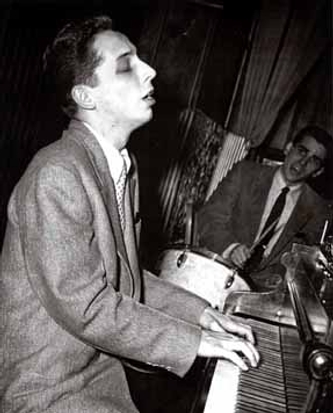
Photo probably by Nick Dean (From the Twardzik / Thompson
Archive, courtesy of Rosamond Thompson & Jane Sumner)
Others were taking notice of Twardzik by this time. Nat Hentoff mentioned him in a piece in Down Beat from December 1951, quoting Serge Chaloff's comments about an "amazingly mature young pianist" in his band. But the following year, Twardzik came to the attention of Charlie Parker, the living embodiment of jazz modernism at the time. Parker probably heard Twardzik playing intermission piano during Bird's March 3-9, 1952 engagement at the High Hat. If anyone in the jazz elite was capable of appreciating what Twardzik was all about it would have been Parker, with his own sensitivity to the significance of modernist classical composers for the jazz idiom. Bootleg recordings of Parker and Twardzik's work together have survived, but merely whet our appetite for more of the same.
It may be worth noting that Parker, during this same Boston engagement, praised Béla Bartók in a radio interview. "Bartók is my favorite, you know," was Bird's comment. Few, if any, jazz musicians of the day, had a better grasp of Bartók than Dick Twardzik, and one would give much to be a fly on the wall when these two modern jazz artists were conversing about matters musical.
The opportunity to travel to Europe with Chet Baker was both a great opportunity for Twardzik, but also set in motion the events leading up to his death. "Chet wanted me to go to Europe with him," Russ Freeman later explained to me, "but I could see where he was heading with the drugs." When Freeman turned down the gig, Baker hired Twardzik, who he had heard during an engagement at Boston's Storyville club.
Freeman also helped arrange for Twardzik's now legendary session for the Pacific label. "When I heard him play he sounded so unique and so different that I called up Dick Bock [producer for Pacific]," Freeman recounted to me. "I told him about this fantastic piano player I had heard. And Dick said 'Why don't you do a recording?' So we went up to New Jersey to Rudy Van Gelder's studio and did the album. I'm glad we did it, because it's one of the few things Dick ever recorded."
These recordings rank among the finest jazz piano trio sides of the era. On "A Crutch for the Crab," Twardzik starts with a sprightly on-the-beat march that gradually veers into a dark landscape of off-kilter rhythms, mutant stride piano excursions, and a conception of right and left hand integration well beyond what passed for progressive jazz in those days. The harmonic reconfiguration of "I'll Remember April," is brilliant, and the trading fours with the drummer toward the conclusion is volcanic in intensity. His interpretation of "Bess, You Is My Woman" is a case study in the jazz-ballad-as-art-song. This latter performance is worth hearing for the pedaling alone—and how often can you say that about a jazz track? But even more striking is his splashes of sound color—the term "voicings" hardly does justice to what Twardzik is doing with the changes.
Twardzik's music is especially noteworthy for his orchestral textures, which stood out in an era of sparse left hand voicings. But this pianist could also reveal new twists even when playing "conventional" right hand bop lines. On "Just One of Those Things," he shows how much he has learned from bop pioneer Bud Powell—in fact, Twardzik sounds as if he has paid close attention to the solo piano version of this song Powell recorded in February 1951. But on this rapid-fire track (oddly described by Chambers as a "ballad") Twardzik imposes unusual patterns, stretching them across the barlines in ways that Powell would never have done. The effect is exciting and very futuristic.
These tapes were still unreleased when Twardzik left with Baker overseas on an itinerary that included Paris, London, Geneva, Copenhagen, Paris, Amsterdam, Stuttgart, Berlin, Milan, Rome and other locales. Here he made some additional recordings alongside the trumpeter that have added to Twardzik's posthumous reputation.
Dick Twardzik would never return home from this tour. He died of a heroin overdose on October 21, 1955. He was expected at a recording session with Baker, and when he didn't show, someone was sent to his hotel room. No one answered at the locked door, and when it was finally broken, Twardzik was found, already dead, with the spike still in his arm.
Some have suggested suicide, and note the locked door as evidence for this. But Chambers argues—persuasively, I believe—that Twardzik had not revealed any suicidal impulses, and his demise was simply the result of what is called "death by misadventure." Chambers notes that many addicts have close calls and survive. This was that time when the odds tilted in the other direction.
The release of Twardzik's trio work on Pacific created a buzz in the jazz world that has continued to the present day. Not many have heard this brilliant and forward-working artist, but those who do so inevitably walk away deeply impressed. Now thanks to Jack Chambers, a new generation of fans will be reminded of this large talent taken from us far too soon.
This is the end of the second and final installment of Ted Gioia's article on pianist Richard Twardzik. For part one, click here.
Tags:

a pretty interesting article!thanks for that! :)
Thanks to both Jack Chambers whose fine book has captured the essence of my cousin, Richard Twardzik, and to Ted Giola for his interesting summation, thus bringing the attention of the book, its author, and the musician to those who follow the world of jazz. In 1946, my family lived in the first floor apartment at Foster Place in Cambridge, MA, and Dick and his parents, Clare and Henry Twardzik lived upstairs. How well I remember the after school, hour upon hour of practice by Dick with the incessant metronome of his heel keeping time and reverberating through our apartment. Nobody ever complained...
You might want to listen to the New Artists Records Dick Twardzik release, entitled "1954 Improvisations." This material was given to the label by Dick Twardzik's roommate in Boston, Peter Morris. The music came from informal recordings. The sound quality is not good and the piano is out of tune on many of the tracks. Some tracks are sketches of tunes that Twardzik later recorded. You can hear the evolution of his conception. The disc ends with "I'll Remember April," a truly great jazz masterwork. Peter Morris, from knowing Twardzik in his formative years, held the opinion that Twardzik was influenced by both Bud Powell and Lennie Tristano.
When Dick Twardzik died, I was too young to be listening to jazz -- but I've had the good fortune to meet Leroy "Sam" Parkins, jazz sage and memoirist, who's published his long, moving first-hand recollections of Dick on my blog, "Jazz Lives," www.jazzlives.wordpress.com. Sam and his wife had dinner with Dick before he left to tour with Baker. It's a heartbreaking piece of jazz history.
Other than when he was alive and working, now is probably the best time to hear his work. Available are: Dick Twardzik: Complete Recordings on Lone Hill Jazz. This includes the Pacific Jazz trios as well as the New Artists Improvisations (in better sound) Chet Baker: Complete Studio Sessions with Dick Twardzik on Lone Hill Jazz. This has the Paris sessions. Chet Baker: Koeln Concert on RLR Chet Baker: Complete Holland Concerts on Lone Hill Jazz Chet Baker: Lost Holland Concert on RLR
"Some have suggested suicide, and note the locked door as evidence for this." I almost always lock hotel doors, and if I were doing something illegal like shooting drugs, Id be sure to lock the door.