The Jazz.com Blog
February 11, 2009 · 3 comments
The King of Western Swing (Part 1)
Below is the first installment of my three-part article on Bob Wills, a pioneer in merging jazz and country music styles. The occasion for this essay is the release last month of The Tiffany Transcriptions, which captures some of Wills's finest work from the post-WWII era. T.G.
The last year has been a joyous time for fans of country-jazz fusion. Who would have thought that Wynton Marsalis would ever collaborate with Willie Nelson? Who could have anticipated that Charlie Haden would evolve from sideman with Ornette Coleman to the leader of a modern day Carter Family band (or Haden family band, in this instance)? But these were some seriously fun albums, and both made my list of the 50 best CDs of 2008.
What's next? Maria Schneider takes on the Merle Haggard Songbook? Cecil Taylor opens up a showroom in Branson, Missouri? Keith Jarrett stars on Hee-Haw?
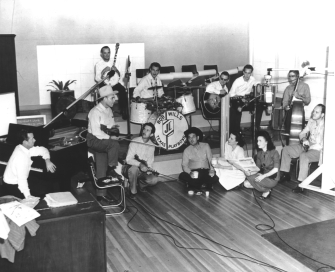
While you're waiting for the next milestone in cowboy jazz, you are advised to spend some time with the master of the genre: Bob Wills and his Texas Playboys. Wills, who was born at one minute before midnight on March 6, 1905 near Kosse, Texas, stands out as the leading star of the Western Swing movement that flourished in the post-WWII years. Indeed, he is one of most engaging figures in mid-century American music, and a grand entertainer on par with Fats Waller (born 1904) and Cab Calloway (born 1907) in any list of the charismatic populists of song from Wills' generation.
The Tiffany Transcriptions, a recent box set from Collector's Choice Music, is a treasure trove of Wills-iana. These ten CDs capture the Texas Playboys at the their creative peak in a series of recordings produced for syndicated radio show—more than 150 tracks that serve as a perfect introduction to this historic ensemble. Charles R. Townsend, author of the fine book San Antonio Rose: The Life and Music of Bob Wills has suggested that "no single list reveals the incredible breadth of Wills' music and versatility of his band better than the Tiffany transcriptions."
"When I'm asked about the music of Bob Wills and his Texas Playboys, the first thing that comes to mind are the Tiffany Transcriptions," rockabilly guitarist Ashley Kingman explains. "These are the recordings that really turned me on to this amazingly talented band. I even remember where I first heard a track off these recordings." Driving across New Mexico in an old Chrysler station wagon, Kingman only had a radio for entertainment. The reception was poor and the station faded out before the song was finished, but the joyous, informal sound of this music made a lasting impact.

Wills was one of the hottest acts in American music in the 1940s. At the close of World War II, his band was out-drawing Benny Goodman, Tommy Dorsey and other leading Swing Era stars. In 1946, Time magazine reported that Wills annual earnings were $340,000—a fabulous sum considering the minimum wage was forty cents per hour during these post-war years.
Some jazz purists were quick to dismiss this music. "[Wills] is tired of being patronized by swing kings," Time reported, and the bandleader complained about people who said he didn't know what he was doing. Yet back in the 1940s, much like today, money talked and people listened in the music world. As a result, even city slickers were catching on to this countrified music. Deejay Cactus Jack (the colorful radio name adopted by Cliff Johnson) was promoting some of Wills' appearances on the West Coast, including a two-day engagement at the Oakland Civic Auditorium that drew almost twenty thousand fans. Only a short time before, Jack had paid little attention to Wills's music, but he caught on quickly to the financial potential it represented. Together with songwriter-businessman Clifford Sundin, Johnson plotted a syndicated radio show that would take advantage of Wills' star power.
The concept was to create a series of pre-recorded, pre-packaged radio shows that stations around the United States could broadcast. These stations would place their own advertisements with the "shows"—a familiar syndication formula nowadays, but far more cumbersome to implement in those days before podcasts, streaming media and satellite networks. Subscribing stations would receive 16-inch vinyl disks which featured five songs per side. The ambiance was similar to a remote broadcast from a ballroom or nightclub (a popular format at the time)—and no doubt many listeners thought they were hearing Wills' band in live performance.
These broadcasts were popular in the west and southwest. In Oklahoma alone, ten stations joined on as subscribers. But Tiffany could not get traction east of the Mississippi, where only one station (in Springfield, Ohio) carried the program. Tiffany would shut down in 1949, around the same time that Western Swing bands—and other types of Swing, for that matter—were falling out of favor.
But while they lasted, the Tiffany broadcasts created some memorable music. The distribution schedule put pressure on Wills to record dozens of songs, and cover a wide range of material beyond his band's familiar hits. Much of the interest of The Tiffany Transcriptions stems from the variety in the band's repertoire, and the obvious spontaneity of the proceedings. Wills plays the familiar jazz hits of other bandleaders: "Mission to Moscow" from the Benny Goodman band; "Take the A Train" from Duke Ellington; "Jumpin' At Woodside" from Count Basie; "At the Woodchopper's Ball" from Woody Herman. The Texas Playboys also take on old blues, pop standards, country songs, traditional tunes, and of course their own original compositions. Along the way, we get everything from "Red River Valley" to "Sweet Georgia Brown."
But the loose and easy atmosphere here is more than just a result of surprising song choices. Wills and the whole band capture a relaxed down home mood that let listeners feel like they are eavesdropping on some friendly folks making music for their own personal enjoyment. There may have been more virtuosic bands during this period. Certainly there were ensembles with a more experimental twist or a more piquant sense of the future of popular music. But for sheer fun, Bob Wills and his Texas Playboys were not to be outdone in these post-war years—a period during which the American public, in the aftermath of fifteen years of Great Depression and calamitous war was looking for precisely this type of lighthearted entertainment.
This is the end of part one of Ted Gioia's article on Bob Wills and his Texas Playboys. Click here part two.
Tags:

Yeeeehawwww - Westrn Swing is king! The ghosts of Bob Wills & The Texas Playboys live on in the music of Asleep At The Wheel. I'll be on the bus tomorrow night in Lancaster, PA as the whistle-stop Willie & The Wheel tour rolls into town. I've already ordered my 10 CD box set of The Tiffany Transcriptions and look forward to traveling back in time with Bob Wills and his band.
Well informed and well written piece, Thanks a Lot! Hope you'll check out our music, too. A-Ha!
Great!!!!!