The Jazz.com Blog
February 16, 2009 · 0 comments
Brad Mehldau and Anne Sofie von Otter at Harvard
Roanna Forman covers the Boston jazz scene for jazz.com. Her recent articles here have included reviews of Pat Martino, James Carter, Dominique Eade, Laszlo Gardony, and Roy Hargrove. Below she reports on Brad Mehldau's unusual classical-meets-jazz performance with mezzo-soprano Anne Sofie von Otter which took place on Friday at Harvard's Sanders Theater. T.G.
The beauty of live music is that you cant know what to expect (except if youre at the Presidential inauguration or half-time at the Super Bowl). So I was intrigued at this out-of-the-ordinary pairing an operatic singer and a jazz pianist/composer.
Unlike Brad Mehldaus collaboration with soprano Renee Fleming in the reverential and heady album Love Sublime (largely a setting of The Book of Hours, Rainer Maria von Rilkes meditations on God), his Friday nights concert with the Swedish mezzo-soprano Anne Sofie von Otter focused on renditions of several original Mehldau pieces and American popular favorites.
This was mostly an artistic mismatch. Partly the problem was the material. Mehldau was more invested, intellectually, spiritually, and musically, in the von Rilke poems, whose musical rendering was more demanding for performer and listener alike. The songs commissioned for the von Otter concert lacked that oomph, not merely because they were conceptually lighter farepoems about love, from unrequited to consummated to lost. On those and the standards alike, the singer was framed with essentially unprovocative accompaniment, considering what Brad can do.
Nevertheless, it was a worthwhile performance, on a number of levels. In particular, the event showed a marked contrast between the more traditional song recital orientation of the first half of the program and the looser second. In the opening portion of the event, the refined Bengt Forsberg, an accomplished classical vocal accompanist who has worked with von Otter for some time, was situated at the piano. He watched every note he played, sitting with a page turner at his side.
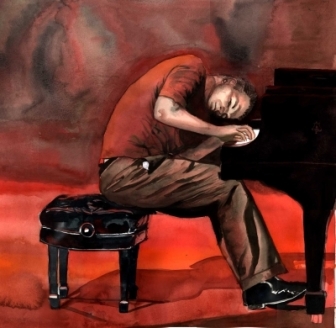
In contrast, Brad Mehldau (b.1970, as the program indicated in the composers notes) set a different tone after intermission. He wore corduroy blaser and brown chinos, swaying, often lost in the music, eyes closed at a keyboard his hands preside over like a small kingdom. There were scored piano accompaniments in the classical portion; ears, memory, and improvisation in the second. Forsberg and von Otter had the complete synergy of years of performance experience and familiarity with the music, while the singer was new to Mehldaus material, referring the scores on a music stand.
It was clearly the sopranos show. If you wanted to see an artist in perfect setting for her genre, it was Anne Sofie von Otter in the pin-drop silence of Harvards acoustically exquisite Sanders Theatre. Unmiked, unfazed, von Otter and Forsberg ran the art songs of Sibelius, Schumann, and several French composers with a command of the full palette of the form.
Stepping into the next musical gallery after intermission, the singer and Brad Mehldau offered up Mehldaus contemporary settings of poets Philip Larkin, Sara Teasdale, and e.e. cummings. To a large portion of the classically-oriented audience, Brad Mehldau was just some pianist. To me, hes some pianist. But he apparently decided to keep within tight parameters of the musical context. He seemed not to want to throw the singer any curves, and the changes were standard fare, although there were some unusual intervals, voicings, and tensions on the endings. He did play, as always, with emotional commitment, more conviction than von Otter, although that may have been from lack of familiarity with the music not having lived with it long enough. It appeared to be a staged replication of the tour; which is, of course, how classical singers perform. But not jazz players. Only on the encore, Well Catch Up Some Other Time, did Brad let himself go on the solo. (Often, the solos sounded like embellishments on the melody with fills of course, they were Mehldau fills; this wasnt Piano Man.)
The original songs, which Id call contemporary classical, lacked the complexity and angularity of Love Sublime, and musically they werent all that memorable, more a centerpiece for von Otters gorgeous vocals. To her credit, von Otter changed vocal gears well on the relaxed, after-hours feel of the standards and pop tunes that finished the concert, closing down any throaty operatic throttle for a low idle rendition. Here, she sang from memory songs she knew and loved, especially lyric ballads like Michel Legrands What are You Doing the Rest of Your Life? Again, arrangements that for Brad were skimming the surface gave the singer the framework she needed. One surprising choice was I Am Calling You the haunting title song of one of the kickiest cult films ever made, Baghdad Caf. The mezzos voice overpowered the song, and Brad was holding back. The audience ate up the Beatles Blackbird, which Mehldau first arranged for piano in 1997. But my favorite was Sakta vi ga genom stan, Monica Zetterlunds big hit in 1962.
Next time, Mehldau might switch from crossover to the intertwining of improvisational and scored musicclearly not unprecedented, but ground-breaking by its very definition. It would stretch each collaborator in new ways while drawing on their greatest strengths.
This blog entry posted by Roanna Forman
Tags:
Comments are closed.