The Jazz.com Blog
February 23, 2009 · 1 comment
New Jazz in London
Thierry Qunum, a regular contributor to these pages, covers the jazz scene from his home base in Paris, and is a jury member for the Django DOr (France) and the European Jazz Prize (Austria). He reports below on the exciting results of an East London festival staged a few days ago by the 4-year-old Loop Collective. In an often challenging economic environment for jazz in the UK, collectives of this sort may be the major breeding ground for the leading jazz artists of the next decade. T.G.

The situation of jazz in the UK is far from being the best in Europe, and its been this way for ages. Lots of British musicianssuch as pianist John Taylor, saxophonist John Surman, or pianist Django Batesmake a living playing, teaching and recording abroad. The British scene itself is little known by the rest of the world. From the outside, it also looks pretty much divided into clans, such as the post-free players such as Evan Parker, the mainstream players such as Gerard Presencer, the pop-jazz players like Jamie Cullum, the British-Caribbean musicians like Courtney Pine, etc.
All of them try to survive in a mostly pop / groove / electro dominated musical environment. Still, anyone interested in European jazz knows that in the UK younger jazz players have recently tended to organize themselves in collectives in order to be stronger in a difficult environment. The best known among these is the F-ire Collective, and it has a younger 4 year-old-brother called the Loop Collective.
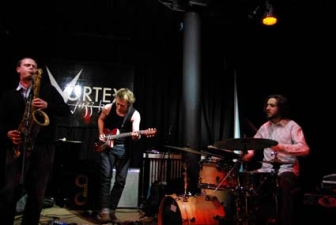
Fraud at the Loop Festival (photo by Stphanie Knibbe)
That this latter collective managed to get the government money to organize the first Loop Festival, held at the Vortex Jazz Club in East London last weekend is already a bold gesture. Loop also wished to invite some journalists and a festival director from France and Germany to this festival, and this was considered as a sign of openness and determination by yours truly and his continental colleagues. Indeed, who could have refused such an invitation to discover some of the groups that roam the young British scene, and to write about them for the rest of the world!
The new Vortex has a capacity of 80 some and is located in a small modern building, above a bar. The building itself and its surroundings have been built recently, which implied opening a new access street to the square opposite the Vortex. Since this street had no name, the Vortex owners suggested Bailey Street (not after Old Bailey, but as a homage the late guitarist Derek Bailey), which was accepted. Who says Britons only care for rock and pop music?
On these two nights (out of four that the Loop Collective Festival lasted in all) that I was able to attend, my first impression, beside the fact that the Vortex was packed, was that the audience was very young: late twenties to mid thirties, about the same age as the musicians onstage. And that was a good surprise and a good omen for the future of a music that can hardly hope to survive if it doesnt appeal to the younger generations.
The Friday 12th late afternoon preview took place on the ground level, at the bar below the Vortex, with a guitar solo by Stian Westerhus, a Norwegian musician established in London, who was to play again later that night with a quintet called Fraud. Surrounded by an impressive set of pedals, Westerhus indulged in an intense 30 minute set, a maelstrom of noisy guitar that was both sonically breathtaking, physically demanding (for him) and musically very coherent. Using a whole array of technical devices and shaking his instrument in a way that might look excessively extroverted, he actually managed to produce a music that totally makes sense once youve admitted that it will not be traditional guitar . . . and that it will be loud. Although sometimes, mainly when he uses an arco, its even amazingly soft and melodic. A very interesting heir of Derek Bailey, Marc Ducret and some others, Westerhus is definitely and genuinely seeking something new on his instrument.
The two next concerts were comparatively disappointing: Dog Soup and the Ivo Neame Quartet (featuring vibist Jim Hart) are obviously beyond reproach as far as technical mastery is concerned, but the aesthetic field they have chosen (late sixties and early seventies Miles Davis for the former, any quartet with Gary Burton for the latter) has already been ploughed so often during the last few decades that its difficult to follow musicians who tread this path again in such a literal way. Of course, the young audience of the Vortex might never have had access to that type of music in a live context, which explains why these performances had a great success although they never reached beyond the level of a good final concert by students from a good music conservatory.
The two following groups, and actually most of those who played the next day, showed that one can expect more personality from young professional musicians, and bore witness to the fact that young British musicians can take chances and be more adventurous. Trumpeter Dave Kane and bassist Alex Bonney, for example, have an acoustic duo that is not only original in its sonic choices, but that values the musical exchange over the perfection of the form.
Kane obviously comes from Don Cherry, be it only by his frequent use of the pocket trumpet, but he carries on in the path that his model opened decades ago rather than just trying to imitate him. His pitch can be hazardous, but thats the counterpart of his quest for sound in the immediacy of an improvised dialogue. Besides, the intensity and authenticity of his interaction with Bonney is so obvious that one wouldnt think of quarrelling with them about pitch. The latter is a very melodic and rhythmic bass player and both his arco and pizzicato playing are perfectly accurate in the brief spontaneous exchanges he has with his partner.
Fraud, the last group of this Friday evening was much more plugged-in and loud but it displayed an idiosyncratic group sound that was as convincing as its predecessor. The deep, dark, thick timbre of James Allsopp, on tenor sax, already sets the atmosphere. This reedman comes straight from Coltrane, Ayler, Shepp and the likes, but he cannot be mistaken for an imitator. Beside the sheer power of his blowing, he masters a variety of nuances that are totally his own. Behind him, Phil Hochstrates keyboards create dreamy or noisy atmospheres, and Westerhuss guitar confirms that it definitely has its own language. As for Ben Reynolds (who was to play again the next day with another band), being the only drummer of this set instead of the usual two, he showed that he could very well support the band on his own.
The quality and originality of the Saturday groups was basically as high as that of these two latter bands. In front of a Valentine Day audience that packed the house, Blink, a piano/tenor sax/drums trio, opened the show and almost stole it. Pianist Alcyona Mick, who writes most of the material, is a deeply original and very promising composer as well as a consistently interesting instrumentalist. She tends to play mostly in the lower register with a highly rhythmic approach that can conjure up memories of the late Mal Waldron. Her melodic vein is both obvious in her writing and her improvising and makes an intelligent use of space and silence.
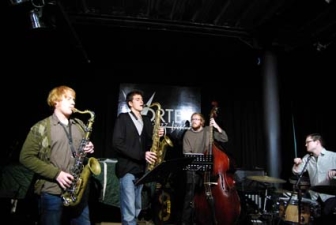
Outhouse at the Loop Festival (photo by Stphanie Knibbe)
French born Robin Fincker (who was to play again later with his own band Outhouse) is a highly interesting tenorist, with a melodic approach to sound and improvisation that may come from his early practice of the clarinet. He shies away from the traditional tenor solo bravado and blends his lines with Micks comping and Paul Clarviss most musical drumming in a very efficient way. These three have developed a group sound thats totally personal and fascinating.
Phronesis, another trio, followed with two musicians whod played the day before in pianist Ivo Neames band: Neame himself, as a sideman this time, and Danish bass player and London resident Jasper Hoiby, in a leader position. Strangely enough, the rather dull quartet of the former night, left place to a much more interesting trio. This was partly due to the lack of the too overtly Burtonian vibraphone, that allowed Neame to demonstrate his ability as a main soloist, to the interesting compositions of the bassist and leader, and to the rich and highly stimulating drumming of Anton Eger, one of the three great percussionists that the Loop Collective Festival presented over those two night.
The third one was Dave Smith, who played with the following Outhouse, a stunning two tenors quartet that had composed a brand new repertoire for this special concert. Here are musicians who like to take chances. Their unit obviously hails from the Ornette Coleman / Dewey Redman combo, but their elders have merely inspired them to follow their own way, and theyve worked hard to do so. The frontlines sound, with Tom Challenger on second tenor, is thick, full of nuances, and avoids the overwhelming tenor solo routine as well as the theme-solo-theme formula. Their use of little melodies as basis for solo or dual improv manages to remain ever fresh and inventive, and Johnny Brierleys bass masterfully holds its traditional support role while Dave Smiths drums produce a dense carpet of percussive punctuations and melodic counterpoints. Outhouse fully deserves to get known outside of the British Isles.
Compared to them, the sound of Sam Crockatts tenor, leading his own quartet, is much more in a seductive bag. This is a very good band, and the presence of Gwylim Simcock on the piano (well known in British jazz for his own trio work) is one of its great assets. But compared to the few truly original bands of the early evening and of the day before, this quartet somehow brought us back to these perfectly trimmed bands that had begun the weekendbands that could be heard about anywhere else, where there are good jazz schools that produce skilled postgraduate students, but bands that can hardly give any idea of the identity of young British jazz.
The fact that the Loop Collective presented both kinds of musicians on this first edition of its festival is a token of their open mindedness and of the diversity of a booming young scene that wont let the poor economic conditions of their country prevent them from perfecting and showing their craftsmanship.
This blog entry posted by Thierry Qunum.
Tags:

Thanks for this, I wish I could attend the Vortex and check out these musicians more often