The Jazz.com Blog
March 01, 2009 · 0 comments
Oliver Lake at Twins
Michael J. West, a regular contributor to these pages, recently shared his thoughts on Benny Golson’s star-studded birthday concert at the Kennedy Center. Below he turns his attention to Oliver Lake’s performance in D.C. at the more intimate Twins Jazz club. T.G.
Saxophone great Oliver Lake has been a frequent presence in the D.C. area of late, his various ensembles making appearances at the Kennedy Center and Twins Jazz. Indeed, the latter club, in the heart of the city’s jazz-soaked U Street, has hosted Lake twice within a month; he headlined its Inaugural Jazz Series on the night in question, and headlined again last weekend, February 20-21, with his Organ Trio.
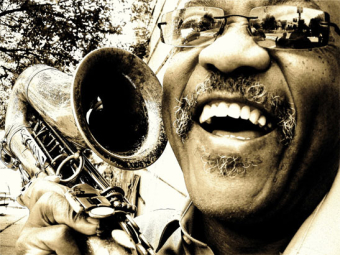
Twins is a small setting, which would have given poetic weight to Lake’s small band (Jared Gold on organ, Aaron Walker on drums) had it not been packed. The table next to the stage was the last available, with a great view of Gold’s Hammond XK3 electric organ and Walker’s customized drum kit: no front head on the bass (revealing the blanket inside), no bottom head on the snare, and a wider-than-usual array of cymbals: barely open hi-hat, splash, two overlapping rides, and a upside-down-mounted crash. Unconventional instrumentation—even including Lake’s alto sax—but one that soon brought forth a stunning, exploratory, and deceptively disciplined set of music.
Lake, dressed elegantly if singularly in a purple shirt and black vest, and the trio began almost on schedule (a rarity at Twins) with Eric Dolphy’s wonderfully angular “Gazzelloni.” Lake and Gold were in playful, almost sloppy communion on the tune, Lake letting loose with fiery melody and Jared Gold doing a weird twist on the Hammond’s churchy soul sound. Gold’s unique blend of sanctified riffs and atonal flights of fancy echoed of free jazz, generally and specifically: his phrases resembled the written bridge in Ornette Coleman’s titular 1960 album. As for Walker, he might have been the most experimental player, intent on exploring the range of colors in his kit (particularly the hi-hat and cymbals); he was also the loudest, but without overwhelming Lake and Gold.
The explorations took a stranger turn on Curtis Clark’s “Amreen.” Gold played a psychedelic intro; Lake entered with a dark rendition of the head that faded back to Gold’s warped organ, which gleefully exploited the Leslie speaker’s fluctuating volume. Both musicians took extended solos, but it was the saxophonist’s that stood out: as dark as the head, it also had a fluttery lyricism (like a human voice on caffeine) interspersed with high-pitched squeals. His style showed a certain hesitancy—not just for space, though Lake used plenty of it, but for careful deliberation of each phrase he played.
That vocal quality progressed into Lake’s McLean-ish composition “After Touch,” but also gained a rhythmic dimension. Indeed, the word “funky” is appropriate, with his spaces here placed for accents’ sake. This time, Walker was the star. His dynamic solo shifted easily between thumping bass, subtle Latin rhythms, and free playing colored by hand-played snare and splash cymbal that Walker would strike, then deaden by clamping his fingers on it. Gold’s solo picked up on Walker’s Latin breaks in a neat synergy that then transferred to Lake’s syncopated reprise of the head.
Walker’s brushes signified a ballad, a thoughtful Lake original entitled “In This.” Lake played the solo in his axe’s low range, making the alto sound like a tenor. Gold then settled in for a long and deeply intriguing solo in a modal vein; his textures, though, were less Larry Young than Richard Wright in early Pink Floyd, with bleeps and bloops and raga drones. Behind him (and Lake, who returned for another low-pitch solo), Walker turned the brushes around for a heavy-handed but contagious groove on the snare and floor tom.
To close the 75-minute set, Lake called for two compositions by the late, underappreciated Chicago trumpeter, Malachi Thompson. “Spirit of Man” featured the most hard ‘n’ heavy fusion arrangement of the set, with Walker at his loudest and Gold at his trippiest and Zawinul-esque. Lake was simply at his most intoxicating, laying out a kicky stoned-soul groove with his improv flowing organically from Thompson’s written melody until distinguishing one from the other was impossible. The three ultimately merged in a tight Sly Stone groove to close—but moved directly into the other Thompson piece, “In Walked John.” The head took off on a rhythm from ‘60s southern soul that crashed into a strident, irresistible swing.
If “Spirit of Man” was the set’s fusion core, “In Walked John” was its straightest piece. Walker did a 4/4 on the ride, with Gold covering the bass and chords together; Lake, however, was on a tear. Here he went wild, there onto a spiritualist plain, there again into bebop devices. Then came a drum breakdown, with Walker trading phrases with Lake and Gold together—then dropping away to let Lake and Gold go into call-and-response before taking them back into swing to end both tune and set.
Among his early and mid-1970s contemporaries, Lake has uniquely retained the generation’s “try anything” spirit, which can tend toward indulgence; in his case, it’s done the opposite, instilling a rigorous discipline that both keeps him from pushing his luck and gives his bandmates nearly equal eminence in the ensemble. It’s a rare trait that makes any Oliver Lake performance, now matter how regular, a worthy venture.
This blog entry posted by Michael J. West
Tags:

Comments are closed.