The Jazz.com Blog
March 15, 2009 · 0 comments
Quincy Jones On (and Off) DVD
Thomas Cunniffe, an editor and regular contributor to these pages, is our resident expert on jazz DVDs. Below he helps fans navigate through the many video releases on composer and producer Quincy Jones. Fans of jazz videos, may also want to check out Cunniffe's recent reviews for jazz.com here and here. T.G.
To call Quincy Jones a modern-day Renaissance man is to state the obvious. No one has mastered as many branches of vernacular music as Quincy, and more often than not, his successes have been simultaneously artistic and commercial. Trying to fit all of Quincy’s many sides into a documentary must be a tremendous challenge and several films recently reissued on DVD (and one that remains unavailable for purchase) succeed or fail based on that criteria.
PBS Video’s An Evening With Quincy Jones is the lightest of the bunch. More of a testimonial than a documentary, the program’s host, Gwen Ifill pitches softball questions to Quincy, who provides rambling and unfocused answers. When Ifill asks about Charlie Parker’s influence, Quincy’s answer goes off on a tangent and never comes back. Ifill asks about Quincy’s disastrous big band tour following the collapse of the musical Free & Easy, and Quincy jumps in at the middle of the story, never really discussing the show, the political issues in Paris that sabotaged the show, or why the band hit such setbacks in Europe. The program features appearances by Leslie Gore, James Ingram, BeBe Winans, Bobby McFerrin and Herbie Hancock, but despite the presence of the last two artists, jazz is severely under-represented. McFerrin & Hancock’s duet is a medley of Michael Jackson songs(!) and the only real jazz material is Hancock’s piano solo near the end of the show.
PBS did much better by Jones with its 2001 American Masters film, In The Pocket. Produced, written and directed by Michael Kantor, Pocket may be the best overall film on Quincy. His life story is offered chronologically, the talking heads range from Bill Clinton to Billy Taylor, the narration is historically correct, and personal details are discussed honestly and respectfully. Quincy’s jazz years are covered in reasonable detail and we hear the whole story about the European tour. But then, about 45 minutes into the film, there is the singing voice of Ray Charles under the opening titles of In The Heat Of The Night, and anyone familiar with Quincy’s biography notices a glaring omission: there is no discussion of Ray and Quincy’s friendship when both were growing up in Seattle, a friendship that exercised great influence on both men’s subsequent careers.
To hear about that chapter of Quincy’s life, you need to see Kantor’s earlier film on Quincy, a 2000 episode of Bravo Profiles. Before you jump over to Amazon, you should know that the film has never been available on home video, and owing to Bravo’s switch from arts programming to reality TV, you may never get a chance to see it. For whatever reason, Ray Charles appears on the Bravo film but not on the PBS film. On Bravo, he told about how Quincy learned about arranging from Ray and how Quincy eventually eclipsed the talent of his teacher. The Bravo film also includes Quincy’s famous quote about Lionel Hampton’s orchestra being the first rock and roll band. Kantor used the recording sessions of the album “Basie & Beyond” as a framing device, and there are several sequences of Quincy and co-leader Sammy Nestico rehearsing an all-star band from LA in a collection of classic big band charts. If PBS ever sees fit to issue a special edition of In The Pocket, they owe it to Quincy and his fans to include the Bravo profile as a bonus feature. I’m not holding my breath….
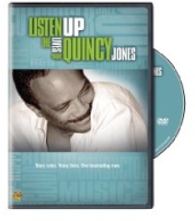
Also recently released is the 1990 feature Listen Up: The Lives Of Quincy Jones. Edited like a long-form music video, the star-studded documentary jumps back and forth between different styles in an attempt to link different periods in Quincy’s career. Unfortunately, this admirable attempt at cross-generational history gets beaten to death by sheer repetition, and any sense of chronology is lost in the process. The interviews are fragmented, with ideas being cut off unexpectedly, and there are several examples of overlapping dialogue that’s impossible to decipher. (Is it too much to ask that when such films are remixed for Dolby 5.1, the voices are spread out throughout the soundstage so we can understand them if we wish?) A new documentary, Q: The Man is included as a bonus feature, and while it does little to clarify the problems of Listen Up, it offers a moving discussion of Quincy’s mentoring of young artists and his recent work with world-wide charities.
To my mind, Quincy’s greatest talents are hardly discussed at all in these films. In addition to creating quality music in several genres, Quincy has an unmistakable sound that permeates the music, regardless of the style. Listen to any of Quincy’s music, from “Stockholm Sweetnin’” to “It’s My Party” to the Austin Powers theme “Soul Bossa Nova” to “Back On The Block” to any of the Michael Jackson megahits, and you will hear something that identifies each one’s composer as Quincy Jones. Many composers in classical music and jazz have shared that trait—Mozart, Beethoven, Stravinsky, Ellington and Gil Evans to name a few—but how many of those eminent composers wrote in as many styles as Quincy Jones? And while there is a brief mention in In The Pocket about Quincy’s trademark sound of flute and muted trumpet, nothing more is said about his musical style. No one, myself least of all, would argue for an in-depth musical analysis in the midst of a documentary, but what is wrong with offering a few simple musical concepts that the layman can understand and would help him grasp the common bonds between a number of varied musical styles? After all, any competent musician can perform in a variety of styles; it takes a giant like Quincy Jones to make those styles his own.
AN EVENING WITH QUINCY JONES 56 minutes. With Quincy Jones, Gwen Ifill, Lesley Gore, BeBe Winans, James Ingram, Bobby McFerrin & Herbie Hancock. PBS Video EVQJ 601.
AMERICAN MASTERS: IN THE POCKET 88 minutes. With Quincy Jones, Sidney Poitier, Gerald Early, Clark Terry, Billy Taylor, David Baker, Jeri Jones, Maya Angelou, Jolie Jones, Benny Carter, Henri Salvador, Patti Bown, Clarence Avant, Sidney Lumet, Henry Mancini, Peggy Lipton, Siedah Garrett, Wyclef Jean, Toots Thielemans, Frank Sinatra, Oprah Winfrey, Melle Mel, Colin Powell, Bill Clinton, LL Cool J. PBS Video AMMS404.
BRAVO PROFILES: QUINCY JONES 45 minutes. With Quincy Jones, Sammy Nestico, Ray Charles, Stanley Crouch, Siedah Garrett, Clark Terry, Peggy Lipton, Billy Taylor, James Ingram, Greg Phillinganes, Patti Austin, Bill Watrous. Not available.
LISTEN UP: THE LIVES OF QUINCY JONES 115 minutes (plus 49 minutes supplemental material). With Quincy Jones, Siedah Garrett, Rashida Jones, Lloyd Jones, Jolie Jones, Ray Charles, Caiphus Semenya, Sarah Vaughan, Michael Jackson, Billy Eckstine, Tevin Campbell, Sunny D. Levine, Quincy D. III, Tina Jones, Jesse Jackson, Alex Haley, Dizzy Gillespie, Ella Fitzgerald, Lionel Hampton, Melle Mel, Sheila E., Ice-T, Flavor Flave, Big Daddy Kane, Harry Lookofsky, Frank Sinatra, James Moody, Miles Davis, Steven Spielberg, Chan Parker, Richard Brooks, James Ingram, Sidney Lumet, Oprah Winfrey, Ahmet Ertegun, El De Barge, Al B. Sure!, Herbie Hancock, Bobby Tucker, Al Jarreau, Irv Green, Clark Terry, Clarence Avant, Barbra Streisand, Bobby McFerrin, Greg Phillinganes, Benny Medina, Rod Temperton, Morris Levy, Donny McLean, Rachel Jones, Ian Prince, Kool Moe Dee, Michel Legrand, Kidada Jones, Take 6, Bruce Swedien. Warner Home Video 24325.
This blog entry posted by Thomas Cunniffe.
Tags:

Comments are closed.