The Jazz.com Blog
March 24, 2009 · 7 comments
The Demise of Cachaça
Eugene Marlow, a regular contributor to these pages, looks at the recent closing of a Greenwich Village club, Cachaça, and wonders about the immediate causes and longer term implications of its demise. T.G.
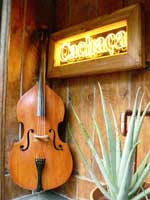
On April 27, 2007 Cachaça, the dream-child of 50-something Brazilian bassist Titus Ribas together with his partner, Ron Ferriolo, a nonprofessional saxophonist and businessman, opened its doors on the ground floor at 35 West 8th Street, in the Greenwich Village section of downtown Manhattan, near the New York University campus. On March 15, 2009, about one month shy of two years, its doors closed.
The financial loss to the partners is reportedly in the six figures. The loss to many musicians, particular younger, less well-known players needing a place to perform and be seen and heard is not measurable. The loss to the jazz and samba listening public—both locals and tourists—is yet another example of the struggle to find a place to hear jazz and related world music, not just in New York City, but throughout the United States.
Was it bad timing? After a year of construction, Cachaça opened its doors just six months before the beginning of what many economists are identifying as the latest (and longest) recession in United States history since the Great Depression. Is Cachaça’s demise yet another incidence of a retail operation closing up in a domestic economy in a deep recession? Is it because in a city that boasts several leading jazz clubs, such as Jazz Standard, Birdland, Blue Note, Smoke, Sweet Rhythm, and Smalls, that Cachaça was too much supply for too little demand in the wrong place at the wrong time?
The answer is perhaps a combination of all of the above. The immediate cause of Cachaça’s problems began with basement flooding. And this problem was not isolated. Apparently, the plumbing problem extended to retail operations on either side of Cachaça. The landlord insisted the club pay for the damages. Cachaça went into arrears after refusing to do so. The two parties went to commercial landlord-tenant court. The judge ruled in favor of the landlord.
On March 7, 2009, Ribas sent out an email stating: “Cachaça’s landlord is having a hard time to adjust to the new economic times and is refusing to see what is unraveling and grant a break. Somebody suggested to make an email campaign to let the landlord know how important is to support each other to make it through this crisis and avoid a domino effect that will affect EVERYBODY. If you love Cachaça and recognize what a loss to the Jazz community as well to the fabric of society in general as a small business this is, as many of us do, please send ASAP an email to let your views be known. . . .”
Three days later, on March 10, Ribas delivers another email, as follows: “Sending out those e-mails has been a mistake that badly backfired. Negotiations have been abruptly stopped. I assume the responsibility.” The much longer complete email references an eviction notice for March 11, and the need for the owners to raise $25,000.
The building is managed under the name 35 West 8th Street LLC. In actuality, the property is owned by the Goldman family, who own hundreds of buildings in the New York metropolitan area. According to one of my sources in the New York City commercial real estate market, at one time the Goldman real estate firm, BLDG Management Co.—established by Irving Goldman and Sol Goldman—was second only to the City of New York in its ownership of real estate in the city. Today the company is run by president Lloyd Goldman and Jane and Alan Goldman.
Attempts to include a comment from the company via email and numerous phone calls to Ronald Lichman, the ostensible direct manager of the property in which Cachaça resided on this matter, went unanswered. One manager I did get through to at the one of the Goldman company’s numerous branches categorically denied ownership of the building. The database of the Real Property Tax Assessment office of the City of New York (located in Brooklyn) confirmed the building at 35 West 8th Street was owned by 35 West 8th Street LLC, a corporate entity further owned by the Goldman company. The Real Estate Board of New York further confirmed this.
Cachaça’s financial woes, however, were evident even before this. In September 2008 Ribas sent out an email inviting people to become investors in the club. The email indicated a need to raise funds in the low six figures. Apparently, the response to this invitation was not sufficient. Moreover, the timing of the invitation came right before the worst quarter in America’s economic history since the Great Depression. Bad timing again?
Or is this an instance of a very well meaning musician/producer attempting to create an environment for the performance of jazz and Brazilian music in New York City, no less, caught between a severe economic downdraft and a landlord with no empathy? There’s no doubt Ribas has the chops as a performer and producer. Born in Foz do Ignacu, Paraguay, and raised in Recife, Brazil, Ribas has played with many outstanding Brazilian musicians. He has served as producer on numerous CDs. Ribas has lived and performed in New York since 1984 and has booked rooms such as the Café Creole and Emporium Brazil, two clubs now defunct. He has played the bass since he was 13.
It is clear Ribas and his partner put their Brazilian hearts and souls into Cachaça. According to a July 2007 blogs.nypost.com/tempo post, Ribas wanted the acoustics to cater to the bass player so no matter where you sat in the 100+ person club you could hear the bass clearly, which in turn gave the other instruments a wonderful lush sound that everyone could appreciate. On Cachaça’s web site the “intimate” room is described as “. . .decorated in a beautiful Brazilian theme, features the best in live jazz and world music. A perfectly conditioned 1932 mahogany 7-foot Steinway piano graces the stage. In addition, the room is tuned using a double bass as an acoustic reference, resulting in superb listening, and a double bass in the lobby sets the tone and vibe of the club.”
In a June 2008 interview in the music section of NJ.com, Ribas comments: “Everybody can find something to relate to [in] Brazilian music. The music has Brazilian aspects, jazz, funk, even West African, because that’s where the music was born. It’s challenging to play, and the rhythms are very free. There is freedom in this style.” The Brazilian influence was overtly evident in the club’s name. Cachaça is the most popular distilled alcoholic beverage in Brazil: the distillation of fermented sugarcane juice, with its alcohol strength anywhere from 38% to 80% by volume. About 1.5 billion liters (396.4 million gallons) are consumed there annually.
No doubt, but there’s not much freedom in creating and running a club. In the world of sales, there are countless stories of very successful salespeople promoted to sales manager who then fail as managers. The question, therefore, has to be asked: who should start and run a jazz club? A musician with performance chops who has musical taste and knows many good musicians, or a businessman with deep pockets and a high appreciation for the music?
There’s no doubt, though, Ribas’ heart was in the right place. At the conclusion of the March 10 email referenced above he describes himself as “just another musician who would have preferred to remain just that, but accepted the mission.” Sadly, “accepting the mission” is not necessarily a good business plan, nor does it lead to an effective exit strategy. Regardless, according to Ribas himself, although Cachaça could accommodate 100 people, it never seated more than 50 patrons, and often a lot less. The nights I was there barely 15 people were present.
It’s easy to be successful when everything is on the rise. But when things begin to fall only those who are prepared for the downturns or are financially robust enough to withstand the downturn survive. There is also the much larger context of the state of the jazz industry to begin with. As everyone knows who has been paying attention, CD sales are way down—not just in the jazz world, but the pop world as well. And while digital sales are significantly on the rise, these sales have not yet replaced the decline in physical CD sales. Jazz radio is apparently waning in terms of number of stations. Public gigs are shrinking. Even the number of private parties for which jazz musicians are hired is declining for lack of economic wherewithal.
The larger story, of course, is the overall state of jazz clubs in New York City and the even larger story of the condition of jazz in the United States. Anecdotally, the reports are everyone is hurting, but there have been no other reports of club closings in New York at least—so far. This reporter intends to investigate further for another blog report.
This blog entry was posted by Eugene Marlow.
Tags:

Welcome, welcome, welcome to the... Grim Regression.
i went to cachaca twice and really enjoyed it. it was beautiful, there was great music, inexpensive,great acoustics and the people who worked there were really nice. they did a lot right but they didn't draw an audience. there are thousands of college students nearby but I guess they were not interested. It costs too much to have a business-it seems.
So, they didn't draw enough to pay the rent. They had a typical landlord dispute. They failed within the 2 years that most new retail businesses fail. This doesn't seem to have the earmarks of a jazz specific problem. Yet, a very well written story, informative for the sense of "mission" a jazz business will always profess, whether or not their business plan is viable.
I honestly cannot believe it. I've been to Cachaca more than a few times, and greatly enjoyed it. I live nearby, so it was comforting knowing it was there for me to pop in whenever I wanted. The music and atmosphere was incredibly cozy and classy. Had I known it would close down, I would have gone more often. I'm shocked and saddened by this. I hope they are able to pick up the pieces and take it somewhere else where it will grow to immense proportions, as it should.
So many memories of so many wonderful performers I saw at Cachaca, during the time it was open. (Plus it made great Caipirinhas.) This is one club I shall definitely miss.
Al Kaye, your comment about "thousands of college students nearby" rings loud and clear for me. I've always wondered if there was a way to invite their participation in the club by offering them a decently priced "hang". It is sad that Cachaça closed. I was there many times and thoroughly enjoyed the warm and cozy atmosphere of the club. Everything about it was so soothing, from the lush turquoise velvet drapes, to the custom bar, to the warmth of the staff, to the serving of the best caipirinhas in NYC, not to mentioned the Big Names in Jazz that performed on Cachaça's stage! I will miss this club forever. I hope that one day it can be resurrected and enjoy the success it deserve's!
Cachaca was a good place, and Titus is a very nice and talented man, but he repeated too many mistakes that have brought down dozens of other NY jazz clubs. Customers need to be greeted at the door, then asked if they want to sit at a table or the bar. Then they need to get their drink order taken care of right away. Cachaca lost too much revenue by not doing either of these things. Then their drink prices and cover charge were a little too high for college students around the area. The key is getting people into the place and making them want to come back, which they didn't do early on, even if it meant taking a bit of a financial hit at first to get the ball rolling. A lower cover or no cover could've helped with that, as well as word of mouth campaigns, hiring a street team to put up flyers, cheaper drink options, food, etc. Too often, people would walk by the place, even coming inside, but not have anyone greet them--meanwhile, they'd see 2 or 3 people seated at a table up front, with 1 or 2 at the bar. Then they'd leave, unsurprisingly. The priority has to be to get people seated at tables, comfortable and with drinks. Then you've got a chance to build something. College students want a cheap, lively vibe, and, unfortunately, Cachaca didn't really have that. Nor did they have the plush, professional style, for bigger spenders, of places like Birdland, The Blue Note, or even Smoke. They seemed to be caught in between, hoping having some good music on stage would do the job.