The Jazz.com Blog
March 25, 2009 · 2 comments
Herbie Hancock and Ravi Shankar Hold East-West Musical Summit
Brian Dwyer recently reported here on Jazz Utsav, a major Indian jazz festival centered in Delhi. Now he fills us in on a journey by Herbie Hancock and other prominent American jazz musicians to India, for a meeting with Ravi Shankar and exciting public concert. The event was held in conjunction with the celebration of the 50th anniversary of Martin Luther King's 1959 visit to India to study Mahatma Gandhi's philosophy of nonviolence. T.G.
(Photo courtesy of Clayborne Carson)
The night began before the music did, with the reverberations of Martin Luther King Jr.’s recorded voice in the ears of the 500 educated Indians still filing into the auditorium. The voice spoke of a dream set in the future. It was a voice that, four years earlier in 1959, had been touched by the teachings of Mahatma Gandhi. Now, with one country still welcoming its first black president and the other nurturing its relatively young democracy, the voice heard was one that would have been proud.
On this night, as the amplified whispers of Dee Dee Bridgewater and Chaka Khan’s “We Shall Overcome” swept the crowd to a place beyond jazz, it was clear the Living Dream concerts, the 50th anniversary celebration of King’s “pilgrimage” to India, was more about America offering its thanks, hoping to weigh the measure of its progress through its music, than an infusion of two cultures.
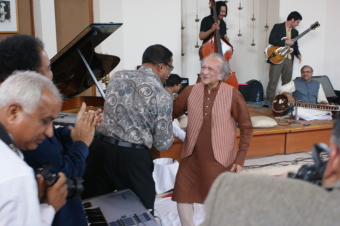
The infusion began a few days before, on Valentine’s Day, behind the closed doors of the Ravi Shankar Institute of the Performing Arts in Delhi when Herbie Hancock and Shankar finally had a chance to get together, along with George Duke and the tour’s other members. [Editor's note: Check here for more specifics of the encounter.] In this private setting, the experimentation took on a more informal tone than at the public concert and a true ambassadors' dialogue opened between the two democracies. The encounter was conveniently timed for Hancock as well, as he’ll be collaborating with, among a host of Indian artists, Ravi’s sitarist daughter Anoushka on his upcoming album.

Hancock and Shankar did not perform together at the invitation-only concert on the following Monday. Yet the event was still a memorable one, and allowed the guests to catch a rare appearance by Hancock, Duke, Dee Dee Bridgewater and Chaka Khan, as well as Indian legends such as tabla master Zakir Hussain, in the jazz-starved culture of New Delhi. Consider the rarity of a concert about which the musicians are as excited—or even more excited—than the audience. The trip, sponsored by the US State Department in partnership with the Indian Council for Cultural Relations and the Thelonious Monk Institute of Jazz, was a bold one and the first of the Obama administration, perhaps signalling a rejuvenation of jazz abroad programs.
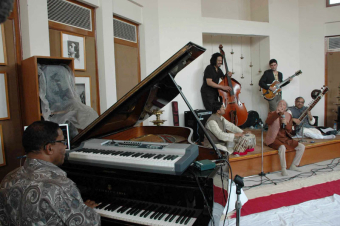
Accompanied by the Thelonious Monk Institute of Jazz Septet, a rotation of the four headliners led a tutorial on jazz history, sweeping through versions of domestic standards by Duke Ellington and Miles Davis. Hancock kept the crowd enthused by jamming with the Monk students on his own “Chameleon.” The chemistry between Duke and Hancock, still strong from coinciding tours of Europe through much of the 1970s, created an effortless blend of piano and electronic sounds. Hancock, in between his efforts on acoustic piano, controlled the sound of Duke’s keyboard with a laptop, with his back to the crowd. Hancock at times felt just as creatively engaged as he’s seemed on many of his recent collaborative albums, with thoughtful but concise solos and reserved comping. Yet, much to the dismay of the crowd, who gave a standing ovation when his name was announced, Hancock’s contribution to songs such as Duke’s “It’s On” were barely noticeable.
Dee Dee Bridgewater stuck to a strictly jazz path, but did it with fervor and respect. On “All Blues” her scatting danced with tenor sax and trumpet solos. With the students doing their best to overcompensate in the presence of greatness, and the stars trying to let all shine, meeting somewhere in the middle was a process that required patience from all participants, but it was worth it if even if only for a few moments of head-bouncing awe. Duke and Khan chose the fallback of funk-based grooves on songs like “A Night in New Delhi,” but also dramatic upbeat transitions, as in the 5/4 meter on Duke’s synth-driven “Brazillian Love Affair.” Duke announced, with the tone of a preacher delivering his sermon: “One thing I understand: Gandhi and King understood the blues.”
When the US State Department began tours of the Middle East, Eastern Europe and South Asia as part of its Jazz Ambassador program, first with Dizzy Gillespie in 1956, it hoped that the proliferation of such a free art form as jazz might overshadow a track record of questionable foreign policy. In fact, the struggle for civil rights was still strong in the homestead, epitomized in the figure of a minister named Martin Luther King Jr., who’d recently organized a successful boycott of the Montgomery, Alabama bus system. His inspiration behind what he referred to as his month-long “pilgrimage” to India in 1959 was drawn from the writings of Mahatma Gandhi, which he’d read as a student at Morehouse College. His tour, however, was not government sponsored.
The pressed suits occupying the first three rows at the concert—diplomats from many countries alongside Indian and American politicians—made it clear that the government was heavily involved in the week-long tour through New Delhi and Mumbai (both cities hosted concerts) from February 13 to 18. The goal was as much to let Indians know that there are still Americans who value nonviolence—perhaps the voice of a new administration making itself heard—as it was a chance to nurture a jazz audience that had once thrived in India back in the 1960s.
Ending their encore with the rolling raga “Raghupati Raghava Raja Ram,” Gandhi’s favorite prayer, the roles were reversed: the Americans were doing their best to learn the tunes the audience knew best. Once the voices of hundreds of Indians joined in from the seats, it seemed they’d finally achieved the harmony they’d been trying for.
This blog entry posted by Brian Dwyer
Tags:

The article should make clear that Ravi did not actually play but nonetheless became very active in orchestrating the exchange between Indian musicians and the Hancock group.
How amazing! I'm so proud that two musical greats: Ravi Shankar and Herbie Hancock were in India to celebrate the 50th year of Mahatma Gandhi's influence on Dr. King.As an Indian living in America and an SGI member I'm so excited about the travels of Herbie Hancock to bring about closer relations between countries, what better way than through music!Wish I could have been there! Leenatha Reddy Berger