The Jazz.com Blog
March 29, 2009 · 0 comments
The Bad Plus in Washington, DC
David Tenenholtz recently reported here on a Duke Ellington tribute concert and Benny Golson’s 80 birthday gala. Now he offers his impressions of a performance by The Bad Plus at the 9:30 Club in Washington, DC. (Site visitors may also want to check out Stuart Nicholson's recent interview with The Bad Plus here.) T.G.
On Thursday the iconoclastic trio The Bad Plus performed in Washington, DC at their regular stop in the city, a bare-bones rock venue called The 9:30 Club. The trio, known to develop their varied repertoire from musical high-water marks in genres outside of standard jazz, delved into their schematic program starting with “Variation d’Apollon” by Igor Stravinsky. Following the opener, two originals were played, the first by pianist Ethan Iverson called “Mint” and the second by drummer Dave King called “Anthem for the Earnest.” On the latter, Iverson’s hammering on the overly-bright piano evolved into a solo where, for once, he did not sound like a precocious piano student wandering through some disjointed melodic gestures. Instead, he executed oddly arpeggiated groupings with precision, and maneuvered throughout the keyboard’s upper register with an emphasis on where he was going and what to play next.
Throughout the first half of the program, the collective took time to develop a few solos with zeal, but the inclusion of some challenging modern classical music left little room for improvisation other than independent solo features. György Ligeti’s “Fém (Etude No. 8)” and “Semi-Simple Variations” by Milton Babbitt both displayed some bombastic, impulsive bursts from King on two separate features. Segueing directly into “Big Eater” from the trio’s album These Are the Vistas, King’s muscular wood-chopping caused his drumstick to splinter and finally crumble on the ride cymbal.
Ornette Coleman’s “Song X” was a welcome inclusion, but after the head statement, Iverson laid out, choosing instead to stroll on Reid Anderson’s bass solo. King, employing some homemade percussion, also pulled out a toy duck, pressing it into the snare head to see if it might squeak, which it didn’t. Anderson’s strumming brought the other trio members in again, stating a fragment of the Coleman melody out. The beauty of including a free jazz tune in light of some of the solo-less modern classical works was that the band might engage more on an improvisatory level. No such luck; the truncated Coleman classic felt hurried.
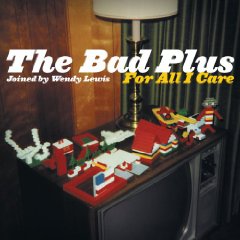
Having quickly played through a few originals, some newly-incorporated modern material from their latest album For All I Care, and the lightly regarded Coleman tune, the trio was then joined onstage by Wendy Lewis. In one tiny package that resembles Daria from the 1990’s MTV show of the same name, Lewis can offer the lilting pathos of Billie Holiday, on-stage comfort of Patti Smith, and powered up belting of Bette Midler. She is a thought-provoking vocal performer, whose participation on For All I Care, and in live performance, is a perfect addition to the trio.
Beginning with Nirvana’s “Lithium,” the quartet presented a naturally flowing second half of the set. “Radio Cure” by Wilco followed the Nirvana hit, and the breathy Lewis delivered warm, serene phrasing. The group let the song build from Iverson’s crystalline chords displaced against a bass and drum hard-edged accompaniment. Toward the end of Iverson’s chaotic solo, the chord progression to the song emerged slowly, but overtly.
The classic rhythm and blues hit “Blue Velvet” by Bernie Wayne and Lee Morris was unexpected, and given a “deranged” treatment. King’s cocktail drumming offset Lewis’s crooning. The 12/8 meter is essential to this song, and the band used it effectively before a return to the murky atmosphere created on the theme. Iverson jumped out again with a solo that took rough elements from ragtime piano staples like Joplin’s “Maple Leaf Rag,” but with less rigidity.
After “Blue Velvet,” Lewis and the trio presented the equally dark “Feeling Yourself Disintegrate” by The Flaming Lips, which was another extended feature for King, where the audacious drummer moved from a manic backbeat into a marching band lead snare style. Taking The Bee Gees’ “How Deep Is Your Love” for a stroll, the band prolonged this ballad, and Iverson added some side-slipping, dissonant accompaniment. Anderson played bass and also sang high harmony on Pink Floyd’s “Comfortably Numb” with Iverson rolling large chords, making the tune come alive with an icy sea of piano abyss. To end the set, Lewis busted out on “Barracuda” by Heart, and for the encore, Anderson sang solo on Neil Young’s “Heart of Gold,” to be joined by all members singing four-part vocals on the refrain.
The Bad Plus have helped create the niche that redevelops music outside of jazz to new emotional ends, while retaining the quality of freedom inherit in much of the jazz tradition. Not all rising performers have the scope to present such challenging material as The Bad Plus so often do. Although on this night, they may have placed too much emphasis on moving through all of the selections, as opposed to extended interplay. Knowing that this band is hardly blasé about the nuances of their presentations, it came as a surprise that only Iverson was given the space to dig in with the support of the other two bandmates.
This blog entry was posted by David Tenenholtz.
Tags:

Comments are closed.