The Jazz.com Blog
March 03, 2009 · 3 comments
The King of Western Swing (Part 3)
Below is the third and final installment of my three-part article on Bob Wills and his Texas Playboys, a pioneering ensemble in combining jazz and country music styles. The occasion for this essay is the recent release of The Tiffany Transcriptions, which captures some of the band's finest work from the post-WWII era. Click here for parts one and two of this article. T.G.
Everything was golden for Bob Wills in the early 1940s. He signed an eight-picture movie contract. He was advertised as the "Best Selling Columbia Radio Band." His biggest hit "New San Antonio Rose" was widely imitated (Bing Crosby's cover version was an even bigger hit than Wills' version), and during this period, Wills recorded many of his most popular songs, including "Time Changes Everything," "Cherokee Maiden," "Maiden's Prayer," and "Take Me Back to Tulsa"—which he performed in the 1940 movie Take Me Back to Oklahoma.
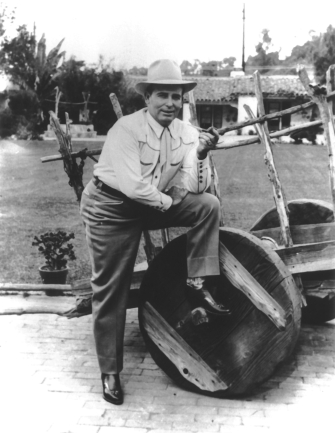
And "Western Swing" was an exciting new style with a growing fan base. This mixture of country music and swing jazz was one of the first crossover styles in modern American music, and it found a receptive audience that reached outside the typical demographics for the hot bands of the day. Except in Hollywood, that is . . . where the movie industry execs wanted Wills to drop the jazz elements of his music (so he could fit more naturally into cowboy films).
How did Wills describe his role in this innovation. He was characteristically low-key in his explanation: "It was nobody intended to start anything in the world. We was just tryin' to find enough tunes to keep 'em dancin' to not have to repeat so much."
In the postwar years, Wills still was a big draw and a popular recording artist. And his music continued to evolve. In 1949, he took "Ida Red," an old fiddle tune that had been a hit for him in 1938, and rerecorded it with a boogie woogie beat as "Ida Red Likes the Boogie." This record spent 22 weeks on the charts, and peaked at number ten. When Chuck Berry recorded "Maybellene" in 1955, fans could hear its derivation from Wills' original "Ida Red." The man who had bridged jazz, blues and country showed that he could even get the attention of rockers.
Yet Wills remained the only constant among the Texas Playboys. By this time, none of the original members of the band remained except the leader. Singer Tommy Duncan's departure was an especially big blow. Wills had auditioned 67 singers before hiring Duncan back in 1932. Duncan was singing for tips in front of a root beer stand in Fort Worth, and Wills listened to him late into the night before making a decision—he finally asked Duncan to sing "I Ain't Got Nobody," a tune Wills had enjoyed hearing Bessie Smith sing, and Duncan's performance earned him a job. This choice was a key factor in the band's success. Duncan's personable, resonant voice grounded this sometimes frenetic ensemble, and it was hard for fans to hear Wills' music with anyone else singing lead vocals. Fans were rewarded with occasional reunions, and as late as 1960 Wills and Duncan collaborated on "Heart to Heart Talk" which would reach number 5 on the country charts. This would be Wills' last hit single.
Again and again on The Tiffany Transcriptions, which capture Wills' syndicated radio broadcasts during the postwar years, Duncan stands out, handing a wide range of material. He refuses to adapt his sound when he is moving into jazz or blues territory, and this assured sense of his own personal take on the proceedings is one of the most endearing qualities of this vocalist, whose work is too seldom remembered these days.
But even under the best of circumstances, Wills glory days were bound to past. Anyone who thought that the future of American popular music would come about through a marriage of jazz and country was sadly mistaken. Jazz itself was in decline, and at the close of the 1940s big bands were an endangered species. The public's musical tastes are fickle, and the Western Swing sound that had once been fresh and provocative, was soon cast aside by fans in search of the next new thing.
Wills himself ran into financial problems in the early 1950s, the result of double dealings by his lawyers and accountants. He would eventually regroup and his career would continue for another two decades. Wills died from pneumonia at age 70 on May 13, 1975 in Fort Worth but (true to the word of one of his biggest hit songs) he requested that his body be "taken back to Tulsa" for burial. But his legacy lives on, centered mostly on his remarkable work in the 1940s, when the stars were in alignment for this seminal figure in American music. The recent reissue of The Tiffany Transcriptions gives us a good reason to celebrate Bob Wills and hear him at the peak of his career.
This is the third and final installment of Ted Gioia's article on Bob Wills and his Texas Playboys.
Tags:

A-hah! Take it, Brother Ted!
I recently came across your blog and have been reading along. I thought I would leave my first comment. I don't know what to say except that I have enjoyed reading. Nice blog. I will keep visiting this blog very often. Sarah http://www.lyricsdigs.com
Yes, Wills was in some bad transactions in which naivete played a role. However he also was over extended-- he actually thought his ranch in California might become a retirement haven for former Texas Playboys. And, his disastrous experience owning a nightclub in Dallas should have been a lesson to musicians of all time, but Willie Nelson would go on to lose plenty of money in Dallas during the "progressive country" craze of the 1970s. I would still love to understand why the Tiffany Transcriptions tower above a body of work that's already undisputably great. Boy, were they hot!