The Jazz.com Blog
March 09, 2009 · 0 comments
Kahil El’Zabar in DC
Michael J. West, a regular contributor to these pages, recently covered Oliver Lake and Benny Golson in this column. Now he reviews Kahil El’Zabar’s Washington D.C. show with his Ethnic Heritage Ensemble. T.G.
Contradiction Dance in Takoma Park, Maryland, was once Sangha, a fair-trade store and community center that hosted dozens of avant-garde performances before closing in 2007. But Transparent Productions, a local jazz promoter, recently made a deal with Contradiction Dance to revive the performances—just in time for Kahil El’Zabar’s annual D.C. show with his Ethnic Heritage Ensemble on February 27.
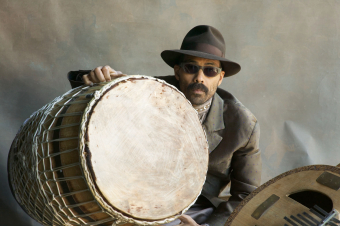
The Ensemble (now featuring El’Zabar on drums, kalimba, and percussion; Ernest Khabeer Dawkins on alto and tenor sax; and Corey Wilkes on trumpet and cornet) is touring their new CD, Mama’s House Live: 35th Anniversary Project, recorded live at Sangha just before its closure. The evening bore little resemblance to the disc, but it was one of the most inspiring concerts in recent memory.
El’Zabar stepped before the studio’s mirrored wall and began plucking his kalimba, which apparently sent him into a trance: He began shaking his head violently but steadily, as though mechanical. But when Dawkins’ tenor and Wikes’ trumpet entered with a slow, Afro-soul melody, he came alive again, grunting and humming; the guttural sounds built into a singsong chant that established the song’s title: “Pharoah…Sanders!” El’Zabar was in a spiritual fever; his solo was melodious but faltering, as if he were flummoxed by his own ecstasy.
“To Be Continued” found El’Zabar behind his drum kit, playing traditional swing behind little more than riffs on the horns. The simplicity didn’t last. Wilkes played with wild, growling intensity, briefly switched to cornet, and was suddenly working both horns at once. Dawkins played both his saxes, too, the two of them blasting into a short, mad duo on “When the Saints Go Marching In.” Dawkins played a muscular solo with trumpet-like bursts, followed by El’Zabar with an astonishing trap workout—heavy on the bass drum but with lightning-quick snare and cymbal flashes.
Out came a large earth drum, a freestanding hand drum which El’Zabar noted that he’d made, for “There It Is.” He also called up Terence Nicholson, a local hip-hop poet better known as Sub-Z, to join in. Sub-Z didn’t disappoint: His recitations were surreal in content and percussive in delivery, losing no momentum when El’Zabar began chanting behind him. The drummer’s solo was distinctly primal, perhaps tribal—though it sounded less sophisticated than it really was, the skin struck with one hand while the other elbow muffled the sound.
As exhilarating as the first set was, the second was actually superior. The first (unnamed) piece had a 6/8 groove and a melody reminiscent of Coleman’s “Lonely Woman.” El’Zabar, again chanting, alternated the beat between small tom, snare rim, floor tom, and bass; Wilkes, playing 4/4 against him, went on a virtuosic rampage through the stylistics of Armstrong, Gillespie, and Bowie (whom 29-year-old Wilkes succeeded in the Art Ensemble of Chicago). The reprised head took a turn towards the gutbucket, with El’Zabar muttering like an ancient bluesman; it was a miniature throwback to some old southern roadhouse, yet completely contemporary.
As he strapped on his ankle bells, El’Zabar talked about his 14-year-old son Kahari. “He’s kicking my butt,” he said, recounting how Kahari had done less than stellar on a recent test. He sounded more amused than annoyed, though, and demonstrated his affection with the tune “Kahari Walk Tall,” the night’s most moving. El’Zabar played a pretty, slinky groove on the kalimba, the backbone of an elegant but tense ballad for alto sax and muted trumpet. Dawkins’ performance was the finest, starting in the alto’s lowest range but zooming up into a sweet, tender line laden with pathos. Wilkes followed with a long, circular-breathed A natural, fluctuating it by swooping his body up-and-down and side-to-side, then settled into a longing melody in sotto voce. El’Zabar’s solo equaled his bandmates for sentiment, but its tone was less polished than folksy; humming over his lithely picked kalimba, he might have been playing on a Smithsonian Folkways record.
At that point the music stopped for a moment. El’Zabar was strapping on the earth drum again, but also pontificating: It was something between a sermon and a cultural history lecture, musing about Dizzy Gillespie’s creative intellect and legacy, and describing American arts with the odd but on-the-nose phrase “miscegenation of cultures.” Then came an uproarious “Salt Peanuts.” Wilkes emitted a bop solo, spacious but crammed with ideas; Dawkins stacked up short, bluesy phrases and quoted Monk’s “Rhythm-a-Ning”; and El’Zabar shot forth a lung-powered scat. The end brought the evening’s only flub: El’Zabar called for a return to the horn line but Wilkes and Dawkins, lost in counterpoint, missed it.
After a short respite, El’Zabar brandished the kalimba and ankle bells once again. “We’re going to do one more, on the other side,” he said, and launched into an incantation in what sounded like Swahili. The horns—tenor and cornet—played a nostalgic, faintly dark horn melody that very much bookended the opening “Pharoah Sanders.” Mostly it consisted of the trio vamping, with Dawkins repeating the five-note phrase from Coltrane’s “Ascension” and Wilkes doing a West African shuffle.
The concert was a wild ride, veering from fervent ecstasy to deep emotion and back again. El’Zabar remains the most interesting percussionist alive, and his ability to translate a spiritual profundity into his fusion of African and American traditions is without parallel. Any performance by the Ethnic Heritage Ensemble is to be treasured.
This blog entry posted by Michael J. West
Tags:

Comments are closed.