The Jazz.com Blog
April 12, 2009 · 3 comments
Jerry Bergonzi at the Acton Jazz Café
Roanna Forman, who covers the Boston jazz scene for jazz.com, recently reported in this column on performances by Stan Sagov, Jimmy Heath and Brad Mehldau. Now she reviews Jerry Bergonzi’s appearance at the Acton Jazz Café, a regular Wednesday night engagement that shouldn't be such a well-kept secret. T.G.
By the blazing (video image of a) hearth—God love the Acton Jazz Café for its offhand camp—tenor saxophonist Jerry Bergonzi, bassist Bruce Gertz, and drummer Bob Kaufman (or KGB if you rearrange the names a little) recently stoked some real musical fire at this longtime Boston area jazz haunt. With special guest Vito Di Modugno on B3, they pretty much ran standards, packaging them with the monstrous chops and relaxed assuredness of master improvisers.
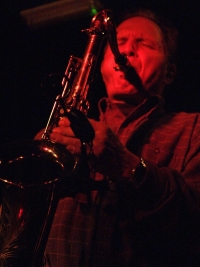
It was an interesting evening to hear Bergonzi, whose latest album Tenorist with John Abercrombie among others, features all original compositions, which are angular and modern though informed by bebop and, of course, John Coltrane, with whom Bergonzi has two things in common—stylistic affinity, and a searching, experimental sensibility. However, for live performance the band picked familiar tunes, so that Di Modugno could jump right in. So you got a chance to see what Bergonzi would do with some Real Book classics, and to hear how high-level musicians blow on what for them is essentially a jam.
They began with Miles Davis’s “Solar,” swinging it with the tenor starting things off. (That was the arrangement for all the tunes, although the order of solos varied). After stating the theme, Bergonzi was well oiled and running melodically and harmonically inventive lines. Bruce Gertz weighed in with a feathery, swinging LaFaroesque solo. Bob Kaufman’s rolls introduced the timbres of his various drums, readying each one for action. Kaufman has a “zone-like” stage presence; he literally looks like he’s riding the groove with his eyes shut. The B3 then fell into place with a solo built on increasingly complex lines, speed, and rhythmic variation.
Next, Bergonzi set “The Night Has a Thousand Eyes” over Bruce Gertz’s pedal point, with intensely rapid saxophone runs. The organ worked some oblique ascending and descending chromatics, and built fast lines topped by arpeggios, then went full throttle into fat block chords that milked the drama of the instrument. On “Thousand Eyes,” and throughout, you began to see the communication that comes not just from musicianship but from years of playing together. (Kaufman, Bergonzi and Gertz first hooked up in the late seventies.) They support and tune in to each other’s rhythmic and melodic variations naturally at this point. Bergonzi’s harmonic sophistication and beautiful tone was also evident as he floated over the bass pedal point at the end.
For a ballad, they chose Matt Dennis’s hard-luck lament, “Everything Happens to Me.” After a clean, contemplative reading of the head, Bergonzi gave the floor to Gertz, who coaxed a contrabass Bachian feel out of his instrument. Bergonzi’s own solo worked into some polyrhythms and then pulled back down into a swing feel anchored by a solid pocket. The organ’s romantic lines led to a close with mallets, bowed bass, and sax cadenza packaging and wrapping this fine tune.
“On the Brink” used changes based on “Confirmation.” This must be one of Bergonzi’s favorite progressions, since “Confrontation” in his CD “Between the Lines” is based on the same Charlie Parker tune. The rhythm section set up a New Orleans groove under Jerry’s solo, which reached into the sax’s higher register. When trading fours turned into a swaggery duet between the sax and drums, you could tell these musicians were a longtime unit, like dancers who intuitively pair off into the right steps.
In “Have You Met Miss Jones,” Bergonzi switched from the squawks of the previous tune to a sweeter, more melodic sound. Bruce Gertz built an exciting solo referencing the opening bars of the song, with some solid double-stop playing. Turning to blues, the group put Monk’s “Nutty” into a 12-bar form, although it’s usually played on rhythm changes. In contrast to Bergonzi’s and Gertz’s swift-moving runs, Kaufman started his solo minimally, leaving spaces, like paused speech, working into a straight-ahead feel for the close.
Then, setting up a brisk “Softly (As in a Morning Sunrise)” at blowing tempo, the group moved pretty quickly toward the dawn, with Di Modugno adding gelatinous, bluesy modal work and Bruce Gertz bowing a solo that moved like speedy low-lying animals. An ending referencing “A Love Supreme” paid homage to one of Bergonzi’s key influences.
I guess my only regret was that not much of the world was there to hear world-class jazz that evening. But Bergonzi and friends play every Wednesday night in this little suburban Mecca. Worth the journey.
This blog entry posted by Roanna Forman
Tags:

3 responses so far
Good post, it should have been a nice evening musical evening.
An excellent review with its own color adding to what was a supurb evening. I really enjoy Ms Forman'touch.
really like the site. i enjoy reading reviews.