The Jazz.com Blog
April 14, 2009 · 22 comments
The Rise and Fall of the Clarinet (Part 2)
What happened to the clarinet? It once was the defining instrument of jazz, and in the hands of Benny Goodman, Artie Shaw and others helped launch the Swing Era. But now it has become a "miscellaneous instrument"a sideline for artists who mostly play sax. Michael Pellecchia continues his looks at the rise and fall of the clarinet below, in the second installment of this three-part article. Check out part one here. T.G.
After World War II, the selfsame Benny Goodman who had previously recorded with Bessie Smith could afford to commission Aaron Coplands Clarinet Concerto in 1947. Meanwhile, the kids from the Palomar Ballroom and Carnegie Hall had moved on from the swing dances and concerts of their callow youth. Now it was the new against the old. Traditional jazz made a comeback and Bird lived. When instrumentalists took themselves off the market, singers filled the breach. Small groups led by the likes of Benny Goodman and Artie Shaw still created definitive swing with clarinet in the lead.
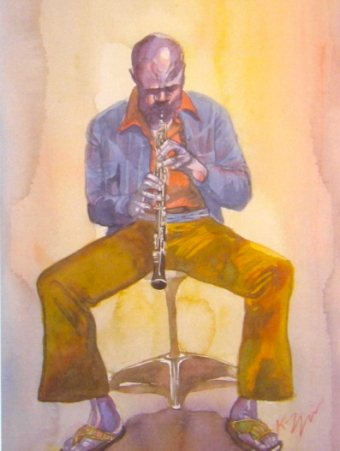
A generation after it helped spawn jazz, the licorice stick went out with a bang. The new instrumental stars were Dave Brubeck, Chet Baker, Count Basie, Stan Kenton, Miles Davis. Were singers calling for clarinets on their gigs? Two word answer: Frank Sinatra.
Clarinetists found other work. Dave Brubecks great clarinetist, Bill Smith, is a distinguished composer. Harry Belafonte had a musical director named Anthony Sciacca (Tony Scott) who is still considered one of the most under-rated jazz clarinetists; he won the Downbeat polls for clarinet in 1958 and 1959.
Duke Ellingtons stable of clarinetists is legend, including Barney Bigard, Russell Procope and Jimmy Hamilton. Though he lost popular favor in the 1950s, students of Ellington are still in awe of his soloists and the beautiful music they made.
Jimmy Giuffre brought the cool to clarinet in the 1950s but was still called over-rated by a 1957 Esquire magazine reviewer. By this time, it was firmly planted as a Dixieland instrument. Yet even as the jazz worlds tastes changed, dozens of imaginative clarinetists never abandoned the axe: Omer Simeon, Irving Fazola, Peanuts Hucko, Albert Nicholas, Edmond Hall, Herb Hall, Mezz Mezzrow, Leon Rappolo, Joe Darensbourg, George Lewis, Tony Parenti; the list is endless.
One of the most successful traditionalists is New Orleans Pete Fountain, who rocketed to popular fame in 2 short years on the Lawrence Welk TV show and left, as he says, because champagne and bourbon dont mix. Millions of viewers supported him for decades after, as pilgrims to his nightclub and buyers of his dozens of best-selling albums full of jazz and contemporary cover tunes during the 1960s and 70s. He hardly ever saw a tune on the charts that he could not re-interpret on clarinet, with the help of his erstwhile arranger Bud Dant.
Bob Wilber once told Whitney Balliett that perhaps Benny Goodman had set such a high standard for clarinet; who could follow him? Pete Fountain did! But clarinetists have a high tolerance for exasperation, and the challenges they have faced on the licorice stick can refine talents applicable (and better paid) in many areas of high achievement. Yes, I bet the IQ of clarinetists is above average. I think of Leon Breeden, a more than serviceable jazz clarinetist who became a music teacher and put Denton, Texas on the map as a school for jazz. Early in his career he self-published a book and record called Fun With The Clarinet.
If you can play Brahms, why learn bebop? Leon actual did make it fun. You played along with him and he overdubbed himself into a clarinet choir. He gave exercises that swung.
Fun, yes to a point. With no other instrument does the player have to cover holes completely with his naked fingertips, while manipulating side keys for the chromatics and substitute fingerings necessary to follow in the footsteps of Bird or Diz. And, be a woodpecker in reverse just to get a decent sound.
The jazz listening ear moved quickly past the clarinets favorite jazz lickthe diminished triad. Coleman Hawkins made the passing chord sound good on sax. Along the veritable (and venerable) Route 66 of popular music, on a typical piece of vintage Tin Pan Alley sheet music, the ukulele or guitar chords will tablature as diminished. Todays fake books will substitute the musical superhighway of ii-V substitutions which keep things dominant. This is not inherently good news for a classically-trained clarinetist, relegated along with diminishment to the Route 66 of jazz. Buddy DeFranco fearlessly and effortlessly commands any ii-V sub, and still found time to command the ghost band of Glenn Miller from1966-1974. Eddie Daniels has so many recording credits as a saxophonist, one might be forgiven for not knowing his breathtaking clarinet jazz. High virtuosity has not brought high fame or the big bucks to clarinetists. Its brought a lot to music, though. Composers are still ravishing the clarinet; I think of Roger Kellaway who has written for both Paquito DRivera and Eddie Daniels. . . .
This blog entry posted by Michael Pellecchia. Check back soon for the third and final installment of this article.
Tags:

Scenic route vs. superhighway -- an apt metaphor, there. Hard work, getting a handle on the clarinet, but entirely worth the effort. Most grueling such exercise I ever experienced was a week-long clarinet workshop with Benny Goodman (via the Amarillo [Texas] Symphony Orchestra and the local school district)... Two high-school first-chairs and a couple of us junior-high kids who had displayed some promise... Came away from that boot-camp endeavor with some lasting chops and a heightened respect for the instrument. The Great Man, B.G. His Ownself, was a bit of a martinet -- and more power to him. Nonetheless genial, though, and generous with the praise when some result pleased him. Brusque and demanding, but encouraging. Learned more in a week under his tutelage than I had absorbed in half-a-dozen years of Conservatory. And the experience lent new depths of meaning to all those Goodman platters in the folks' record cabinet...
Jimmy Giuffre overrated? By whom? I always thought of him as going outside without honking. But then most people don't honk on a clarinet do they?
I tested my own theory by taking my clarinet to the local jam session last night. It's led by a pianist in his 70's and the average age of the players and audience is probably about 60. I sat down with a friend who said he'd already read my blog here on jazz.com. He saw the clarinet in my hand and told the two women with him that I also played bass clarinet (almost apologetically). There was a bari player and a trumpet player on the stand. I've been here before and my tenor sax always gets a nice reception. I sat through a few numbers and got the axe out for Summertime, followed by Green Dolphin Street and Song for My Father. On the first tune the horn was still cold. My bad. I attempted to play in the chalumeau register but could not attain any volume. I thought briefly about the "power trip" some people do by talking so you have to get close to them to hear. I tried this for a few seconds but realized it might look more like pantomime. So I cut to the chase and headed for the clarion. It sounded thin against the banging piano chords and electric guitar. I went back to the lower register and with no mike, hopeless. On Green Dolphin I was joined by a young bebop trumpet player and a serviceable bari player. This time the drummer went for the pieces on his kit which would drown me out, consciously or otherwise. The young trumpet player tried his best to ignore the clarinet as if it were from another planet. On Song For My Father, they simply didn't allow me a solo. As I said, the reception for my tenor playing is usually fantastic. I am self-taught on sax and have only had lessons on clarinet (masters degree in performance). So, this laboratory experience seemed to confirm my blog. There is one clarinet player who can play as much as he wants at this regular weekly session. His name is Brad Terry and he is a legend among the clarinati. However, last few times I saw him he might play one chorus on the clarinet and then whistle the rest of the tune. You gotta hear this guy whistle....
We're fortunate to have some very good clarinet players here in the Chicago area. Two of my favorites are Kim Cusack and Eric Schneider.
Michael, I'm a bit confused by this statement..."After World War II, the selfsame Benny Goodman who played hot solos on the 1920s Bessie Smith shellacs..." According to Tom Lord's Jazz Discography on CD, Benny only recorded one time with Bessie, in 1933, on one track which is available on Bessie Smith, The Complete Recordings. Chris Albertson's liner mention Benny on Gimme a Pigfoot, stating "one barely detects his presence." Although I think your article is interesting and makes some excellent points, I'm very disappointed when I read an article this is historically inaccurate. It seems that way too many current jazz writers are trying to rewrite jazz history. I cringe to think what the future holds for jazz journalism. Sincerely, Chris Tyle
Hi Chris, It's possible Benny was on that entire session, on as many as four tracks. That said, there is no evidence of "hot solos" on any of them. So, you are absolutely right. Consider me corrected. Would you mind clarifying what you mean by too many jazz writers trying to rewrite jazz history? In the next sentence you mention "jazz journalism" and I have always heard that journalists are responsible for most of the inaccuracies in what we take to be "jazz history."
I suppose the overriding question is why the clarinet seems to have largely fallen out of favor with the advent of the so-called modern era of jazz that commenced with what is commonly referred to as "bebop." Did it have to do with (mis)perceptions perhaps that the clarinet couldn't keep up with the breakneck tempos and velocity favored by bop musicians? Was it somehow considered a corny member of the traditional jazz pantheon not worthy of being modernized? Its a curious question that one might ask such survivors of that era as James Moody or Jimmy Heath. As far as the 21st century pantheon of clarinetists, don't sleep on Evan Christopher who's based in New Orleans and has one foot squarely in the ancient, another in the future (as likely to excel at "Nuages" as he is Ornette's "Lonely Woman" or "Ramblin'".
Michael, I suppose it IS possible that Benny was on the whole session, but since he was recording with bass saxophonist Adrian Rollini on a session in another studio, and he can't be heard on any other of the titles, I would suspect he is only on that one title - btw, recorded in 1933, produced by his future brother-in-law John Hammond who likely is responsible for the info that Benny was only on the one side. If you writing about jazz history, why not get the facts straight? Is it THAT difficult to do a modicum of research? But I guess I should expect that from someone who obviously doesn't know what a journalist is. From the Webster-Merriam dictionary: 1 a: a person engaged in journalism ; especially : a writer or editor for a news medium b: a writer who aims at a mass audience. Someone like yourself... Chris Tyle
Chris, I will give my opinion as to "why not get the facts straight." And why I asked you to expand on your idea about jazz history and what it has to do with jazz journalism. Attacks using facts as the high road reflects a medieval guild mentality that has kept jazz from expanding. Scholarship is a uniquely subsidized form of journalism, which got its start in jazz lore by criticizing those who reported on being around musicians first hand. Facts and accuracy created the hinging effect for the academy and the writers to play see-saw. I love metaphors and vivid descriptions. The idea that Benny played hot solos with Bessie Smith is far more important to me than what John Hammond might say, even though he arranged the session. That is why I don't bother to get the facts straight. I'm just pursuing ideas within the realm of likelihood. I do not have a subsidy for "getting the facts straight" on a blog entry... and by the way, there's been some discussion in various places which distinguish journalism from blogging. I don't check the dictionary much, but you did talk about cringing at the future of jazz journalism. I think you meant you "shudder" over the prospect of what might come. Wouldn't "cringing" be something you are doing right now while reading these inaccuracies?
Obviously, you are entitled to write whatever you please. My concern is, as a historian, musician and writer, that if something is presented in a factual way ("Benny Goodman didn't double on sax"), that the accuracy of a statement like that is taken at face value by readers who don't know the true fact that he DID double on alto. I don't see how presenting the correct information can impinge upon your creativity. Personally, after reading all the inaccuracies in your article I came away wondering if anything in it was actually factual or whether the whole thing was fiction - especially since I work with a lot of clarinet players. Jazz history is still filled with much misinformation and misconceptions. Why make a situation that is already bad, worse? Just for your own sake? I personally don't get it. What does it actually do, in the long run? I suppose it pleases you, but is that the ultimate direction of your writing? By misinforming readers? Why not just write fiction? But then even fiction writers do some research... Your going to have to explain to me how the study of jazz history and journalism have kept jazz from expanding. As I see it they have done the opposite. If people don't spend the time to research and write about a subject, how is anyone going to know about it? BTW, you are absolutely right about my misuse of the word "cringe." I did mean shudder. But I wasn't shuddering when I read the inaccuracies in your article. I was irritated and saddened, really, because as someone who cares a great deal about jazz history and the people who created jazz music, I believe that it's important for those who study the music in the future to be able to know the truth about what happened - as best as can be ascertained. Sincerely, Chris Tyle
You hit the nail on the head that my blog is fiction, as defined by some by not enough research. POV trumps all in my opinion, and future readers be damned, as we have all been, by the prideful boasts of erstwhile jazz knowledge gatekeepers. After Part 3 is published, and I can't even remember what was in it, I hope that attention will be paid to individuals such as Evan Christopher whose artistry far surpasses the challenges of the instrument they have chosen-- as has Buddy DeFranco's-- and get right back to the heroic part of jazz, clarinet style. I can't imagine how the equivalent goal could be set by quibbling over discography.
I wholeheartedly agree that attention NEEDS to be given to players like Evan Christopher. I would like to also mention Tom Fischer, Tim Laughlin, Carl Hird, Allen Vache, John Defferey, Orange Kellin, Thomas L'Etienne, et. al., I could go on and on. There are a LOT of fine clarinetists in the world, if one only takes the time and inclination to find their recordings or to seek them out in live performance. IMO bringing attention to great musicians who are undervalued deserves just as much time and effort as understanding the value of conscientious and accurate research into jazz history. Sincerely, Chris Tyle
Hey Mike, I met and knew you 39+ years ago in Texas, but I had no idea that you wrote so well. I certainly look forward the third installment of your clarinet article. Thanks a lot for sending them to me, and let's keep in touch. Later, Don
Chris, Great names you mention and its been years since I've since Tim Laughlin, any word on what he's up to would be appreciated. I do mention some names in Part 3 but not those (except for Vache) so if and so inclined, please do go on and on!
As a writer who occasionally blogs on jazz.com, I am disappointed at Michael Pellecchia's responses in this thread, particularly his admission that "I don't bother to get the facts straight. I'm just pursuing ideas within the realm of likelihood. I do not have a subsidy for 'getting the facts straight' on a blog entry."
This is a shabby copout and a sure sign of intellectual laziness. "POV trumps all in my opinion," Pellecchia asserts, "and future readers be damned, as we have all been, by the prideful boasts of erstwhile jazz knowledge gatekeepers."
My own jazz.com blogs have included nonfiction, such as:
/jazz-blog/2008/7/9/where-copyright-goes-wrong
and humorous fiction:
/jazz-blog/2008/7/2/buddy-bolden-on-the-holodeck
and even a blend of the two approaches:
/jazz-blog/2009/3/16/jazz-com-s-new-expert-translator
In all cases, I strived to get the facts straight. To me, a writer owes that to his readers as an absolute minimum. And in this I take my cue from a far better writer than I will ever be. In the introduction to his book Slow Learner (1984), Thomas Pynchon regrets his past mistakes and concludes: "The lesson here, obvious but now and then overlooked, is just to corroborate one's data, in particular those acquired casually, such as through hearsay or off the backs of record albums. We have, after all, recently moved into an era when, at least in principle, everybody can share an inconceivably enormous amount of information, just by stroking a few keys on a terminal. There are no longer any excuses for small stupid mistakes."
As I see it, there never were. But the larger issue is pretending that bloggers have a license to get things wrong and then, which is even more offensive, pridefully boast of their ignorance. Readers be damned? Sorry, Michael, but as one of those readers, I find your pose shamefully insulting. As far as I'm concerned, you have discredited yourself. But then, I suppose you will take that as a compliment, which is certainly not my intent.
Think this is getting way out of proportion. I don't view blogs as being fictional, and they shouldn't. On the other hand, they can't be researched as thoroughly as a "New Yorker" article. So if there is a mistake, why not (politely) pointing it out (instead of launching an attack), and then (politely) responding "Sorry, I was wrong, thanks for putting it right".
Mr. Pechura: The "proportion" issue is appropriate here. The blog is something in which commentary forms a part of the whole. In fact my first comment to the inaccuracy about Benny blowing hot solos on Bessie Smith records was "you're absolutely right. Consider me corrected." The editor of jazz. com kindly corrected the original statement as well. That was not enough for the commentator. He wanted to parcel out his problems with the article and my writing, at least one per comment it seems. In few other media, can a comment hog joust with an original author in sequence. So I did! This gives a happily long life to an article, but also brings in the proportion issue. It also brings on such an absurd statement that I could discredit myself in a commentary, after allegedly also discrediting myself in the article the comments were based on. If I'm such a clown, you will probably never see Part 3 of the clarinet story. The editor will see to it! It makes a good case for an original author staying out of the commentary. However, I feel that commentators clearly have a lot to say, they want to say it, and if I can spur them on, I'm not putting myself above or below anybody, just creating discussion. Isn't it nice that other writers have also been able to open their own jazz.com archives by posting links to their articles from their comments on mine? You are so right though, the issue of proportion comes up. Commenting in the heat of the moment, watching your words appear on screen, and regretting them later, is built in.
It is hard to tell who has taken the most self-righteous tone here. But my vote goes for this statement: "I believe that it's important for those who study the music in the future to be able to know the truth."
I'm crestfallen at losing the Most Self-Righteous Tone Award. I felt sure my entry would win. Perhaps the editor-in-chief's usual acuity has been obscured by hanging chad. After all, Chris Tyle's claim that it's important for those who study music in the future to be able to know the truth is more self-evident than self-righteous. Perhaps I ought to demand a recount. Losing this way hurts even more because I'm not even in the running for Most Pompous Comment Award. That one goes hands-down to Michael Pellecchia for his unforgettable riff: "I don't bother to get the facts straight. I'm just pursuing ideas within the realm of likelihood. I do not have a subsidy for 'getting the facts straight' on a blog entry."
Of course, the commenters here simply love the art form. So the appearance that they are pedantic, self-aggrandizing and holier-than-thou is merely an illusion.
Hey! Pedantic, self-aggrandizing and holier-than-thou is our stock-in-trade! Great series, Mike.
Interesting story for you: I am a housepainter by trade, also an amateur musician, writer, and artist, and I once lived and worked in the area around Kent, CT ('82-'98). Through mutual friends, I met a woman who was a novelist (8 books to her credit, at that time), although I have since forgotten her name. Finding out that I was a painter, she bartered with me to paint her recently deceased grandfather's house, in Sherman, CT, in return for a classical guitar, 10" reel-to-reel tape deck, dual cassette recorder, and other items of interest to anyone with a love for music. The inside of the house had one enormous room with very high cathedral ceilings, a series of sliding glass doors looking out toward a pool, and although the room itself was probably 60 or 70 feet square, the only furnishings in it were a grand piano at the far end, near the sliding doors, and a picnic table and wall bar at the other end. The wall on the left was a full-length bookshelf, with every imaginable book on music, some of them old and probably very rare, and cases and jackets of 78's and LP's, from one end of the room to the other. My job was to paint a couple of the smaller rooms down the hall, where her grandfather slept and had a small private studio, which also had shelves of books and records, and a collection of interesting knick-knacks. As she showed me around, and let me play her grandfather's guitar, I asked her what he had done for a living. She casually replied, "He was Benny Goodman's clarinet teacher." My first response was, "Why would Benny Goodman need a clarinet teacher?" We both laughed, but having experienced more of the music world since then, I realize now that the best of the best never stop learning. I still have the guitar, and every time I pick it up, I think back to where it came from, and who played it before me.