The Jazz.com Blog
April 19, 2009 · 2 comments
Extreme Jazz in Vossa
Stuart Nicholson continues in his quest to cover more jazz events in more countries than any other critic of the present day. His latest trip brought him to Norway for the Vossa Jazz Festival. This is one of the longest-running jazz events in the world, and as Nicholson reports, definitely has not become stodgy and cautious with the passing years, like so many US festivals. Anyone up for a Finnish version of the Andrew Sisters singing in 11/8? How about some music for trolls? Or love songs played by a drum choir? Read on! T.G.
Credit crunch or not, theres not many jazz festivals in the world whose literature helpfully posts the dates of future festivals up to the year 2021. But Vossa Jazz has been around for 36 years and has a sure sense of its identity. Great names have performed there in the past such as Max Roach, Betty Carter and Dexter Gordon while one of this years festival headliners, vocalist Silje Nergaard, even hitch-hiked to Voss as a young teenager in the 1980s to see Steps Ahead with Mike Brecker, Mike Mainieri, Eliane Elias, Eddie Gomez and Peter Erskine.
Voss is in the heart of fjord Norway, one of the most picturesque places in Europe. Sitting between the Hardanger and the Sognefjord fjords, the town is one of Norways top ski resorts with 11 ski lifts and 14 pistes. Yet while its population is not much more than 13,700, Voss athletes have competed at every Winter Olympics since 1948 (with the exception of the1972 games) and won a total of 6 gold, 5 silver and 7 bronze medals. The long list of town over-achievers even includes US Senator Knute Nelson and US football player and coach Knute Rockne.
Although small, Voss has a lot going for it, not least the worlds biggest extreme sports festival, Ekstremsportveko, held in the summer. Events include white-water rafting, para-bungee jumping, skydiving and all manner of sports where one tiny error lands you at the Pearly Gates. The extreme sports festival sponsored Vossa Jazzs major Saturday night event, Ekstremjazz, a free, outdoor event held on the edge of the large lake that provides the backdrop to the town. Wild speculation about what form Ekstremjazz might take preceded the event: a jam session while simultaneously white water rafting? A composition played by descending skydivers? A concerto for a kite-surfing trombonist?
In the event the concert was not quite as ekstrem as the outer limits of imagination; yes, there was scuba diver riding his BMX into the lake, bikers doing wheelies, paragliders with searchlights descending through the gathering gloom and a jazz ensemble afloat in the lake, but the project was predicated on community outreach.
A drum choir led by percussionist Helge Norbakken from pianist and ECM recording artist Jan Balkes group Pratagraf provided a constant throb of rhythmic activity, while young local dancers enacted a tableau loosely based (it seemed) on unrequited love. Balke himself mediated the ebb and flow of the music from an electric piano, as his guitarist emerged as the prime melody carrier. A large crowd turned out to witness the event, thus raising the profile of Vossa Jazz within the local community. As Trude Storheim, the head of Vossa Jazz said later, We want everybody to have a good time, and there was no doubt she succeeded in her mission.
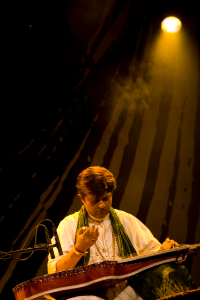
The festival proper took place in the more prosaic surroundings of the Park Hotels three performance centres and three nearby locations. It opened on Friday night with a performance by a group led by the Grammy nominated Indian slide guitarist Pandit Debashish Bhattacharya and his group from Calcutta. A former child prodigy, he has adapted a modified slide guitar to Indian classical music, and has performed with the likes of John McLaughlin in Remember Shakti, while collecting countless awards for his musical prowess in his native India.
The theme of his concert, Debashish Bhattacharya explained, was for humankind to love each other without condition, a nice note on which to begin any festival. Reaching deep into the raga form, his improvisations, based on centuries old traditions handed down the generations, made it clear why Indian music has long held such a fascination for jazz musicians with beguiling, hypnotic improvisations over the gently undulating rhythms of tabala, pakhawaj, mridangam and ganjira.
A performance by saxophonist Fry Aagre and trumpeter Mathias Eick with Andreas Ulvo on piano, Audun Ellingsen on bass and Freddy Wick on drums was a festival highlight. Aagres compositions were triumphs of the quietly unexpected, full of subtly shifting moods that ended up at unexpected destinations. The improvisers worked within the mood and melodic parameters established by the compositions, blurring the distinction between the written and the improvised, so that each composition assumed an organic life of its own. Ulvo on piano caught the ear with touches that were quite unique, adding tonal interest that complimented Aagre and Eicks absorbing lines of musical enquiry.
In contrast, The Core have never been ones to hide their light under a bushel. A saxophone quartet led by drummer Espen Aalberg, they draw inspiration from Coltrane and Pharoah Sanders as much as Keith Jarretts Belonging Quartet and thrash metal. However, after the departure of inspirational saxophonist Ketil Mster, they seemed somewhat neutered the last time I saw them, but they solved the problem this time out with the inclusion of saxophonists Jonas Kulhammar and Petter Wettre, who are not noted for pussyfooting around, plus the technically accomplished and often astonishing Magnus Broo on trumpet. The result was a set of bracing full-on improvisation shaped by the compositions of Vidar Johansen and energised by the rhythm section of pianist Erlend Slettevoll (a major talent in the making), bassist Steinar Raknes and drummer Aalberg.
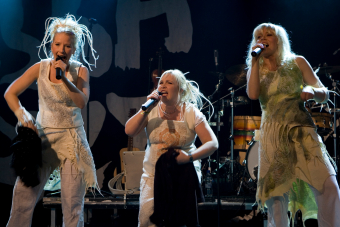
Friday nights concerts were climaxed by the Finnish group Vrttina, 21st century descendents of the Boswell and Andrews Sisters, who have taken three-part close harmony singing and gone nuclear with it. Their music has its roots in Finnish folk music from the Karelian region, and the timing and rhyme scheme is something specific to ancient Finnish folk music and poetry. The Finnish language is unique in Europe in that it shares little in common with any other European languages, which linguists classify as Indo-European. Finnish, along with Basque, Hungarian, and Estonian, are quite different and classified as Finno-Ugric.
Finnish has double-long vowel sounds and double consonants (i.e. geminates), which give the language a distinctive "sharp" sound and a stress pattern which puts the emphasis or primary stress on the first syllable, meaning that every word basically has the stress pattern of BA-ba-ba-ba-ba. Thus even to a non-Finnish speaker, the Finnish language is highly rhythmic and since in music, melody and rhythm follow language, Vrttinas music in terms of melodic phrasing and rhythmic construction were quite different to songs shaped by the English language.
One aspect of Vrttinas totally mesmerising set was how difficult it was to unravel the time signatures the girls sang in. They swung like crazy, but in otherworldly rhythmic groupings. Speaking to bassist Hannu Rantanen afterwards he explained that while a piece such as Richa, while in 11/8 and counted one-two, one-two, one-two-three, one-two, one-two, it was often counted differently in parts of the song to follow the singers phrasing. Fascinating. And what a rhythm section to follow these nuances.
It might seem like bassist Steinar Raknes quartet had drawn the short straw by being programmed to begin Saturdays concerts at midday in Oba Osasalen, the performance centre for Vossas Folk Music Academy (which offers courses in Norwegian folkloric studies). A thread that linked many performances at Voss was the close relationship between folk and jazz, which was given brilliant exposition by the Raknes quartet with Ola Kvernberg on violin, John Pl Inderberg on baritone saxophone, Raknes on bass and drummer Hkon Mjset Johansen on drums.
Playing music from their album Tangos, Ballads and More, they presented a way of looking at jazz that reflected their own cultural backdrop. And why not? The Hardanger Fjord is just a few kilometres away and is the centre of the centuries old Hardanger fiddle tradition. And fiddle player Kvernberg was a revelation. He has two acclaimed albums of his own out, Night Driver and Folk that feature his remarkable virtuosity. Yet playing delicate unisons and harmonies with Inderberg on baritone sax, or adding elegant counterpoint, he seemed able to broaden the tonal palette of the quartet at will. Even at midday the standing-room-only audience was rapt with attention.
Pianist Helge Lien recently won a Norwegian Grammy for his album Hello Troll! On this album of originals, he consciously explored aspects of Norwegian folkloric heritage within a jazz context, and it deservedly garnered critical acclaim in Scandinavia, Germany and the UK. The group, with Frode Berg on bass and Knut Aalefjaer on drums, came together in Oslo Music Conservatory and their years of playing together has produced a remarkable empathyLien and Aalefjaer do not even share eye contact such is the configuration of piano, bass and drums on stage.
Their set was one of finely nuanced moods, of melodies explored in the middle register of the piano whose melodic motion gradually and symmetrically ascended and descended before finding its center of gravity. It was spellbinding stuff whose impact was made all the more telling by the unhurried manner in which Lien told his musical stories. The Troll, the subject of Liens album, is a fearsome being from Norse mythology, and brings to mind Edvard Grieg the Norwegian composer who wrote several pieces on trolls, not least In the Hall of the Mountain King. The analogy does not end there; there was a moment when Lien used a fall from the leading tone to the dominant, which is something Grieg also liked to do (instead of conventionally ascending to the tonic).
With several bands making use of their cultural backdrop, it was interesting to go the whole hog in the company of Sver, a traditional Norwegian fiddle band, who saw out Saturday night. The group has its roots in the traditional music of the Rros-area, but also draws on influences from Hallingdal and Hardanger. Its a high energy group whose modern adaptations of traditional music not only illustrated the trajectory on which some Scandinavian jazz musicians are travelling, but also gave insight into the rhythmic feel of the music, the extravagant syncopations and intricate subdivisions of the beat that could also be heard in the work of several of the Norwegian drummers. Amazing.
On Sunday morning the young Belgian pianist Jef Neve and his trio was assigned the early shift. A piano virtuoso who pledges alliance to Bach, Mozart and Beethoven as much as Oscar Peterson and Bill Evans, he has developed his own highly individual, and at times inspirational style. He certainly raised the roof of the Oba Osasalen, climaxing with his own special anthem, Nothing But a Casablanca Turtle Slideshow Dinner, providing a rousing entry into Sunday.
With his own trio, Tord Gustavsen is a pianist of poetic caste who occupies a dynamic range somewhere between p and ppp, as aware of the folkloric traditions in Norwegian music as he is of the Swedish pianist, Jan Johansson. Little known outside Norway is the musical persona of his alter-ego, a rip roaring gut-bucket pianist in traditional Nawlins style with the Nyman Collective. Gustavsen also has a background in religious music, especially gospel, which he has played in church since a young age. So his late afternoon gig with clarinettist Carl Petter Opsahl, in Vangskyrkja, the stone church in the centre of Voss that dates back to 1277, promised much.
Playing spirituals, folkloric themes, gospel and more, pianist and clarinettist were locked in a series of captivating duets for over an hour. Opsahls tone on clarinet was so broad you could fry reindeer steaks on it, his chalumeau register vibrating the foundations of the church deep in Mother Earth. Looking up at the old wooden ceiling, with hand painted clouds and the occasional angel peeking down, the music entered the soul and began to assume an additional life in memory, to be replayed over and again. . . .
This is the end of part one of Stuart Nicholsons report on the Vossa Jazz Festival. Click here for part two.
Tags:

I would be very happy to read this piece, but the typeface is illegible (and I don't even have poor eyesight!). Could you ask your web designer to try to switch to a more reader-friendly font, and perhaps a larger size? Thank you!
Nice article, Professor! Is it ok to put it on our web site, too?