The Jazz.com Blog
April 04, 2009 · 5 comments
Remembering Bud Shank (1926-2009)
The last time I talked to Bud Shank was in November 2007 at a conference on West Coast jazz held by the Getty Center in Los Angeles. Not many of the pioneers of West Coast jazz had lived long enough to witness this amazing turnabout. Few of them anticipated a day when an international symposium would be held to honor a music that had been subject to so many coy dismissals in earlier decades. I was delighted to catch up with Bud, but it was an even greater thrill was to watch him (and a few others) getting some respect from the assorted academics and opinion leaders.
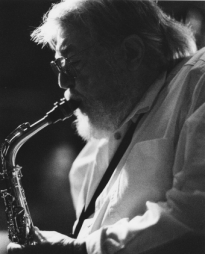
Don’t get me wrong, Bud Shank always had plenty of admirers and fans, but they tended to be ordinary people who just loved the music and knew that Bud was the real deal, and few of them had tenure at a university or wrote for the influential journals of the day. Shank, like many of his contemporaries on the West Coast, made a living despite the institutions that handed out favors. His success testifies to the power of his music, plain and simple.
When jazz lost much of his audience in the 1960s under the onslaught of rock and roll, Shank had no safety net to fall back on, no university gig waiting in the wings. But he could play a range of instruments, and play them brilliantly, and he made a new career doing more studio work than straight-ahead jazz. The same jazz establishment that had rarely acknowledged him when he was playing on classic jazz dates in the 1950s, was quick to call him a sell-out. I enjoyed Shank’s response to a high-handed question from a European critic who tried to take him to task. Bud’s reply:
You have to survive. When I became a full-time studio musician, I had been unemployed for a long time since jazz music left us in 1962-63 or whenever. I don’t think any of us realized what was going on, but some American jazz musicians ended up here in Europe, some gave up playing altogether, some went off into never-never land by whatever chemical they could find. And there were some others who went into another business. That’s what I did. I went into another business using the tools I had, which was playing the flute and the saxophone. Consider that a copout? No, I don’t.
As this quote makes clear, Bud Shank was not one to mince words. When I was researching my book on West Coast jazz, I met up with him in his hotel room on Van Ness and Lombard Streets in San Francisco while he was in town for a gig. He delivered frank, intelligent answers to all my questions, showing a candor that contrasted markedly with the guardedness that jazz players often adopt when talking to a music historian.
He amazed me by being so critical of his own work. Shank had won awards as a jazz flautist, but he told me: “I think the flute is a stupid instrument to be playing jazz music on.” No other musician interviewed for that book was less given to self-congratulatory attitudes than Bud Shank. But I have learned over the years that the greatest musical talents are often those who are most dissatisfied with their own efforts. This very dissatisfaction is what spurs them to new levels.
The altoist was born as Clifford Everett Shank, Jr. in Dayton, Ohio on May 27, 1926, and grew up on a country farm some ten miles from town. His country school had an experimental music education program, and the youngster started playing clarinet at age ten. He recalled to me making his musical debut four weeks after starting on the horn. "A very simple piece," he told me. "I still have the music." At age twelve, he started on the saxophone, and later studied music at the University of North Carolina, where his father was stationed in the armed forces.
Shank left the university during his third year, along with other student musicians, to go on the road as a touring band. The experience lasted only a few months, but Shank never looked back. He played with Charlie Barnet in 1947, and headed to Los Angeles in 1949, where he worked with Alvino Rey. But his break came when Shank was invited to join Stan Kenton's new Innovations in Modern Music band. This proved to be a springboard to solo career in the early 1950s. Shank recorded with guitarist Laurindo Almeida, and though it is not correct to claim, as some have, that this music was the birth of bossa nova, it certainly set a precedent in combining a jazz sensibility with Brazilian-oriented material. He was an important member of the Lighthouse All-Stars, and collaborated with Bob Cooper on some memorable projects, including a vital 1956 live recording made at Cal Tech. Shank was often at his best in live performance, as demonstrated on a powerful mid-1950s amateur recording made the Haig, which sat unreleased for many years. This first rate (but seldom heard) album finds Shank in transition between his earlier cool and later hot styles. In the early 1960s, he played regularly at the Drift Inn in Malibu, often with Carmell Jones, Dennis Budimir, and Gary Peacock in a forward-looking band that also deserved greater visibility.
Shank, for his part, propelled his whole career by burning the bridges behind him. His work with the Stan Kenton band helped boost him to notoriety in the jazz world, but Shank told Gene Lees “that band was too clumsy to swing.” On the LA scene, Shank helped develop the cool alto sound, not entirely different from what Paul Desmond and Lee Konitz were doing at the time, and he might have pursued this approach for the rest of his career. But Shank decided to throw this overboard too, and became a hotter and more aggressive improviser during the course of the 1950s. He was defying the "marketing angle" associated with West Coast jazz, a spin that portrayed this music as cool and melodic, but Shank didn't have much patience with those kind of considerations. He later had success in the band LA 4, alongside another former Kenton colleague Laurindo Almeida—a unit which often featured Shank on flute. And I have already told you how content Bud was with that aspect of his music.
Yet through all this, he continued to expand his conception of the alto and improvise with a zeal and integrity that fans appreciated. They didn’t need to talk to Bud Shank, as I had done, to hear how straight and honest he was. These attributes showed up on the bandstand at every gig. At our meeting in 2007, he told me how much inspiration he continued to find in old standards such as “All the Things You Are.” He said that these songs still fascinated him and drew out his creative energies whenever he played them.
Mr. Shank could take care of himself. When I saw him that last time, he needed to use a wheelchair to get around. But over lunch he told me of his travels—as I recall, he was just back from Japan—and the touring schedule he was pursuing in his 80s would have been enough to exhaust a much younger man. He was reportedly in San Diego, shortly before his death, working on a recording. Certainly a huge amount of credit must be given to his wife Linda Shank who, in my opinion, was a major reason why this altoist stayed so productive in his later years. All jazz players should be so blessed in their choice of a soulmate.
Of course, in the last stage of his career, Shank didn’t need to play mindless studio gigs. His solid body of work, made over the period of sixty years, had built him a fan base from Tokyo to Copenhagen. I am sure that many today are mourning the passing of this stellar artist thousands of miles away from his birthplace in Dayton, Ohio or Los Angeles where he helped establish the West Coast sound. Now is the time to grieve, but let’s also put on one of this artist’s records, and celebrate a life well lived and a first rate musical talent who never took the easy way out.
This blog article posted by Ted Gioia.
Tags:

5 responses so far
Our deepest condolences to the family of Bud Shank. Nenette, Evan and family
My condolences to Linda. It was a delight for me to interview Bud for an article. He was very proud of his somewhat obscure recording "The Lost Cathedral," a suite that combined improvisations recorded in an abandoned cistern with a live performance in real time.
Bud, you will be missed. My condolences to your family.
That's a great comment about playing jazz on the flute! I heard a variation on that comment, on an NPR interview with Mr. Shank a couple years ago. He is an artist on a very high plane. It would never occur to me after hearing him that the flute and jazz were anything but a match made in heaven.
As a jazz enthusiast, Bud Shank was one of the magnificent windists around in his era. His flute and his sax, he handled them well.