The Jazz.com Blog
April 06, 2009 · 14 comments
The Rise and Fall of the Clarinet (Part 1)
The clarinet was once the dominant instrument in jazz, literally defining the sound of the Swing Era, as demonstrated by the commercial and artistic successes of Benny Goodman, Artie Shaw and others. But somehow that all changed during the modern jazz era. Michael Pellecchia tries to uncover the reasons why below, in the first installment of this three-part article. T.G.
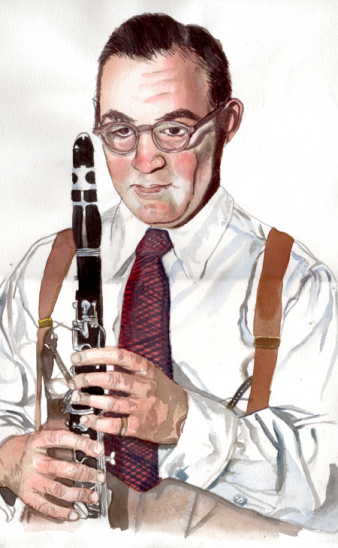
Its said that Benny Goodman died with Brahms Clarinet Sonata Opus 120 on a music stand nearby. He had finished his work for jazz, and jazz had finished its work with him.
Like the banjo, the clarinet had an important role in jazz but now its either a sax double or a dark didgeridoo, some cultural artifact of a signaling race approaching extinction. In order to survive, the jazz instrument check-out desk had to refine its selections. Ask for a clarinet, and get a saxophone.
Its easy to forget how important the clarinet was. Alphonse Picous flag-waver, the oft-quoted High Society chorus, is worth a thousand words in this respect. Racing up and down scales and arpeggios was devilishly easy on this instrument which inspired ladykiller virtuosos to gig on the transient showpieces of Carl Maria von Weber and drive composers to heights like Mozart and Brahms.
The clarinet and piano gave jazz its Eurocentric roots, making the music go up and down while the banjo helped it go back and forth. A pianist such as Lil Hardin might be asked to keep her right hand out of the clarinets range. A cornetist working a limited range of notes would be filigreed by a nervously fingered clarinetist.
Ever since Schuberts Shepherd on the Rock the clarinet and voice have gone together. From opera to blues, its the perfect foil for a good singer, be it Lily Pons or Ma Rainey. It seemed to have the necessary ingredient for ethnic and racial mixing: a field holler of European pedigree, with its growling and snapping effects. Alongside the banjo in jazz, it was integrating the literate and nonliterate, the European and African, the country and the city, writing a new language. The clarinet sounded best on records made before the advent of electrical process recording during 1925 and 1926. Todays microphonics dont really favor its shape or manner of sound production. But live in personthe sound of an Albert System clarinet, with a little less metal than the keywork of clarinets todayit was really somethin.
By the early 1920s, all cities had speakeasies where the sound of trained and untrained musicians merged in a cacophony of alcohol. Just like electrical guitar today, its easy to play a little clarinet. Squeak too much, and you were not long for the gig. There was incentive to get good. And good some cats got . . . very good.
The clarinet had a muse-like charm. When Louis Armstrong got to New York, he began as an undistinguished section player in Fletcher Hendersons band. One day, clarinetist Buster Bailey was hired. On the stand at Roseland, Armstrong followed Baileys Tiger Rag break with four choruses of his ownthe first time he cut loose with this band. The sound Bailey brought from Chicago reminded Louis of his roots.
In this wooden tube with holes and a single reed, inhabited the classical legacy of Franz Schoepp, who helped jazzers Bailey, Jimmie Noone, and Benny Goodman polish their technique. The Creole Tradition of Lorenzo Tio, the American side of the European coinage. It held the formality of a Jelly Roll Morton. It gave up the moan of the blues. It projected the smoky vapors of the Windy City. It boasted three different registers built in twelfths, unlike the octave stretch of the sax.
Early 20th century clarinetists appeared more often than not on jazz and blues records, and not just for solos. Duke Ellington and Claude Thornhill used the clarinet trio and Glenn Miller mixed clarinet and low brass for his trademark sound.
By the beginning of the Great Depression, though jazz had a superstar in Louis Armstrong, the two beat was evolving into a 4/4. A prominent shepherd of this movement was also a clarinetist. Interesting that the 4/4 banner was carried by the cat who played the most 16th notes per minute in a traditional jazz bandthe clarinetist.
Benny Goodman, who had gotten his big break on a program called Lets Dance, was not known to have doubled on sax, unlike Sidney Bechet or Johnny Dodds. He had adopted a new formula with a band that did sophisticated call-and-response between the brass and winds, could play music both sweet and hot, and featured a clarinet soloist. He became far and away the most popular clarinetist to have ever lived. This reticent, bespectacled man finished the clarinets work in helping to create jazz, though it would become a mere foot soldier in the musics history from 1948 on.
This blog entry posted by Michael Pellecchia. For part two of this article, click here.
Tags:

there is nothing like a good smear into a swingin' high note on the ol' liquorice stick.
Great article, Michael. To my thinking bop killed the clarinet, and generally lessened the importance for other jazz musicians to generate a beautiful, signature tone. Ben Webster's big, sexy tone became passe right along with the clarinet.
Wonderful article-the clarinet really did fall from grace, as Charlie Parker and John Coltrane established themselves. Then again, jazz fell by the wayside as rock became such a powerful presence, and hopefully is making a comeback of sorts. Maybe the many voices of the clarinet can again sometime reach the public consciousness in this complex time in the world.
Well done, Mike. Interesting.
Hi Mike- Wonderful article! You put together a lot of material on this- Excellent job! Partly, I suspect it's as simple as folks like what they grow up with- kids don't really come up with clarinet in their ears nowadays...no heroes- just like it's very hard to hear a 1969 Triumph Bonneville exhaust note on the streets.....I'm still groovin' on that killer WES LP, Kismet. J. Ray hipped me to your article....I still play my clarinet!
Hi Jim, When I put a radio/CD player in my BMW 1600 (1969 vintage with a 72 2002 4 banger), it bugged me that I couldn't hear the motor.
Eddie Daniels is my favorite modern clarinetist, but even Mr. Daniels records with saxophone. Great article! I'm looking forward to reading parts 2 and 3...
Hi Kathy, I just resurrected some memorable Eddie Daniels quotes on my store blog, http://moneyblows.blogspot.com/
Great article,but I wont be forwarding it to Buddy DeFranco.
Thanks Jay, I've been studying transcriptions of DeFranco/Tatum on "Out of Nowhere" and "This Can't Be Love." And where do you find a better clarinet obligato than by Buddy on your own great version of "It's Funny To Everyone But Me." Hope you will read parts two and three when they come out, I'd be interested in more of your comments.
Intriguing, although I would take odds with the dramatization of Louis's explosion from being an "undistinguished section player," but that's not the issue. The clarinet is much harder to play well than the saxophone (ask any professional reedman) and it was associated in the popular imagination with the Big Band Era -- i.e., B.G., Shaw, Woody, and many others. So when Bird and Miles became the new deities, the clarinet became a relic for most young players. A pity!
<ship> "The clarinet sounded best on records made before the advent of electrical process recording during 1925 and 1926." Michael, I suggest you give a listen to the 1928-1929 Victor recordings of Johnny Dodds. Electrical recording really brought out the sonority of his instrument and what a masterful exponent of the blues he was. Cheers, Chris
Another couple of points - Goodman doubled on alto in his pre-bandleading days. He's part of the sax section with the Ben Pollack Orchestra in the late 1920s, and with the recording bands of Fred Rich and Ben Selvin in the early 1930s. And also FYI, Dodds didn't really double on alto - he played it on a couple of recordings and, at the insistence of his colleagues, put it back in the case forever. Cheers, Chris Tyle
Excellent piece. I'm a symphony clarinetist who also plays a lot of jazz (mostly on saxophone). I think another factor in the demise of the clarinet as a jazz instrument was the fact that the big bands of the 70's became incredibly loud. The clarinet simply wasn't useful in the midst of those sustained sonic assaults. In addition, the flute was a fixture in the Pop music of that same era and, as a result, it became the double of choice for working sax players. To this day, most of the sax players I know play decent flute while their attempts to play clarinet are excruciating.