The Jazz.com Blog
May 18, 2009 · 5 comments
Jane Monheit in Boston
Roanna Forman covers the Boston scene for jazz.com. She recently reported in this column on performances by Cyrus Chestnut, Jerry Bergonzi, Stan Sagov and Jimmy Heath. Now she sends in this update on singer Jane Monheit's recent appearance at Scullers. T.G.
While I was all set to take up where Nat Hentoff left off on Jane Monheit, I have to admit she can sing jazz. Despite brushes with lollipop sentimentality on some of the ballads, her voice is more mature and sultry now, and theres solid musical intelligence to her scat (unfortunately on only one number). Yet, I still felt there was something missingan ability to relate to emotionally sophisticated material, particularly the three Ss sorrow, suffering, and so-what.
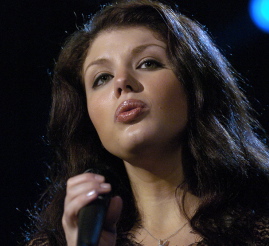
Not that you need to be black, product of a broken marriage, or a candidate for rehab to empathize with and put over all the shades of blues in the jazz vernacular. But this singer, lovely and supple as her voice isand in that respect a true delight to hearstays far from dark corners, partly by sensibility, Id conjecture. And partly by audience demand. Jane Monheits fans, who bathed her in attention, appreciation, and applause in Boston recently, dont really want to visit those sad places, the ones defined by Lush Life, which I could neither imagine her choosing nor singing believably. They want, and get, prettiness, just the way Diana Kralls fans want, and get, easy cool.
Whats not easy is what Monheits doing onstage. It doesnt come across in the albums or videos. Singing aside, Monheit is a born performer, and has honed her conversational style with years of experience. Just back from a tour of Japan, guzzling Red Bull to cope with exhaustion, she put on a relaxed, entertaining show. Shed let you in on stories about her young son Jack as if shed just bumped into some friends at Starbucks. (You dont want to bring a toddler to Asia, trust me)
But the singing, when you focused on it, didnt disappoint either. Intonation, timbre, and attitude changed from song to song seamlessly. Monheits voice has deepened, and she mustered a soulful, throaty cry in the bridge of Corinne Bailey Raes Like a Star, and then pulled back into the smooth opening phrase of this simple song about complex love. Starting The Devil and the Deep Blue Sea with a voice/bass duo, she zipped nicely through a fairly straight reading with some bluesy touches. She finally started taking a chance on improvisation with a swinging Takin a Chance on Love.
After a straight-laced chorus of Stardust, she surprised me by scatting musically intelligent lines on the changes, and I saw what all the kudos were about when she first came on the scene. Ending the tune near C below middle C, she surprised me again with her range. When she ripped through Twisted, the Lambert, Hendricks and Ross classic, I knew she had something going on.
Ballads, however, are another story. While you hear some Peggy Lee lilt occasionally, you just dont get away from prettiness. Admittedly, this singer doesnt draw from personal experience for tunes like Something Cool, about romantic dalliance with a stranger, but she didnt give you any sense of biting into the forbidden fruit while delivering the lyric. Shes more made for Lucky To Be Me, a Bernstein-Comden-Green Broadway-style pinch-me-is this-really-happening paean to happiness which she dedicated to the birth of her son. The inevitable Rainbow Connection Over the Rainbow melody, on which Michael Kanan used a Rhodes for the beginning tune, defined the aw-gee mood that Monheit fans love, but which is rather too saccharine for a jazz set, at least the way she sang it.
Ms. Monheits trio is tight and tasteful, with well-calibrated volume and dynamics. One has to thank her tour manager Lee Ethier, who worked the soundboard for the show to ensure the accompaniment framed the singer appropriately. Pianist Michael Kanan, who has been Monheits accompanist for a while, complements her well, with mainstream playing that doesnt interfere with her vocals. As an arranger, he can be somewhat repetitive: the chromatic phrase that opened Get Out of Town, showed up again in an easy swing rendition of Gershwins My One and Only. Only on the encore, Jobims Waters of March, did the group lose the containment which ironically is the key characteristic of the original Brazilian version. Hitting harder, with heavy cymbal accents, the drummer backed Monheit as she belted the ending in an aesthetic disconnect for a song that is built on subtlety.
So, to get back to Mr. Hentoffs original question several years ago, is Jane Monheit a jazz singer? Let us now, ladies and gentlemen, open up a can of worms. What is a jazz singer? All depends on what dictionary you pick up. For me, it means swinging and improvising on a melody, and being part of the band, not just fronting it. I also think you have to understand the blues, no matter where or how you work it in to your vocals; its too integral to the music to ignore. And, yes, the greats really pull everything they can out of a lyricwitness Sheila Jordan, who made You Are My Sunshine into a heartbreaking lament.
But the public has apparently chosen other models now. While its arguable that Jane Monheit is more cabaret than jazz, although I think shes come a long way from the rehearsed, theatrical quality that Laura Pellegrinelli of Jazz Times spotted in 2001, I dont agree with Nat Hentoff that shes not saying anything interesting. Shes saying something different, less challenging, prettier, more soothing. And that, I think, is what audiences want, or are at least defining as jazz these days.
This blog entry posted by Roanna Forman
Tags:

All this "writer" can do is mention "prettiness" regarding Jane Monheit's performance at Sculler's? How lame... I was at the same performance and thought Jane Monheit and her band put on a wonderful and tight set of jazz (not cabaret) music with perfect pitch on each song. What do I know...I am not a jazz "critic."
Patrick obviously doesnt have perfect pitch.
Michael: The article was about Jane Monheit, not me. Do you have something to contribute or you just being a dumbass?
Please Patrick, we don't call each other dumbassess at jazz.com.
i think this writer is right about her definition of a jazz singer..ala ella, and torme! however, i feel jane has an extraordinary gift for the "american songbook"! it's the ease with which she sings that displays her top level talent!!! so yes, count her among the best! no need to compare!