The Jazz.com Blog
May 27, 2009 · 7 comments
On Discography
If the jazz world is a subculture, then the most cultish members of all are the discographers. I would rather cross a Mafia don than take on one of these fellas. Will Friedwald is a braver soul than me, and sheds some light on the inner workings of this cabal below. And if you think Rust, Jepsen & Lord is the name of a law firm, you need to hear what he has to say. Mr. Friedwald, by the way, is an esteemed critic whose works include the highly recommended books Jazz Singing, Sinatra: The Song is You, and Stardust Melodies. T.G.
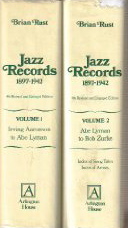
To a certain extent, discographies are not only a document of an artists career, they also form an autobiography of the collector. You may wonder, for instance, why is it that I own two copies of Brian Rusts Jazz Records, 1897-1942 (the familiar green-hardcover, Arlington Press two-volume edition of 1977). First theres my own copy, which Ive owned since I was a teenager, in which I dutifully marked in every new acquisition. Rust didnt list LPs, so when I obtained a new volume of Henry Red Allen on Collectors Classics or Charlie Barnet on Bluebird, I marked in the LP numbers so I could see exactly what I had and what I was missing. Cant live without the alternate take of The Rhythmakers doing Mean Old Bed Bug Blues.
When my father died in 1997, I inherited his copy of the selfsame Jazz Records, and I realized that my Dad had kept track of his collection in a different way: mentally. He somehow kept his ongoing private catalog of what he had and what he lacked in his head. Somehow he never bought the same record twice (or when he did, he said that he had done so intentionally, as a gift for me). His copy of the two-volume Rust set was pristine, as if it had never been opened, and yet I know that he looked at it every day. So here I was with one copy of Rust that was chewed up and dog-eared, and one that was virtually newobviously I couldnt de-acquisition either one.
My father didnt live to see the age of computerized discographies, CD-ROMs, or the InternetI wonder what he would have made of it. A psychologist would have a field day (an interesting expressiondo psychologists actually ever have field days?) in seeing to what extent I have recreated the previous situation, albeit in digital terms. Now, the basic discography I use and consult several dozen times a day is the online edition of Tom Lords The Jazz Discography: in fact, last summer, when I needed to create a formal inventory of my collection, I employed TJDs very useful my collection feature and dutifully entered in all the LPs that it could find. (Okayfull honesty departmentI paid a trio of graduate students to do it.) So, my personal edition of Lord is, in fact, as marked up and personalized as my vintage edition of Rust. The discography isnt just a history of recorded jazz, its a history of me.
Back in the analog era, there were some very high powered collector-scholar dudes who were critical of Rust: the late Bozy White, whose mission in life was to document every note ever played by the great Bunny Berigan, railed against the idea that Jazz Records should be considered a definitive work. He was, however, very keen on the idea that anyone wanting to do further research should use Rust as a starting point: take the info presented in those green volumes, but double check everything, update and add as much info as possible.
All along, individual discographies, which concentrated on a specific artist, were a valuable supplement to Rustor possibly the other way around. After Chris Sheridans monumental volume on Count Basie came out, it was a cinch that I wouldnt look up anything concerning Basie in Rust (or Jepsen eitheralthough Jepsen had, many years earlier, done a much smaller set of book on Basie that doubtless were one of Sheridans starting points) any longer. The same was true for Fletcher Henderson, Jelly Roll Morton, Fats Waller, and Clarence Williams, whose recorded output was definitely detailed in Walter C. Allens Hendersonia, Laurie Wrights Mortons Music and Fats In Fact (double check last 2) and Clarence Williams by a British scholar named Tom Lord who is no relation to the Tom Lord of the big Jazz Discography (all but the first of these were published by Storyville Press in England).
With the vast territory of information and misinformation on the world wide interwebnet, the discographical situation is the same: there are some musicians whose work is treated in painstaking detail (and not always the obvious ones, your Miles Davises and John Coltranes), much more so than Mr. Lord could (or even should) put in a general discography, where the mandate is to cover everybody. The most relevant site that I frequently check is Michael Fitzgeralds JazzDiscography.com, where there are very complete listings on 82 (currently) artists and leaders both major and minor, painstakingly prepared by individual specialists who have spent a lot of time researching their charges.
As with the printed discographical books of old, the specialized lists are laid out much more luxuriouslya logical thing, since theres no paper or printing costs on the net. Composer credits are given, a very valuable thing, and each issue of each song is listed vertically, with the name of the album given, so that you dont have to remember, for instance, Prestige PR7394 is Lucky Thompsons Happy Days are Here Again. Mr. Lord gives you the album titles at the bottom of the session in most instances, but one of the signatures of the JazzDiscography.com projects (which are generally done using Steve Albins Brian software, named after Mr. Rust) is that they give you the album title every time, in a list thats easier to read than Mr. Lords text.
But even with the musicians covered in detail at JazzDiscography.com (who, Im happy to say, include some worthy non-jazz performers, such as Hank Williams and Dusty Springfield), there are limits. When I was working on Lucky Thompson, I needed to know if his composition Deep Passion (based on Body and Soul) had ever been recorded by anyone else; Ive heard Mark Turner play it at The Vanguard, but did he record it? Such info normally would not be in a single artist listing, but I found it quickly in Lord, who listed two recordings by Thompson and, while Turner, so far, hasnt done it on an album, it was recorded by tenor saxophonist Tad Shull (of Widespread Depression Orchestra fame).
In general, I have gotten so acclimated to The Jazz Discography, even with whatever faults it has, that I cant imagine having to do without it. Theres nothing like looking at a session of Lucky Thompson and clicking on Oscar Pettifords name to see what sessions the bassist did around the same time he was recording with Thompson. The same goes for the songs at a given date.
Having worked with TJD throughout all of its permutations, including the original softcover print edition, I have to commend Mr. Lord for making the latest, online edition, the most accessible and most easy to navigate. One suggestion I would make: right now, if you want to look at Louis Armstrong sessions from the 50s, you have to search for Armstrong (as musician or leader) and go back to 1923, then keep pushing next page, in this case, about 20 times, before you get to 1950. It might make sense to have a search panel with a musicians name and a date range, so you can just search for Armstrong (or whoever) in a specific period. Or perhaps a date range can be added to the multi-search.
The digital discography has been a long time comingweve been listening to recordings, old and new, via digital technology for a quarter center, and its high time that the art of discography has followed suit. Still, I wonder what my father would say. Probably, turn the bloody record over!
This blog entry posted by Will Friedwald.
Tags:

Where there's a Will, there's a ray of light, always. Thank you, Lord.
For all of Rust's arbitrary inclusion or exclusion of artists and records, Jazz Records is the most worn-out book in my house. I've never written it it--but it's definitely been used. And I've got the dust cover--somewhere.
Having done discographies for the past 40 years I have to agree that when I finally put it out on the web, many other collectors began contributing their own info from their own collections so I did not have to do all the work by myself. Using the online method has expanded my discographies tenfold.
Thanks for the mention of the resource that Steve Albin and I have been running for six years now. To be accurate, there are 400 leader entries and 74 artist discographies found at www.jazzdiscography.com - with many more to come. Assistance (informational and financial!) and suggestions for future projects always welcome. Mike
It's a fascinating thing when the old world meets the leading edge of the new, in this case, "crowd sourcing." It's precisely endeavors like these that benefit from the collected knowledge of everyone else. Congratulations and thanks to all those researchers with the passion to do the work themselves, and make it available to be improved by the next generation.
A fascinating and thoughtful article! It's nice to have things available digitally, makes research much easier (and quicker). But the print sources should also be consulted, and kept (and remembered for for leading the way).
thanks for all those outstanding comments - Steve Abrams (a friend of mine!) is responsible for a marvelous online listing titled THE ONLINE DISCOGRAPHY. I highly recommend it, it is a major resource that I use almost every day. It's at <http: />. Thanks to all of you for the swell comments.