The Jazz.com Blog
May 05, 2009 · 0 comments
Afro-Cuba Meets Appalachia
Tim Wilkins edits the Encyclopedia of Jazz Musicians at jazz.com, and regularly contributes reviews in this column. Below he reports on a collaboration between Afro-Cuban pianist Omar Sosa and ethnomusicologist Tim Eriksen who is a genre-crossing master of the banjo, guitar and fiddle. T.G.
"The first Negroes did not come to America as slaves. They came as explorers."
When poet Langston Hughes recorded these words for Folkways Records in 1955, he was evoking the memory of black conquistadores like Juan Garrido, who explored the New World for Spain in the sixteenth century. But they also apply to Cuban pianist Omar Sosa, who drew on Hughes as an inspiration for his latest project, the album Across the Divide, just out on Half Note Records.
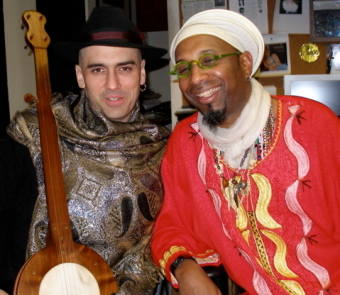
Sosa is an iconoclast whose explorations of the African diaspora have led him to work with artists from Mozambique, Morocco, Mali, Brazil, Ecuador and Venezuela. But this latest project, a collaboration with musicologist Tim Eriksen, came as a surprise even to him. Eriksen is a singer and multi-instrumentalist who specializes in the "high lonesome" sounds of Appalachia and the New England seaboard.
The shotgun marriage of Afro-Cuban with Americana might look like the product of some producer's fevered imagination. But in this case, the result is an evocative success: it is the musicians' shared spirit of openness and inquiry which makes it work.
There' s such a deep African influence in the culture," said Eriksen, when I caught up with the pair between sets at New York's Blue Note. "The stuff that we've been singing together is old American songs that kind of illustrate the Afro and the Anglo like this (interlaces fingers), and sometimes like this (two fists)."
This unlikely musical conversation started off as an accident, and sounds uncalculated. When Sosa visited Dartmouth College last April, he overheard Eriksen singing an eighteenth-century Welsh hymn, "Promised Land," for his students. Sosa walked in to the class and sat down at the piano. Mozambican bassist Childo Tomas, who also plays thumb piano, followed him in, and the three played without exchanging a word for the next ten minutes.
"When we finished I said, 'Wow! You just blew me away," Sosa recalled. "Because it's not only the voice, it's what comes to what he sings and the background to the music he sings. It's a mix of a lot of stuff, you know?"
Inspired by this chance encounter, Sosa began to research Eriksen – whose resumé includes work on the soundtrack of Anthony Minghella's Civil War film Cold Mountain, and performances with Nirvana, Sting, and Elvis Costello – and his inspirations, such as Appalachian banjoist Dock Boggs. When Half Note producer Jeff Levenson approached Sosa about an album, he knew he wanted to record with Eriksen.
"I always say, you need to figure out a way to do something different," Sosa said. Because the spirit of every musician is different, and this is what I try to do."
Like other Half Note albums, Across the Divide was recorded live on the Blue Note's stage, over two days in June of last year. Eriksen's vocals, as well as his banjo and fiddle playing, can be heard on "Promised Land," "Gabriel's Trumpet," "Sugar Baby Blues," and Night of the Four Songs." All four are traditional, from Kentucky, Maine, West Virginia and North Carolina, respectively.
"I tried to ask, 'what is this?'" Sosa said. "Now I enjoy more and more this kind of 'I don't know how to call this' music. We tried to find some kind of name to call Tim's thing, the way he sings and the way he plays. Because he have a little bit of the South, he has the middle of the States, he have a little bit of Irish, he have a little bit of Appalachian. It's just… it's just him!"
The balance of the tracks, "Glu-Glu," "Across Africa," Solstice," and "Ancestors," are compositions by Sosa. Tomas can be heard on bass and thumb piano, along with David Gilmore on guitar, Marque Gilmore on drum kit, Leandro Saint-Hill on saxophones and Roman Diaz dubbed in on batá drums.
At the Blue Note, Sosa led a tighter ensemble of Tomas, John Santos alternating between batá and tumbadora drums, and Peter Apfelbaum on saxophone, and the set included two compositions from earlier recordings by Sosa, "Métisse" and "Paralelo." Eriksen joined the band on stage for "Promised Land" and "Gabriel's Trumpet."
Listeners already familiar with Sosa's work may find Across the Divide more restrained than his previous recordings, as the focus is less on the pianist's formidable technique than on the lyricism of the material. "When you put all of these elements together, you know, for some people it can be a little strange – because we jump from this 'High Lonesome' to the Middle East, to some Afro-Cuban groove," said Sosa. "This is why the record is more cooler than live."
I enjoyed the focused energy of the live show. The combination of Tomas and Santos creates a firm but flexible backbone to Sosa's compositions. Both settings, however, benefit from a stripped-down approach to improvisation, in which Sosa is more likely to trade Cuban tumbao or African-inspired rhythmic figures with the other musicians, than to indulge in extended flights of jazz fancy.
"I don't like to do a solo for twenty minutes, even though I used to," said Sosa. "Now, the way I really like is when the banjo comes in with the piano and plays one tumbao, then he plays, with his singing voice. This is the way I look at the music now."
While there was plenty of improvisation on display, the project is such a dramatic departure from listeners' expectations, which bends together the end points of an arc of Americana which spans from Havana to Appalachia, it may prompt some to ask, 'Is this jazz?'
To Sosa, it is. "Jazz is a style of music, but beyond this, it's a philosophy," he said. "What we do here is simple: Tim plays what he feels, and he sings what he feels, and that's all! We play what we feel: some people can like or no, of course, that's another point. But what our philosophy tries to express is our selves, with entire freedom."
Then Sosa came up with what he thought might be a better description of the music on Across the Divide, and possibly the title of the next album he hopes they will record together: "How about 'Black Beans with Steamed Rice!'" he exclaimed.
"All of this is about what in Cuba we call congri, or in Puerto Rico arroz con frijoles: rice and beans," he said. "Because you know, it's all the same. Sometimes we make the differences: to divide this into jazz or blues, or something else. But jazz is everything."
This blog entry posted by Tim Wilkins
Tags:

Comments are closed.