The Jazz.com Blog
June 10, 2009 · 7 comments
Rust Never Sleeps
Will Friedwald recently offered some reflections in this column on the arcane world of jazz discographersthose intrepid souls who can tell us which jazz musician did what, and when it happened, and who else was there. No small featsince even their spouses and parole officers often can't answer those questions much of the time. But the discographers always prevail in the end, and the story of their behind-the-scenes efforts is not without its own heroism and glamor. Mr. Friedwald returns to the subject below. T.G.
Up until his death in 2003, Roger Sturtevant, dean of New York area record collectors, would regularly organize trips to London for himself and fellow collector pals. His mission was threefold: cover the waterfront in search of rare British 78s, catch new plays in the West End, and, not of least importance, pay a visit to Brian Rust, the worlds pre-eminent discographer of jazz and pop music from the 78 RPM era. This part of the trip was always like a Holy Pilgrimage; those of who are us immersed in the music of the pre-war years can only echo what Bart Simpson once said of his own spiritual mentor, Krusty the Clown: I base my life on his teachings.
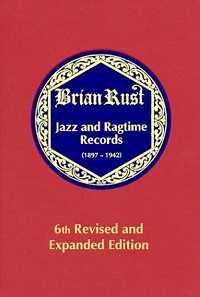
Rusts Jazz Records 1897-1942 is still the universal standard of printed discographies, but to anyone remotely interested in the period, The American Dance Band Discography and The Complete Entertainment Discography (first published in 1973) are no less essential. His two other major Anglo-centric works, British Dance Bands and London Musical Shows On Record 1897 1976, are, perhaps, somewhat more specialized, but you dont have the right to call yourself a serious scholar of the music unless you own a marked-up copy of the big three: Jazz Records, American Dance Bands, and Entertainment. (As I mention elsewhere, when Steve Albin developed his discographical software application, my major contribution was convincing him to name the program Brian.)
Jazz Records came firstthe original edition was in 1961and has been revised on five occasions. This is Brians real baby, the jewel in the crown, and, at times, it seems as if the other two books grew out of leftover research that Mr. Rust accumulated for Jazz Records. That, in fact, is a key idea, in understanding how the three booksand the music of the prewar period in generalwork. There is some duplication amongst the three, in that both American Dance Bands and Entertainment represent a recording format, ie, a big band or a popular vocalist, whereas Jazz Records documents a style of music: there are bound to be band records or vocal records that are also jazz records.
And thats a fascinating distinction: the major area that is totally unique to Jazz Records is recordings by black bands; it doesnt matter if its a hardcore jazz act like Ellington or Basie, or Noble Sissle, who led more of a society-oriented dance orchestra (but played plenty of jazz nonetheless). White small groups, such as those led by Eddie Condon or Red Nichols, are included, but when it comes to white dance bands, thats when Rust starts getting subjectiveand Jazz Records becomes a work of interpretation rather than just a straightforward laying out of names and numbers.
Its a primary topic of discussion how Rust deals with the popular dance bands particularly of the pre-swing period; this is an era (like post-war, pre-rock pop) that has no name. You could call it Jazz Age Music (as opposed to New Age music), but by and large, even specialists in the period, like contemporary bandleaders Vince Giordano or Johnny Crawford or radio host Rich Conaty, dont know how to label it. (I tell them to grin and bear it and call it what everyone else does: Little Rascals Music.) Take a band like Paul Whiteman: he employed a consistent string of hot soloists throughout the 20s and 30s, but in no way is every Whiteman record a jazz record. Rust has done the remarkable service of, it seems, listening to all of the thousands of 78s released by Whiteman and sorting out the sides with hot solos that, as he puts it, will be of interest to jazz fans.
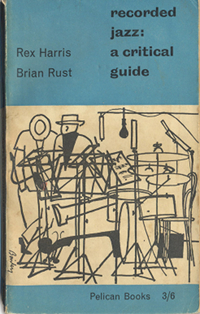
There are a number of white bands, including Ben Pollack and the Casa Loma Orchestra, whose entire output is included, and Rust tends to give you the whole enchilada on swing bands, like those of Tommy and Jimmy Dorsey. Possibly the latter is because many of the straightforward dance discs of the Swing Era tend to have improvised content (even on ballads), or equally likely because Mr. Rust is personally more interested in spending time with the major bands of the earlier period, and more conspicuously enjoys investing the labor to distinguish the jazz from the non-jazz in the copious recordings of Ben Selvin, Sam Lanin, Nat Shilkret, or, on the other side of the pond such British bands as Jack Hylton or Ambrose. The same holds true for pop vocal records: singers like Cliff Edwards and Annette Hanshaw, to name two vigorously championed by Mr. Rust over the decades, regularly employed jazz soloists on their record sessions, and he makes a point of telling us which are the sides with hot content. The JR listing on Bing Crosby is particularly useful, telling us which Crosby sides have jazzy band accompaniment, like the Dorsey Brothers or the singers own brother Bob, as opposed to bread-and-butter studio bands.
Thus even to those of us who also own The American Dance Band Discography and The Entertainment Discography, JR is essentialand its worth noting that Rusts successors, those chroniclers of the modern jazz era, such as Jepsen, Lord, Raben, and Brunynckx, have followed Rusts lead: they follow his example, for instance, in drawing attention to those albums by The Jackie Gleason Orchestra, that are of jazz interest (nearly all of em, it turns out), the same way Rust does for Whiteman.
This is the second installment of a three-part article by Will Friedwald on jazz discography. Check back soon for part three.
Tags:

As always Will, superb!
These books are essential; are they in print anywhere these days, or available online or as a CD? Brian Rust is to be saluted by music lovers everywhere, as is Will Friedwald for his entertaining, thoughtful and well-researched articles. We need a link to the first installment! I'm not sure I've read that one yet, and I really want to.
Ah, I just found the link to the first section--that clever little "reflections" that's underlined up at the top. As Emily Litella used to say, "Never mind."
Good work, Will. And thank you for the mention. My "Green" Rust books are out for some binding work (the Dick McDonough page kept falling out). I want to check if a genuinely hip Frank Sylvano is listed.
In the course of planning a show I sometimes refer to all three Rust discographies (the American Dance Band tome, lately acquired, is proving very useful) as well as the Online 78 RPM Discographical Project and Google (to find references to recordings not mentioned in the foregoing). Sometimes I find a record that I think SHOULD be listed in "Jazz Records" and it's not. (Which is why I need the other books.) But thanks to Brian Rust, Steve Abrams, and others I don't have to say "Here's a really old record" and leave it at that.
Great article and overview on Rust's work. I,also, refer to Rust on an almost daily basis.
Not a day goes by that I don't open up one of the three books I own. Every 78 rpm record that I find gets checked in the books to see if all the info is in there. I have sent Brian Rust almost a thousand new entries to the Dance Bands....he even asked me to stop for awhile while the new edition gets sent to the printers. My old copies are so marked up with additional info that there is hardly any more space on the pages. Anyway most of my info has been added to the online www.78discography...so that the whole world can have access to the information.