The Jazz.com Blog
June 02, 2009 · 3 comments
The Strange Case of Nat King Cole
It is simply not true that Alan Kurtz listens to recordings just to count the mistakes. But we can't deny that he is jazz.com's resident curmudgeon, as this list of his contributions to this column will make clear.
Below Mr. Kurtz casts a wary eye at the trade-offs an artist faces when trying to balance the dictates of pop stardom with the requirements of a jazz career. In this instance he sets his sights on one of the great crossover success stories of the modern in era. Gather around the fireplace as he recounts the strange case of Nat King Cole. T.G.
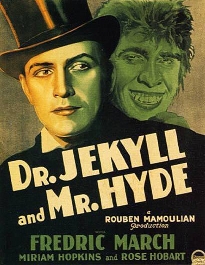
The Strange Case of Dr. Jekyll and Mr. Hyde (1886), Robert Louis Stevenson's gothic tale of good versus evil, pits a proper Victorian gentleman against his own tempting sensuality. The virtuous Dr. Jekyll juggles dual identities, reassuring himself that "the moment I choose, I can be rid of Mr. Hyde," the depraved incarnation through which Jekyll indulges forbidden pleasures. Even his alter ego's name is carefully calculated: compelled to conceal one's thrill seeking, what better alias than Hyde?
Yet as his excesses grow, Jekyll's control weakens. "I was slowly losing hold of my original and better self, and becoming slowly incorporated with my second and worse. Between these two, I now felt I had to choose." For Jekyll to renounce Hyde would mean denying "those appetites which I had long secretly indulged and had of late begun to pamper." But forever succumbing to those appetites would require forsaking all respectability. While preferring "the better part" of himself, Jekyll is hostage to his own desires and can regain control only by annihilating Hyde. In so doing, he destroys himself.
Oddly, there is a jazz counterpart to this venerable morality play. In the 1940s, singer/pianist Nat King Cole was similarly conflicted. On the one hand, whether leading his incomparable King Cole Trio in such jive classics as "Straighten Up and Fly Right" (1943), "The Frim Fram Sauce" (1945) and "Route 66" (1946), or showcasing his superb instrumental skills on Jazz at the Philharmonic's "Blues" (1944) and Lester Young's "I've Found a New Baby" (1946), Nat King Cole was vocally and instrumentally the Minister of Protocool.
On the other hand, he was also a budding superstar, scoring huge pop hits with "(I Love You) For Sentimental Reasons" (a Billboard Top 40 single for two years running in 1946 47) and "Nature Boy" (one of 1948's Top 20).
So there seemed to be two Nat King Coles. As an urbane jazz pianist, his artistic potential was unlimited. As a handsome, suave balladeer with the century's most rapturously insinuating voice, his commercial potential was boundless.
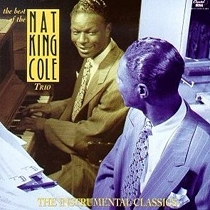
Certainly you don't play jazz the way he did without a deep love for the music. Yet when seated at the piano, Nat the vocalist twisted to an uncomfortable 45 angle so as to politely present more of himself to the audience. Although he somehow managed to play topnotch piano from this contorted position, in swiveling towards the audience Nat symbolically turned away from jazz. It was less a matter of posture than of divided attention. Like Dr. Jekyll, Nat lost hold of his better self, growing ever more consumed by pop stardom.
Beginning in 1950, his records were no longer credited to the King Cole Trio, but solely to Nat King Cole. That year his "Mona Lisa" was #2 on the pop charts, and in 1951 "Too Young" topped even that, finishing as the year's best-selling single. Since the King Cole Trio had by now been dissolved, to flesh out these recordings Olde King Cole called for his fiddlers three. Alack, the musicians' guilde inflated the decree, so Nat was backed by extra fiddles and harp. Even his original laid-back trio version of "The Christmas Song" (1946) was repackaged with strings, transforming cool yule to lukewarm humbug.
We'll never know to what extent Nat King Cole may have tried, like Dr. Jekyll, to resist his baser instincts. But during the 1950s, he rarely dabbled in jazz, detouring instead down Route 666 to material success. He acted in Hollywood movies, hosted his own network-TV variety series, played the big rooms in Las Vegas, and churned out a veritable one-man hit parade. Year after year, week in and week out, Nat King Cole had at least one record on the pop charts, and often two or three. Among his generation's singers, only Doris Day, Frank Sinatra and Dean Martin equaled his multimedia success. And excepting Doris Day, Cole was arguably the squarest of the bunch.
Still, during his reign of the 1940s, he was Nat King Cool, and to the monarch we must pay tribute. Jazz diehards can but wistfully wonder what might've been if Dr. Jekyll had withstood Mr. Hyde.
This blog entry posted by Alan Kurtz.
Tags:

Nat Cole "square"? Not likely. Nat was the Cool King, perennially hip, crowned even when crooning, admired by all Jazz pianists and vocalists, envied by other perpetrators of pop balladry. Unseated from his TV show by Jekyll racists, he was yet comfortable in his skin and his dual career, and he succumbed to cancer rather than the succubus of success. Kurmudgeon, Hyde thyself. (Remove tongue from cheek; your artistic license is revoked.)
There's a certain musical snobbery at work here - jazz is just another form of music and was itself the 'pop music' of its day. All of the artists you mention were happy to make both jazz and pop records. Doris Day's extensive film career required her to record many songs that she probably wouldn't have chosen personally but her 'jazz roots' can be found in many of her other albums, "Latin For Lovers", "Duet" with Andre Previn, "Cuttin' Capers", etc. Sinatra cut "Something Stupid", "High Hopes", "My Way", etc - does that make him 'square' too? Forget the labels and the music styles - these people are essentially entertainers - judge them in the round - they gave the public (and still do) what they wanted and we are all the richer for it.
Maybe a present-day analogy is George Benson, who has enjoyed enormous pop success, although any jazz guitarist could watch the smoke rise behind him in a cutting session. As for Nat King Cole, I think he made fabulous music in both genres, and the whole debate about "selling out" is, if not moot, unimportant. It would only matter to me if I thought there was no artistry in "Mona Lisa," and believe me I've heard the Nat King Cole Trio. Nat was a superlative jazz pianist. And he was a great entertainer. That's okay. Another guy did that, too: his name was Louis Armstrong.