The Jazz.com Blog
June 23, 2009 · 0 comments
Gary Burton & Pat Metheny Perform at Berklee
Roanna Forman, who covers the Boston jazz scene for jazz.com, recently reported in this column on performances by Steve Kuhn, Jane Monheit and Hiromi. Now she reviews Gary Burton and Pat Metheny's concert at Boston’s Berklee Performance Center last Saturday. T.G.
Question: How many parts nostalgia and how many parts new ground in this recent concert at Boston’s Berklee Performance Center? Answer: Equal. “Picking up where they left off,” as Steve Swallow wrote, this famous group had plenty new to say after thirty years, thanks to their own improvisatory powers and the different energy of drummer Antonio Sanchez.
It was a stage filled with wunderkind-to-doyen phenomena: Gary Burton, who formed the Gary Burton Quartet when he was 24, and is now a jazz icon; Pat Metheny, whose hook-up with Burton and Swallow at age 20 started a path to jazz stardom; and Antonio Sanchez, a Berklee student in the 90’s who, catching a casual glimpse of Gary Burton on campus, never dreamed he’d be playing one day with what he calls “jazz royalty.”
Looking out over the audience, Burton mused that Berklee Performance Center was the hall he always imagined playing in while practicing, unlike his friend Michael Brecker, who once confessed to Burton he dreaded it, picturing an army of musicians scrutinizing his every move and note.

No such worry for Gary Burton at this Boston concert; he couldn’t have had a warmer crowd. The heavy concentration of music students and musicians not gigging that night were as friendly as ever: rising for a standing ovation at opening; yelling out “Perfect!” after Pat Metheny brought “Question and Answer” in for a landing; and registering on the applause meter the relative number of drummers, guitarists, bass players (egged on by Swallow to raise their hands), and vibes players (“come on, applaud, both of you,” Burton urged.)
The concert, part of a tour that suggested itself when the group appeared at the Montreal Jazz Festival, centered on tunes done by the Quartet when Pat Metheny joined it. There were songs by band members, as well as key artists of that time like Chick Corea (“Sea Journey”) and Keith Jarrett (“Coral”). The show was at the same time a retrospective on the era-defining music that contributed to a changed conception of jazz—more electric; incorporating rock elements; and more accessible to lay audience’s ears, like Steve Swallow’s “Como en Vietnam” and Gary Burton’s “Walter L.”
I can say musically of Burton, Metheny, and Swallow what Gary said himself in his precise, understated way, “I believe you know everybody but I’m going to introduce them anyway.” Burton continues to be technically impeccable. He never labors over his instrument, but works the four mallets like a painter—with the right touch here, the right mallet action there, to create smoothness, or he’ll move furiously up and down its length in more burning pieces. Each phrase is like a clear thought that occurs to him, whether he ends mid-measure or completes the progression down to the last beat.
When the spotlight turned to Pat Metheny, he would tell a story with each solo. Metheny never sounds like he’s playing over changes even with straight-ahead arrangements. He’s playing more than notes—maybe a cry, a wail, wonder, whatever he feels as he builds the solo. He began the lines of “Question and Answer” playing his archtop, and ended it, as he characteristically does, with guitar synthesizer, playing a leave-no-prisoners solo with the rhythm section solidly supporting him. Yet the guitar synth, used also on “Walter L,” literally distorts Metheny’s enormous gift. His musicality is more fully developed and appreciated on the archtop, which is his signature sound.
You might say Steve Swallow has the same sensibility as Metheny, although the reverse is more accurate, given the chronology. He was in great form, with some especially fine soloing on “Falling Grace,” the second tune Steve Swallow ever wrote. (We can forgive Gary Burton some historical inaccuracy for introducing the song as Swallow’s first composition. That would be “Eiderdown.” Whatever.)
Burton, Metheny, and Swallow are a known quantity, with a huge discography and a synergy one expected to stay intact onstage, even after many years. Yet Antonio Sanchez, although he has been recorded with this group, is new to the mix, so the big question was how he changed the group’s sound. Sanchez brought very tight, musical playing to this already powerful unit, and added quite a bit of kick. On slower numbers like “Olhos de Gato,” “B & G,” and “Coral,” his steadiness kept the tunes calm, with well-placed accents on bass drum and sticks. He was driving hard, and finished the high energy tunes sitting back on his seat, like a fighter who had given his strongest punch in the ring. Sanchez is a highly musical drummer: you clearly heard the tune to “Como En Vietnam” throughout his excellent solo, over and above the rhythmic figures. A less skilled drummer might be merely flashy and lose the thread to the original music during a solo.
Not surprisingly, certain of these tunes frame the vibraphone better than others. With a rhythm section smooth as glass, “Coral” shone bright as a sunset bell. Similarly, “Hullo Bolinas” sets off vibes well, and the entire band was in sync with the sensibility of this lilting, quirky tune by Steve Swallow. On songs where guitar had a prominent place, like “Question and Answer” and “Walter L,” there tended to be an imbalance in the sound and you couldn’t hear Gary Burton well enough, which was unfortunate.
Besides ensemble playing, there were several duets. A nice exchange between Burton and Sanchez on “Syndrome” brought out the percussive qualities of the vibes and the musical aspects of the drums. The centerpiece duets of the concert featured Burton and Metheny, pairing them in different contexts. With Metheny rapidly strumming acoustic guitar, Burton laid out an uptempo “Summertime” in 6/8, during which the lighting crew was a bit late switching back to Burton after Pat Metheny’s solo.
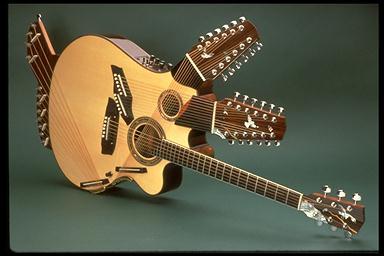
Picking up the archtop, Metheny then backed the vibes on Jobim’s “O Grande Amor,” where Burton pretty much played within the constraints of the form. While the guitar solo started closer to the Brazilian voicings you would expect (or American jazz guitarists’ takes on Brazilian voicings), Metheny flattened and widened the lines into shapes more typically his own on the second chorus. He then began a piece on his 42-string custom-built “Pikasso Guitar”—imagine harp, sitar, and acoustic guitar all in one, with Gary Burton joining eventually.
As for nostalgia, which was part of the original question about this concert, it was definitely there. No matter how much we say that what counts in jazz is experimenting and moving forward, we do come back to what James Lincoln Collier referred to in Ken Burns Jazz as the solace of the music of our youth. When the band broke into its encore, “Unquity Road,” the man I was with sat transfixed, tapping his foot and singing every note of Pat’s song about the Boston street both of them had ridden down some thirty years ago.
This blog entry posted by Roanna Forman
Tags:

Comments are closed.