The Jazz.com Blog
June 29, 2009 · 9 comments
More on Late Period Bill Evans
A few days back I wrote an piece in this column entitled "Late Period Bill Evans: Genius or Decline? Bill Kirchner, a noted saxophonist, jazz scholar, and editor of The Oxford Companion to Jazz, contributes a response to this article below. (Be on the lookout soon for Kirchner's "Dozens" article for jazz.com on pianist Denny Zeitlin.) T.G.
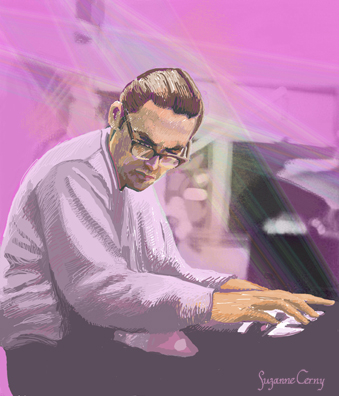
On May 12, Nonesuch Records reissued a 6-CD boxed set by pianist Bill Evans, Turn Out The Stars: The Final Village Vanguard Recordings, June 1980. The box contains music recorded by Evans's last trio (with bassist Marc Johnson and drummer Joe LaBarbera) on June 4, 5, 6, and 8, 1980only three months before his death on September 15 at age 51. It was originally co-produced by Jeff Levenson and myself for Warner Jazz and issued in 1996. Prior to that, the music had never before been released.
Readers of this site and JazzWax may have read recent postings by Ted Gioia and Marc Myers about this music and late-period Bill Evans in general. Both writers, despite their overall admiration for Evans, have repeatedly voiced reservations about his playing in his last years. As one might expect from my involvement with Evans' 1980 Village Vanguard recordings, I see things rather differently.
I take a back seat to no one in my affection for the Evans / Scott LaFaro / Paul Motian trio; their 1961 Village Vanguard recordings in particular are among my "desert island" treasures. But we all need to be mindful that the music of that trio was created under a distinctive and rather narrow set of parameters, especially with respect to dynamic range. No doubt this was partially due to esthetic choices, but another reason was that during LaFaro's lifetime, jazz bassists played gigs without amplification. To play the way he played, LaFaro used what bassists call a low action, which limited his volume. So if Motian had played much louder than he did, LaFaro probably would have been inaudible.

A few years later, when bassists regularly started using amplifiers, the nature and balance of jazz rhythm sections understandably changed. Bassists could be heard bettersometimes too muchand Evans gradually returned to the relative extroversion of his pre-LaFaro playing. When I first heard Evans live in 1972 with Eddie Gomez and Marty Morell at New York's Top of the Gate, I was surprised and thrilled by the often downright ballsy nature of his playing. (For a recorded example of what I heard, listen to the Evans album Montreux II.)
With all enormous respect due to Ted Gioia and Marc Myers, I have a modest proposal: it's time to lighten up a bit about Bill Evans. Great music can often serve as a kind of Rorschach test, and Evans' Village Vanguard recordingsboth from 1961 and 1980are a perfect example of this.
Marc in particular seems to be bringing "stuff" to the tablethis statement, for example: "Evans' anger and stormy frustration is way too evident and disconcerting." My reaction to that bit of armchair psychoanalysis is a series of questions: Really? How do you know that? Did you talk to Evans? Did you read something that he or someone who knew him said that would lead you to believe that? (I'm reminded that John Coltrane was at one time described as an "angry" player, which apparently puzzled the gentle Mr. Coltrane no end. Intensity in music is often mistaken for anger.)
Let's go with something we know: i.e., Evans' own words. In a 1980 interview, he declared: "This trio is very much connected to the first trio. Different things have begun to happen with material that I've been playing for years. Things that were more or less static have gotten into motion and are developing." Whatever the frequent turmoil of Evans' personal life (most recently including the suicide of his brother in 1979, as well as Evans' own cocaine addiction that eventually killed him), Marc Johnson and Joe LaBarbera were inestimable sources of inspiration for him. Clearly, the direction this trio's music was taking was a most positive force in his life. Far from being angry or frustrated on the bandstand, Evans was delighted to be there.
Ted Gioia's objections to Evans' playing are more specific. Let's take this example: "Compare the 1961 version of 'My Romance' with the 1980 rendition, and see how Bill Evans at age 50 worked to squeeze the romanticism out of 'My Romance.' The same comes across if one compares 1980 performances of 'Polka Dots and Moonbeams,' 'My Foolish Heart,' and other songs with his classic recordings from the past. The later works are jittery and aloof, at times almost savage in their undermining of any vestiges of sentimentality." There are, in fact, three versions of "My Romance" in this set; it was a tune that the trio played almost every night in a multi-tempoed arrangement. What Ted hears as "jittery and aloof" I hear simply as a common practice among jazz musicians with repertoire they play frequently for yearsthe tendency to play the pieces faster. (Compare 1940 and 1966 Ellington recordings of "Cotton Tail" or 1954 and 1965 Miles Davis versions of "Walkin'".)
(Joe LaBarbera made a revealing comment: "That give-and-take was always there, that room to keep the music spontaneous. [Drummer] Jake Hanna came up to me after one gig and asked what I was doing on 'My Romance.' I said, 'Go ask Bill, I'm just following him.' So Jake asked Bill, who said 'I don't know, I'm just following Joe.'")
Ted makes similar complaintsincluding ones about Evans rushingabout several other performances in the set, and furthermore laments that "Evans no longer shows his grand conception of space and silence." In a collection of over six hours(!) of music recorded live in a club, unevenness is inevitable. But for every perceived shortcoming someone finds in this music, I'll point out multiple instances of great beauty, spaciousness, and spontaneity. Perhaps not coincidentally, these are often found in the newer pieces in Evans' repertoire, including Paul Simon's "I Do It For Your Love" and four then-new Evans compositions: "Tiffany," "Your Story," "Yet Ne'er Broken," and "Knit For Mary F."
Most of all, though, the centerpieces of the set are four extended versions (each 15-16 minutes long) of "Nardis," a piece that became a nightly highlight of any Evans trio performance. I've often remarked to students since Turn Out The Stars was released in 1996 that if they want to do a great doctoral dissertation, transcribe and analyze the Evans solos on these four versionsall different, and all mind-boggling. I regularly play one of them for my jazz-history classes, and the students are always dazzled. If proof be needed of Evans' phenomenal artistic growth in his final years, these will more than suffice.
I do not use the word "phenomenal" lightly. When Bill Evans made these recordings, he was 50 years oldpast the age when most jazz musicians make major changes in their playing. Not even Miles Davis altered his own playing significantly past his late forties. So to hear Evans at the twilight of his career taking the risks he did, and succeeding as often as he did, is inspiring to me as a musician/listener/fan. Pianists like Harold Danko (who along with critic Bob Blumenthal did exemplary notes for this set), Jim McNeely, and others who heard Evans at the Village Vanguard at that time have expressed similar feelings.
In any case, for anyone with a serious interest in the art of Bill Evans, Turn Out The Stars is must-hear music.
This blog entry posted by Bill Kirchner
Tags:

When these sessions were first released in the late 1990s, I weighed in on them in the late, lamented audiophile mag, FI. Then & now, I'm closer to Kirchner on this; my original take being that those 1980 Vanguard sessions reminded me of the way Miles was crashing & thrashing around his standard repertoire at the Plugged Nickel during Christmas week 1965. What Ted took for sloppiness, I take as restlessness bordering on desperation. He was (& I can only speculate as can we all) struggling to take things beyond where he'd been for most of his career. It's possible that there wouldn't have been very much there had he lived long enough to break through, but (again) who knows for sure?
It is very difficult to describe the state Bill had entered during the last couple of years of his life, but I would have to agree with Bill Kirchner, that Bill was not in an angry state on the bandstand or in his personal life. Laurie
A brief comment: I am sadly no musician, merely a lifelong listener and general appreciater. I bought the set in question when it was released, played it maybe three times, admiring/enjoying various items (yes, the Nardis versions among them), then filed it away. I revisit the early Evans; I mourn the late.
I am usually reluctant to respond to these discussions simply because everyone is entitled to their opinions. In the words of an old friend, it's what makes for jazz and horse racing. It was very obvious to me that for the two years that Marc Johnson and I were with him, Bill was experiencing not only a period of growth as a player and composer, but also tremendous satisfaction from the experience. Those of you who remember seeing Bill in earlier periods may recall that he rarely spoke from the bandstand other than to announce the players at the end of the set. This changed while Marc and I were with him to the extent that he would announce tunes and engage the audience more. He enjoyed the connection with his fans. Re: Anger or frustration: Artists are human beings as well so it goes without saying that there may have been nights when he felt one of those emotions and no one can say for certain if it affected his playing. My feeling is that it did not simply because Bill was always so up front about everything, so I know he would have made mention of anything that was bothering him. For example, from the video "Jazz At the Maintenance Shop" Bill gives the audience an earful about the sound system. I can't tell you how many people have mentioned this one incident to me and have assumed that Bill was "difficult" based on that video. The fact is, this event was planned months in advance but upon arrival Bill discovered that the piano was not what was promised. Then, after a lengthy sound and camera check, we arrived at the gig to find that the wait staff had moved all the tables around the bandstand both messing up the sound and obscuring preset camera angles in one fell swoop. So here was definite frustration in Bill's life but not in his playing. One of Bill's own criteria for creativity was to not wear your heart on your sleeve. To paraphrase his words, anyone can play how they are feeling at a particular moment; it takes a real artist to distill these feelings and to dig deeper to bring something more worthwhile and longer lasting to the listener. As far as anyone feeling that there is an inconsistency from night to night or between different performances, please bear in mind that this was 1980 and we were making one record of approximately 45-50 minutes. No one was more particular about their recorded output than Bill Evans. He would prepare in detail for weeks for each project. He would never present back to back trio projects for example or if he was going to record a solo album, he would practice that particular art for weeks in advance. He considered his recordings to be his progeny and was very protective of them. In the same spirit he was deeply offended by bootleg releases. So, the fact that all of the 4 nights of recording were released for all of us fans to enjoy has nothing to do with Bill. He simply would never have allowed it. Anyway, love it or hate it but believe me when I say that he gave his life to his music every night.
Fascinating comments by all. Lest Joe LaBarbera's comment about bootlegs be misinterpreted, though, I'll add that TURN OUT THE STARS is a legitimate release for which the musicians or estates were fully paid.
Don't know if Bill (i.e. Bill Kirchner agrees), but while there's no doubt in my mind that Evans was correct in his estimate of the Johnson-LaBarbera trio, I hear a considerable difference in nature and quality between the music on "Turn Out The Stars" and that on "The Last Waltz" and "Consecration," which were recorded at the Keystone Korner in San Francisco in Aug-Sept. 1980, less than two months after the "Turn Out the Stars" material and about two weeks before Evans' death. In particular, the IMO breathless, harried quality of musch of the music on "Turn Out The Stars" (especially those four [again IMO] scrambled/scrambling long intros to "Nardis") gives way in the Keystone Korner performances to a kind of relaxation and airiness that had been rare in Evans' music for a long time. As someone who had engaged in what might fairly be called armchair psychonalysis of Evans in print, I can think of several things to say: No, I never met the man, but there is the evidence of the changing nature of his music (which of course is art, not a direct revelation of his inner states of being, but still...); there are Evans' own remarks about himself, his own music, and music in general over the years; there are the remarks about Evans' nature made by other people who knew him well, such as his former girlfriend Peri Cousins; and there are the facts of the varied patterns of Evans' drug use, the impact upon him of Scott LaFaro's death, his brother's suicide, etc. Without doubt, there are right and wrong ways to use this material, but potentially fruitful speculation about the relation between someone's art and his or her self ought not to be limited to those who talked to the person; and in Evans' case it not as though we have the art and nothing else to go on. Pushing Bill K's point to its logical conclusion, would he say that such speculation ought to be limited only to the persons with whom the artist had a professional theraputic relationship, provided there were such? Seems to me that this is very much "a way that you do it" kind of thing, and that what Bill is rightly concerned about is someone who attributes (often in a "blaming" tone) some aspect of a person's art that he thinks doesn't work solely to the artist's supposed or actual personal flaws. P.S. About Joe LaBarbera's: "One of Bill's own criteria for creativity was to not wear your heart on your sleeve. To paraphrase his words, anyone can play how they are feeling at a particular moment; it takes a real artist to distill these feelings and to dig deeper to bring something more worthwhile and longer lasting to the listener." Yes, that's what Evans said (and probably what he wholeheartedly believed) his goals as a musician were, but that in itself is not evidence that he functioned as as artist only in that way.
At the risk of belaboring the obvious, I invite anyone who believes that Evans' musical powers were in decline to listen to his performance of his final composition, "Turn Out The Stars," on the Oslo Concerts DVD. taped a few weeks prior to his death. In all the annals of great musical creators facing the imminent close of their time on earth (think late Beethoven Quartets, the late Brahms Intermezzi, Tchaikovsky's Pathetique Symphony, etc.) I can think of no expressions more profoundly (or skillfully) uttered.
A thousand pardons!! It was of course the composition "Your Story" that I was referring to above. But at age 74, it is perhaps MY competence that need be called into question.
I'm just catching up with the hailstorm over late Bill Evans recordings. I'm amazed that (unless I missed it) nobody has mentioned the Keystone Korner sessions of August 1980 (captured in two eight-CD box-sets on Fantasy). It's every note from every set (one box devoted to the early sets, the other to the late sets) and, therefore, inherently uneven. But I think it's much more satisfying than the Vanguard sessions (which, I agree with some of the essays, are a bit ragged - it's the coke, I'd guess) - a swooning synthesis of late Evans' intensity and early Evans' lyricism. Check out, in particular, Disc 4 of the late sets box.